

In The Media
Lina Khatib
{
  "authors": [
    "Lina Khatib"
  ],
  "type": "legacyinthemedia",
  "centerAffiliationAll": "dc",
  "centers": [
    "Carnegie Endowment for International Peace",
    "Malcolm H. Kerr Carnegie Middle East Center"
  ],
  "collections": [],
  "englishNewsletterAll": "menaTransitions",
  "nonEnglishNewsletterAll": "",
  "primaryCenter": "Malcolm H. Kerr Carnegie Middle East Center",
  "programAffiliation": "MEP",
  "programs": [
    "Middle East"
  ],
  "projects": [],
  "regions": [
    "Levant",
    "Syria",
    "Jordan",
    "Middle East"
  ],
  "topics": [
    "Political Reform",
    "Security",
    "Foreign Policy"
  ]
}
Source: Getty
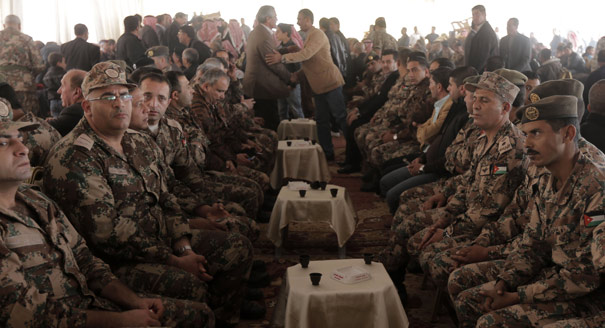
Jordan’s revenge marks a major shift in the war against the Islamic State and is likely to change the nature of the actors in the Syrian conflict.
Source: CNN
Jordan has executed two imprisoned jihadists in retaliation for the murder of its pilot, Lt Moaz al-Kassasbeh, by ISIS, which calls itself the Islamic State. The executions follow Jordan's initial agreement to release one of the jihadists, Sajida al-Rishawi -- a demand made by the group through a video statement by one of its Japanese hostages -- in return for the pilot.
The release of a gruesome video by ISIS on February 4, showing al-Kassasbeh being burnt alive triggered the Jordanian decision to carry out the executions few hours later. In doing so, Jordan has dragged itself deeper into the Syrian conflict and exposed further weaknesses in the strategy followed by the U.S.-led international coalition set up to fight ISIS.
Neither of the jihadists executed by Jordan are connected with ISIS in its current incarnation, but with al Qaeda. For example, one of them is Ziad Karbuli, an Iraqi national linked with the late al Qaeda in Iraq leader Abu Musab al-Zarqawi and who had been detained in Jordan on death row since 2006. Through their execution, therefore, Jordan has inadvertently strengthened the link between ISIS and al Qaeda.This is significant because the two groups have been engaged in a battle over resources and legitimacy since the start of the Syrian conflict. ISIS has been trying to present itself as the "true" al Qaeda, causing the latter to increase its military activities worldwide as well as within Syria to affirm its influence. Despite initial condemnation of the brutality of ISIS, al Qaeda's Syrian offshoot Jabhat al-Nusra has recently begun engaging in similar activities itself, such as beheadings and other forms of public violence.
One reason behind this is that al-Nusra has felt upstaged by the Islamic State and has escalated its violent acts in order to assert its presence in the face of its rival. But another reason is that the actions of the international coalition set up to fight ISIS have pushed the two groups together.
The coalition airstrikes in Syria have targeted both ISIS and Jabhat al-Nusra, thereby presenting the groups with a common enemy. The Syrian regime's attacks on ISIS following the organization's advance in Iraq in June 2014 also shifted the position of ISIS away from the regime, aligning the organization with Jabhat al-Nusra, which still regards fighting the Assad regime as its primary objective. In the Qalamoun area bordering Syria and Lebanon, ISIS and Jabhat al-Nusra have begun cooperating against the Syrian regime and Hezbollah.
The coalition's mediocre support for the moderate Syrian opposition in southern areas of Syria not only contributed to the Free Syrian Army's vulnerability to attack by al-Nusra brigades but also pushed some members of the two entities to maintain a working relationship based on material necessity and backed by sharing the mutual goal of fighting the Assad regime.
Today, several towns along Syria's south-western border witness al-Nusra presence. In the north, a number of towns have shifted their alliance from al-Nusra to ISIS due to a number of reasons, from fear to coercion to seeking material gains.
Now that ISIS and al-Nusra have been pushed towards one another even more as a result of the Jordanian executions, a similar shift of allegiance is likely in southern Syrian towns as well. If that were to happen, Jordan, which has borders with southern Syria, would find itself with ISIS on its doorstep overnight.
This bears bad news for the coalition. The south is where the Free Syrian Army retains more control than anywhere else in Syria, and where the coalition is planning on empowering the moderate opposition through training and weapons provision. Being confronted with ISIS in the area derails this plan.
The presence of ISIS in the south would also push Jordan to escalate the level of its engagement in the Syrian conflict. It will be forced to change from a supporter of its patrons, the United States and Saudi Arabia, in their fights against ISIS and into a participant in frontline warfare with the organization. This will in turn trigger further entrenchment by not just those two countries but also other members of the coalition in the war as they scramble to aid their Jordanian ally in its fight against ISIS.
Such a development would heighten the reactive nature of the coalition's strategy towards ISIS. Jordan's executions have already demonstrated that countries within the coalition do not have a uniform strategy for dealing with hostage crises and act singularly and in haste.
All this is playing into the hands of ISIS, which has been calculating its moves carefully -- the Jordanian pilot had been executed weeks before, Jordanian authorities believe, during which time it had been fooling the Jordanian government by demanding the release of Sajida al-Rishawi, in a build-up towards the final planned humiliation that came with the release of evidence of al-Kassasbeh's murder.
Jordan's revenge, then, marks a major shift in the war against the Islamic State. It is a shift that is likely to change the nature of the actors in the Syrian conflict as ISIS and al-Nusra move closer to one another. It is also a shift that will trigger wider regional repercussions, and drag members of the anti-ISIS coalition into an open-ended confrontation on a wider scale than before. In the midst of all this, the moderate Syrian opposition risks becoming extinct.
The international coalition therefore simply cannot afford to continue to act in the Syrian conflict without having in place a harmonized, long-term, and proactive strategy that takes into account the urgent need to end the conflict through a political-military plan rather than a reactive one based on irrational retaliation and limited military activity.
Former Director, Middle East Center
Khatib was director of the Carnegie Middle East Center in Beirut. Previously, she was the co-founding head of the Program on Arab Reform and Democracy at Stanford University’s Center on Democracy, Development, and the Rule of Law.
Recent Work
Lina Khatib
Lina Khatib
Carnegie does not take institutional positions on public policy issues; the views represented herein are those of the author(s) and do not necessarily reflect the views of Carnegie, its staff, or its trustees.

With the growth in points of friction between the great powers, organizations like the SCO will continue to play a role in the strategic adaptation of the smaller powers caught between them.

Temur Umarov
Amid celebrations of bilateral ties was a deeper focus on stability in the Middle East.

Amr Hamzawy

Canadian Prime Minister Mark Carney has twice inspired praise for standing up to U.S. President Donald Trump: at the 2026 World Economic Forum in Davos and on Canada-U.S. trade negotiations. Is Carney showing a third way better than the EU has in dealing with the Trump administration?

Rym Momtaz, ed.
Moscow is testing Europe’s defenses with drone incursions and could decide to use drones against the continent on a much larger scale once the war in Ukraine pauses. European countries will need Kyiv to help them prepare for such a possibility.

Pavlo Zvenyhorodskyi

Xi, Putin, and other regional leaders are back-slapping in Bishkek, but the SCO has yet to answer the most serious questions about continental Asia's economic future.

Evan A. Feigenbaum