

Commentary
Despite a new textbook, an influx of Russian teachers and managers, and an end to the teaching of Ukrainian, the Kremlin is unlikely to have “reprogrammed” locals.
Konstantin Skorkin
{
  "authors": [
    "Nikolay Kozhanov"
  ],
  "type": "commentary",
  "centerAffiliationAll": "",
  "centers": [
    "Carnegie Endowment for International Peace",
    "Carnegie Russia Eurasia Center"
  ],
  "collections": [
    "Iranian Proliferation"
  ],
  "englishNewsletterAll": "",
  "nonEnglishNewsletterAll": "",
  "primaryCenter": "Carnegie Russia Eurasia Center",
  "programAffiliation": "",
  "programs": [],
  "projects": [
    "Eurasia in Transition"
  ],
  "regions": [
    "Middle East",
    "Iran",
    "Israel",
    "Russia"
  ],
  "topics": [
    "Security",
    "Military",
    "Foreign Policy",
    "Nuclear Policy"
  ]
}
Source: Getty
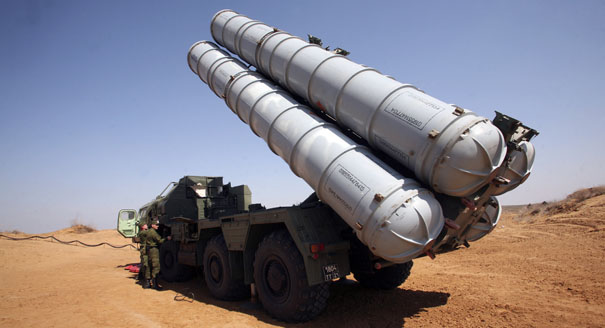
Vladimir Putin’s decision to lift a ban on the exports of the S-300 air defense missile system to Iran has caused shockwaves in the West and Israel. However, the Kremlin’s move was quite predictable with a rather clearly discernible logic behind it.
Russian President Vladimir Putin’s decision to lift a ban on the exports of the S-300 air defense missile system to Iran has caused shockwaves in the West and Israel. While the timing of the announcement was a surprise, the Kremlin’s move was quite predictable with a rather clearly discernible logic behind it.
The situation has become far more dynamic following the conclusion of negotiations between Tehran and the P5+1 in Lausanne on April 2, 2015. Russian authorities appear highly satisfied with the results of the talks and the parameters for a possible future final agreement (the so-called Joint Comprehensive Plan of Action) between Iran and the P5+1. Sergey Ryabkov, deputy minister of foreign affairs and Russia’s chief representative to the Iran nuclear talks, even expressed his hopes that the Joint Comprehensive Plan of Action could be signed by the deadline of June 30, 2015, without any further delays. If properly implemented, this deal could create reassurance that Tehran will not be able to secretly develop its military nuclear program. Moreover, even if the Islamic republic dares not to honor the deal the international community will still have, at least, a year to constrain Iranian breakout efforts. This, in turn, completely satisfies Moscow. Intense contacts with the Iranian authorities also convinced the Russian government that Tehran is seriously about implementing its part of the nuclear deal. Under these circumstances, the Kremlin believes that it has received necessary guarantees of the peaceful nature of Iran’s nuclear program, which, as Foreign Minister Sergei Lavrov insists, means that it makes no sense for Moscow to preserve the ban on exports of the S-300s.
It is conceivable that delivery of the S-300s might have been one of the carrots that Russia offered to Tehran in exchange for Iranian flexibility in Lausanne. Moscow also believes that its decision to suspend the exports of S-300s to Iran in 2010 never received a proper degree of appreciation in the West. Although this belief by the Russian authorities that their efforts have been underappreciated can hardly be one of the reasons behind Putin’s decision to lift Medvedev’s ban, it serves the Kremlin as moral justification for reconsidering the earlier approach.
Finally, the suspension of the S-300 exports to Iran appeared to be very costly for Russia. Apart from the loss of 800 million dollars that Moscow was expected to receive for the export of S-300s the future of all Russian military cooperation with Iran was thrown into question and the country’s overall reliability as an arms exporter was tarnished. Tehran also filed a 4 billion dollars claim to the International Court of Arbitration. Judging by Kremlin’s nervous reaction to this move, Iran had a very strong chance to win the case. It surely is no coincidence that Moscow’s decision to renew the exports of the S-300s is expected to lead to a speedy conclusion of the bitterly contested arbitration proceedings.
Practical calculations also determined Moscow decision. Russia is naturally interested in securing its political influence in Iran as well as in strengthening its economic presence. Arms deals may, at least partly, help to achieve these goals. The necessary groundwork for renewed Russian-Iranian military cooperation was created by the agreement signed during the visit of Russian Minister of Defense Sergey Shoygu to Tehran on 19—21 January 2015. Yet, this document mostly set the framework for Russian-Iranian cooperation in such fields as information exchanges, military training, education and coordination of counter-terrorist efforts. Russian arms manufacturers hope that the export of the S-300s will spur a resumption of significant arms exports.
At the same time, the exports of S-300 complexes may cause a serious blow to Russian-Israeli relations. Against this backdrop, Putin’s decision to lift the ban does not seem well-thought-out. During the last several years, Moscow placed a high priority on improving ties with Israel. In 2014 bilateral trade achieved $3.4 billion, which is roughly twice the size of trade with Iran. The Israeli government has staked out a muted position regarding Moscow’s involvement in Ukraine and refused to join U.S.-EU-led sanctions against Russia. Even Moscow’s longstanding pro-Palestinian stance has become a fairly minor constraint in the bilateral relationship with Israel. It is unclear as of this writing whether the Israelis will now reassess their approach and move closer to U.S./EU stance toward Moscow in response to increased Russian-Iranian military cooperation.
Russian officials have stressed that the impact of Putin’s decision on the S-300s for the existing regional balance of power should not be exaggerated by either Israel or the West. Lavrov has emphasized publicly that the decision was made with Israel’s security needs in mind. According to Lavrov, the S-300 is a defensive system that cannot be used for aggressive actions. However, to be fair, Moscow is stretching the truth with this line of argument.
The S-300s may not shift the balance of power in the region, but they do have the ability to affect it. Of course, the S-300s cannot be used as an offensive weapon and it is entirely possible that Tehran will receive S-300PMU-1 modification, a version of the system that is relatively old and no longer even produced in Russia. Yet, as one Russian leading military expert Vladimir Evseev suggests, even in the S-300PMU-1 modification “the five batteries of S-300s guarded by TOR M1 short range missile systems that Iran previously bought from Russia [would] extremely undermine Israeli capacities to make an effective airstrike against the Islamic Republic [of Iran]”. For U.S. airpower, the presence of this system also means that possible military action against would no longer be an easy walk, Evseev adds.
Under these circumstances, the international community should neither exaggerate the threat of the S-300s supplies to Iran nor overlook it. While it is probably impossible to reverse Putin’s decision, that does not mean that nothing could be done. This week’s decision implies that Moscow is expected to provide technical services and support for the S-300s as long as Iran fields them. It seems fair to expect that the West and other regional powers may soon turn their focus to persuading Moscow to make the provision of such support dependent on Tehran’s behavior in the region, including its relations with Israel.
This publication originally appeared in Russian.
Nikolay Kozhanov
Former nonresident scholar, Foreign and Security Policy Program, Moscow Center
Kozhanov is a former nonresident scholar at the Carnegie Moscow Center and a contributing expert to the Moscow-based Institute of the Middle East.
Carnegie does not take institutional positions on public policy issues; the views represented herein are those of the author(s) and do not necessarily reflect the views of Carnegie, its staff, or its trustees.

Despite a new textbook, an influx of Russian teachers and managers, and an end to the teaching of Ukrainian, the Kremlin is unlikely to have “reprogrammed” locals.

Konstantin Skorkin

For every ruble allocated to social policy, health, and education in 2027, double that amount is earmarked for the army, the police, and the security services.

Alexandra Prokopenko

The acknowledgment has sparked fears of a new arms race with China and Russia.

Chris O’Meara
Smaller powers cannot go it alone, but Canadian history shows that integration with the United States will not always be benign.
Paul Samson

The European Commissioner for Trade is headed to China. But after President Xi’s bridge-building visit to Washington, can a more isolated EU overcome Beijing’s stranglehold on critical raw materials? Who will blink first?

Rym Momtaz, ed.