

Research
- +10
Rosa Balfour, Frances Z. Brown, Yasmine Farouk, …
{
  "authors": [
    "Moisés Naím"
  ],
  "type": "legacyinthemedia",
  "centerAffiliationAll": "",
  "centers": [
    "Carnegie Endowment for International Peace"
  ],
  "collections": [],
  "englishNewsletterAll": "",
  "nonEnglishNewsletterAll": "",
  "primaryCenter": "Carnegie Endowment for International Peace",
  "programAffiliation": "",
  "programs": [],
  "projects": [],
  "regions": [
    "North America",
    "United States",
    "Middle East",
    "North Africa",
    "East Asia",
    "China",
    "Russia"
  ],
  "topics": [
    "Political Reform",
    "Security",
    "Foreign Policy",
    "Global Governance",
    "Technology"
  ]
}
Source: Getty
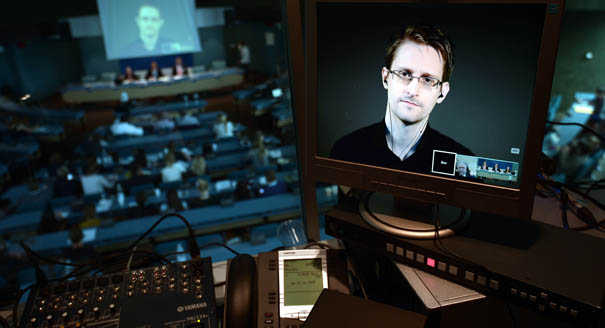
The most worrying form of government spying isn’t the kind Edward Snowden exposed.
Source: Atlantic
This month, two years after his massive leak of NSA documents detailing U.S. surveillance programs, Edward Snowden published an op-ed in The New York Times celebrating his accomplishments. The “power of an informed public,” he wrote, had forced the U.S. government to scrap its bulk collection of phone records. Moreover, he noted, “Since 2013, institutions across Europe have ruled similar laws and operations illegal and imposed new restrictions on future activities.” He concluded by asserting that “We are witnessing the emergence of a post-terror generation, one that rejects a worldview defined by a singular tragedy. For the first time since the attacks of Sept. 11, 2001, we see the outline of a politics that turns away from reaction and fear in favor of resilience and reason.”
Maybe so. I am glad that my privacy is now more protected from meddling by U.S. and European democracies. But frankly, I am far more concerned about the cyber threats to my privacy posed by Russia, China, and other authoritarian regimes than the surveillance threats from Washington. You should be too.
Around the time that Snowden published his article, hackers broke into the computer systems of the U.S. Office of Personnel Management and stole information on at least 4 million (and perhaps far more) federal employees. The files stolen include personal and professional data that government employees are required to give the agency in order to get security clearances.The main suspect in this and similar attacks is China, though what affiliation, if any, the hackers had with the Chinese government remains unclear. According to the Washington Post, “China is building massive databases of Americans’ personal information by hacking government agencies and U.S. health-care companies, using a high-tech tactic to achieve an age-old goal of espionage: recruiting spies or gaining more information on an adversary.”
But these attacks are not limited to espionage, and there is not always a government behind them. Many independent hackers make a living off their criminal activities on the Internet; extortion, thefts of commercial secrets and people’s identities, breaches of databases belonging to retailers and other companies, and the sabotage of critical infrastructure are all proliferating. To cite just four recent examples: Hackers have stolen personal information from 83 million JPMorgan Chase accounts, 56 million Home Depot payment cards, 110 million Target customer records, and 80 million accounts belonging to Anthem, one of America’s largest health-insurance companies. “Our information systems are attacked multiple times a day, every day,” the president of one of the world’s largest electricity companies told me. Nowadays, he added, “We spend 10 times more protecting ourselves from cyber attacks than we did three years ago. And despite that we feel we are always a step behind our attackers.”
Numerous reports indicate that the frequency of and damage inflicted by cyber attacks is steadily increasing. According to a recent Verizon report on data breaches in the United States, the main victims are the government and the financial-services and information and technology industries, with the healthcare sector, and especially hospitals and health-insurance companies, also frequent targets. And the threat isn’t only coming from China—experts emphasize that attacks from Russia are as aggressive, frequent, and sophisticated. And thanks to Snowden and others, we know that several U.S. government agencies are also actively engaged in cyber espionage, cyber sabotage, and cyber attacks.
Still, in this respect, the United States and other technologically advanced democracies can’t be placed in the same category as Russia, China, or North Korea. In the U.S. political system, despite all its imperfections, there is still a strong separation of powers, functioning checks and balances, an active and independent media, and a legal system designed to ensure that government officials who break the law are held accountable and don’t enjoy the impunity their colleagues in Moscow and Beijing do. U.S.-based criminal networks don’t operate internationally knowing that they can rely on the protection of friends and accomplices at the highest levels of government.
In other words, while it is important that democracies not spy on their citizens, it is as important that democracies have ways to defend themselves and their citizens from the dangerous cyber world that is emerging. This new world is significantly imbalanced in favor of non-democratic nations—not because authoritarian states are more technologically sophisticated than their democratic counterparts, but because they are more institutionally flexible, opaque, unaccountable, and often corrupt. Last May, for example, the U.S. Justice Department indicted five Chinese military hackers for “computer hacking, economic espionage and other offenses directed at six American victims in the U.S. nuclear power, metals and solar products industries.” The U.S. military is also active in cyberspace and surely trying to breach the cyber defenses of other governments. But in contrast to their rivals in China or Russia, U.S. companies cannot rely on their nation’s spy agencies to steal the commercial secrets of foreign competitors.
The 9/11 attacks popularized a concept that until then was mostly found in reports by war planners or in academic texts on geopolitics: asymmetric warfare. It’s the kind of conflict in which one side has far less power and resources than the other, but still manages to score important victories and may even win the war. Al-Qaeda was far weaker than the United States, but by using disruptive tactics and unconventional tools (suicide bombers, box cutters, and jetliners) succeeded in inflicting great damage on its enemy. The increasingly fierce barrage of cyber attacks originating from non-democracies against the governments of democratic nations and their private firms, scientific centers, foundations, and civil-society organizations is a new form of asymmetry for which democratic countries lack effective answers. It’s yet another sign of this imbalance that Russia and China do not have their own Snowden.

Distinguished Fellow
Moisés Naím is a distinguished fellow at the Carnegie Endowment for International Peace, a best-selling author, and an internationally syndicated columnist.
Recent Work



Rosa Balfour, Frances Z. Brown, Yasmine Farouk, …
Moisés Naím
Carnegie does not take institutional positions on public policy issues; the views represented herein are those of the author(s) and do not necessarily reflect the views of Carnegie, its staff, or its trustees.

European Commission President Ursula von der Leyen is about to give her annual address on the state of the EU. Here’s what she won’t—but should—say.

Rym Momtaz

Depleted financial reserves and a shrinking tax base mean it is no longer possible to simultaneously deliver high defense spending, price stability, and economic growth.

Alexandra Prokopenko
Understanding the climatic pain points is necessary for policymakers hoping to minimize the war’s negative environmental consequences.



Alejandro Martin Rodriguez, Joy Arkeh, Sarah Yerkes

Huawei pushed hard to enter the Egyptian data centers market, until the Americans made a better offer.

Angie Omar

Radical-right parties are expected to do well in upcoming elections in four of the EU's biggest member states. If successful, they could prevent the union from addressing key challenges ahead.

Stefan Lehne