

Article
C. Raja Mohan, Darshana M. Baruah
{
  "authors": [
    "C. Raja Mohan"
  ],
  "type": "legacyinthemedia",
  "centerAffiliationAll": "dc",
  "centers": [
    "Carnegie Endowment for International Peace",
    "Carnegie India"
  ],
  "collections": [],
  "englishNewsletterAll": "ctw",
  "nonEnglishNewsletterAll": "",
  "primaryCenter": "Carnegie India",
  "programAffiliation": "SAP",
  "programs": [
    "South Asia"
  ],
  "projects": [],
  "regions": [
    "South Asia",
    "Afghanistan",
    "Pakistan",
    "India"
  ],
  "topics": [
    "Foreign Policy",
    "Security"
  ]
}
Source: Getty
Even if Pakistan succeeds in getting the new Taliban leadership to the table, there will be enough Afghan elements to challenge the terms.
Source: Indian Express
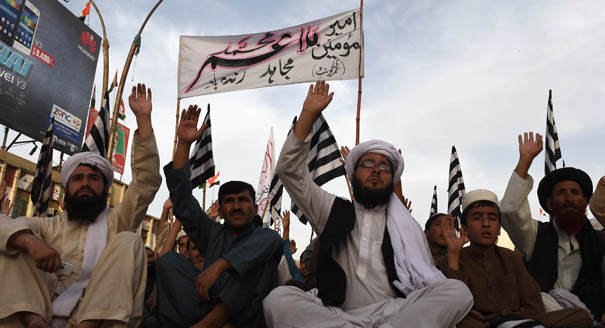
The “killing” of Mullah Omar last week, more than two years after he died, will only add to the mystery surrounding the reclusive leader of the Taliban who seemed to dominate the Afghan landscape for nearly two decades. But the sudden death of the man, in whose name the Taliban leadership issued Eid greetings just days before, reminds us that Pakistan remains the most important external player in Afghanistan. It also tells us how effortlessly Pakistan can change the international storyline on Afghanistan.
The carefully constructed myth of Mullah Omar attributed political charisma, religious wisdom and great leadership skills to a man who was hardly literate. However, some of Pakistan’s opponents in Afghanistan have long insisted that Mullah Omar and the Taliban were mere creatures of Rawalpindi’s invention.
Although the truth about Mullah Omar and his movement might be a long time coming, no one denies the intimate relationship between Pakistan and the Taliban, ever since the organisation came into public view two decades ago. Some say Pakistan has pulled the plug on Mullah Omar because Rawalpindi is now deeply committed to peace in Afghanistan. Others counter by arguing that Pakistan was finding it hard to sustain the deception that the one-eyed Mullah Omar was alive and leading the Taliban. They suggest Pakistan has had to reboot the Taliban amid emerging internal divisions within the organisation and external pressures, especially from the US and China, to support political reconciliation within Afghanistan. Pakistan found that Mullah Omar had outlived his utility, and that it now needs to revamp the organisation and prepare it to regain power in Kabul and international legitimacy.But this is where the story gets a bit complicated. Within hours after announcing the death of Mullah Omar, a new leader, Akhtar Mohammad Mansour, was proclaimed as the new Amirul Momineen, or the commander of the faithful. But mobilising loyalty to the new leader has not been easy. Many, including Mullah Omar’s brother, Mullah Abdul Manan, and son Yacoub, have challenged Mansour’s “selection” by a small clique as the new leader of the Taliban.
Pakistan will certainly want to stamp out dissidence and make sure that potential breakaway factions are small and ineffective. That the talks scheduled for this week between Kabul and the Taliban had to be postponed suggests that Pakistan has much work to do. An audio statement issued in the name of Mansour over the weekend promised to continue the jihad until Islamic rule is brought to Afghanistan and urged the Taliban to stay united. While some were hailing Mansour as the new champion of engagement with Kabul, the audio statement rubbished the peace process as a “propaganda campaign by the enemy”.
The peace credentials of the new leadership are also undermined by the installation of Sirajuddin Haqqani as one of the two new deputy commanders of the Taliban. Sirajuddin heads the Haqqani network, arguably the most violent Pashtun group. Based in Pakistan, the Haqqani network has conducted attacks on the US and Indian diplomatic missions in Afghanistan and is affiliated to al-Qaeda. More importantly, as the seniormost US military officer in 2011, Admiral Mike Mullen, told the US Congress, the Haqqani network is a “veritable arm of Pakistan’s Inter-Services Intelligence agency”.
There is no question that Pakistan’s Afghan strategy is evolving. If the Taliban seemed inflexible about negotiations in the past, Pakistan is promising to make it more reasonable. Many in the West and China are ready to accept, at least for now, Pakistan’s claim that a new and moderate Taliban is at hand. Not everyone in Afghanistan is convinced, however. Even if Pakistan succeeds in getting the new Taliban leadership to negotiate peace with Kabul, there will be enough Afghan elements on both sides challenging the terms of settlement.
Meanwhile, the world will deal with the new Taliban with a much weaker hand, thanks to the precipitous decline in the Western military and economic footprint in Afghanistan. But Pakistan has its own historic handicap in Afghanistan. Like the British Raj, Pakistan believes dominance over Afghanistan is critical for its national security. As the successor to the Raj on the Durand Line, Pakistan wants a say in who runs Kabul, and how. Geography — physical, political and ethnic — has given it the power to disrupt any regime in Afghanistan. Pakistan has demonstrated that capability beyond doubt since the mid-1970s.
Yet, the Pakistan army may not have either the material resources or the political vision to construct an inclusive and durable state structure in Kabul. The gap between Pakistan’s strategic ambition in Afghanistan and its national capability might inevitably set the stage for the next round of blood-letting on India’s northwestern frontiers.
Former Nonresident Senior Fellow, Carnegie India
A leading analyst of India’s foreign policy, Mohan is also an expert on South Asian security, great-power relations in Asia, and arms control.
Recent Work

C. Raja Mohan, Darshana M. Baruah


Alexander Gabuev, Paul Haenle, C. Raja Mohan, …
Carnegie does not take institutional positions on public policy issues; the views represented herein are those of the author(s) and do not necessarily reflect the views of Carnegie, its staff, or its trustees.

Despite public disputes over trade and immigration, the strategic partnership’s foundations remain sturdy.

Sameer Lalwani
It signals a new era of tech diffusion and warfare.

Steve Feldstein

With its public finances in shambles, the far right polling at 35 percent ahead of the 2027 presidential election, and a growing protest movement, is France’s crisis a threat to the EU’s geopolitical awakening?

Rym Momtaz, ed.

Russia’s AI-driven propaganda campaigns operate in a fragmented, chaotic, and often illogical manner. That’s not necessarily a problem for the Kremlin, though: It’s much easier to mimic genuine public debate that way.

Ilya Klishin

Ahead of a tough winter for Ukraine, Donald Trump’s swing back toward Russia bodes ill. But instead of panicking, Kyiv’s European allies are focusing on action.
Rym Momtaz