

Q&A
Dara Massicot, Aaron David Miller, Andrew S. Weiss
{
  "authors": [
    "Andrew S. Weiss"
  ],
  "type": "legacyinthemedia",
  "centerAffiliationAll": "dc",
  "centers": [
    "Carnegie Endowment for International Peace"
  ],
  "collections": [],
  "englishNewsletterAll": "ctw",
  "nonEnglishNewsletterAll": "",
  "primaryCenter": "Carnegie Endowment for International Peace",
  "programAffiliation": "russia",
  "programs": [
    "Russia and Eurasia"
  ],
  "projects": [],
  "regions": [
    "Middle East",
    "Syria",
    "Russia"
  ],
  "topics": [
    "Security",
    "Military",
    "Foreign Policy"
  ]
}
Source: Getty
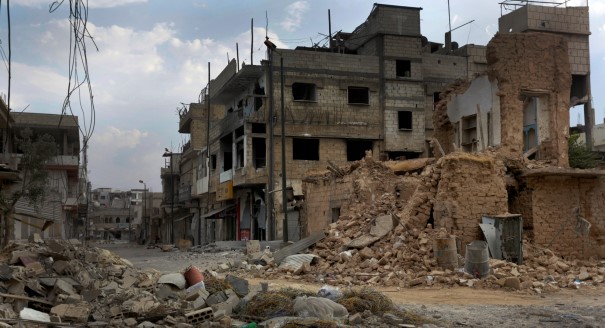
Russian military activities in Syria could create a recruitment boon for the global jihadist movement, and highlight Russia as a target for that movement, as opposed to the United States or other Western partners.
Source: PBS’ NewsHour
JUDY WOODRUFF: Late this evening, Secretary Kerry and Russian Foreign Minister Lavrov came out together and agreed to military talks.
We get a closer Russian — look at Russia’s military moves in Syria with Andrew Weiss. He was the director of Russian, Ukrainian, and Eurasian affairs at the White House National Security Council during the Clinton and George H.W. Bush administrations. He’s now with the Carnegie Endowment for International Peace. And Steven Simon, he’s a visiting lecturer at Dartmouth College. He served on the National Security Council staff during the Obama and Clinton administrations.
And we welcome you both back to the program.
Let me start with you, Steven Simon.
Is this an occasion for the U.S. to be pleased that it has a partner in going after ISIS or alarmed that the Russians are in Syria helping their friend President Assad?
STEVEN SIMON, Dartmouth College: I think, on balance, there’s cause for some satisfaction and the presence now in Syria of a powerful military player with a serious strategic stake in defeating ISIS.
It’s really the only, I would say, tacit partner. It’s certainly not an explicit or de jure partner of the United States in this battle against ISIS. So, at least the United States has a partner, even if it’s not official. On the other hand, it does mean that there is a serious friend of the Assad regime also present in Syria, and this is undoubtedly a cause for concern for the administration.
JUDY WOODRUFF: Well, let me turn to you, Andrew Weiss.
More cause for concern or a cause for some satisfaction?
ANDREW WEISS, Carnegie Endowment for International Peace: I think the cause for concern here is that Russia is plunging headlong into a military adventure in a part of the world where it’s been absent for the better part of the last two decades.So, I defer to my friend Steve Simon about the impact on the ground. It certainly looks like this is a big shot in the arm for Bashar al-Assad. The question is, have the Russians thought two or three moves ahead? This to me looks suspiciously like what happened in Ukraine, where what seemed like a good idea, a very pressurized decision by the Russians to unleash aggression against Ukraine, has backfired quite badly.
And so when I hear Secretary of Defense Carter today saying that he thinks this is ultimately going to basically be something that is doomed to fail or that is going to hurt Russia, I have very little reason to doubt that.
JUDY WOODRUFF: What do you mean? Come back to you, Andrew Weiss. What do you mean it looks like what happened in Ukraine?
ANDREW WEISS: Well, people like to talk Vladimir Putin as if he is this great master strategist.
In fact, what he is someone who is fairly impulsive. And so the intervention in Ukraine was done very spur of the moment. And now what we’re seeing — and we have had about three weeks or so of a steady drip of Russian military buildup in and around the Western Mediterranean coast of Syria, and now he’s plunging into a military adventure.
There’s no domestic Russian political support for foreign military activity of this type. And I think there’s a real question, which is, he is basically now putting a target on the back of every Russian soldier and many Russian civilians, including inside Russia itself.
So, he’s creating a recruitment boon, I think, for the global local jihadist movement, and he’s putting Russia at the center of that, as opposed to the United States or other Western partners.
JUDY WOODRUFF: Steven Simon, why was it so difficult today to figure out who the Russians were targeting?
STEVEN SIMON: Because the situation on the ground is, in fact, confused, and there is no geolocation of the attacks that are publicly available yet.
The information available to me is that they struck targets affiliated with al-Nusra, which is another Islamist group. But, as a practical matter, the first priority for the Russians right now is protection of the regime and the survival of the regime and its viability. So, they’re going to attack the targets that they and the regime have decided are most threatening to the regime right now, and then move on to targets that are less immediately threatening.
So, whoever was knocking at the gate right now was going to get the first Russian blow. The other thing, of course, is that the Syrians will be encouraging the Russians to be attacking ISIS targets the United States has thus far refrained from attacking because they’re politically sensitive. If there’s a target that looks as though its destruction would be mostly of benefit to the regime, rather than to the Syrian people at large, then the United States will save its ammunition, keep its powder dry, and strike other targets that are less ambiguous, if I can put it that way.
So, that would be — that will be the Soviet — the Russian priorities.
JUDY WOODRUFF: Well, Andrew Weiss, for any American or anybody listening to this, it sounds like a very confusing situation to keep track of who is up and who is down and who is being targeted.
I mean, how should we — how should Americans view this? Do we wait and withhold judgment until we see what the Russians do over the next few days?
ANDREW WEISS: Well, I think President Obama’s been quite reluctant to get the U.S. more involved militarily, and that’s been going on for some time now. So, I think the idea that the U.S. is either going to stand up to the Russians and tell them to knock it off, all that, I think is misplaced.
The real question, I think, for us, as the U.S. and other Western partners in the fight — and the regional partners in the fight against ISIS, is whether we’re going to bump into the Russians in some sort. And the Russians up to now had talked a good game, saying, oh, we want our militaries talking, this is really important.
But they have plunged ahead without getting that coordination mechanism locked in, and I think there’s a real risk here that the Russians, who don’t have the same level of experience, don’t have the same kind of intelligence backbone to support their operations, could be doing things that are either dangerous or that put Western pilots and others at risk.
JUDY WOODRUFF: Steve Simon, why isn’t that a big worry? I mean, there was a sense that we were led to believe ahead of time the Russians were going to give the West, the U.S.-led coalition, more advanced notice. It sounds like they barely had an hour’s word ahead of time.
STEVEN SIMON: Yes, I think it is problematic.
And we have got to get those mil-mil talks going and there needs to be better coordination. But, as a practical matter, the Russians are going to be striking in sectors of Syrian territory and Syrian airspace that lie outside of the areas that the United States has focused on, which are mainly targets that are close to the Turkish border in the north.
So, as a practical matter, I think the risk of a collision are low.
JUDY WOODRUFF: Let me just quickly conclude asking you both, what are you looking for in the next few days to tell you whether this is a positive development or not?
Andrew Weiss?
ANDREW WEISS: I think the immediate question is how the Russian people will react.
I have no doubt that there’s great sense of celebration inside Assad’s inner circle, and frankly in Tehran, but I don’t think the Russian people were prepared for any of this. This has all been thrown at them with maybe two or three weeks’ notice. It plays to Putin’s domestic agenda, which is to say Russia is a big, great power, it can thrust itself into the international stage at its own — a time of its own liking and a place of its choosing, but there’s no one I think at home who is really enthusiastic about this whole activity.
JUDY WOODRUFF: All right, we are going to have to leave it there.
Andrew Weiss, Steven Simon, thank you both.
James Family Chair, Vice President for Studies
Andrew S. Weiss is the James Family Chair and vice president for studies at the Carnegie Endowment for International Peace, where he oversees research on Russia, Ukraine, and Eurasia. His graphic novel biography of Vladimir Putin, Accidental Czar: the Life and Lies of Vladimir Putin, was published by First Second/Macmillan in 2022.
Recent Work

Dara Massicot, Aaron David Miller, Andrew S. Weiss

Frances Z. Brown, Nate Reynolds, Priyal Singh, …
Carnegie does not take institutional positions on public policy issues; the views represented herein are those of the author(s) and do not necessarily reflect the views of Carnegie, its staff, or its trustees.

For every ruble allocated to social policy, health, and education in 2027, double that amount is earmarked for the army, the police, and the security services.

Alexandra Prokopenko

The acknowledgment has sparked fears of a new arms race with China and Russia.

Chris O’Meara

Smaller powers cannot go it alone, but Canadian history shows that integration with the United States will not always be benign.
Paul Samson

The European Commissioner for Trade is headed to China. But after President Xi’s bridge-building visit to Washington, can a more isolated EU overcome Beijing’s stranglehold on critical raw materials? Who will blink first?

Rym Momtaz, ed.
The summit may be remembered as a fatal blunder, when Washington, Beijing, and the AI industry collectively chose ceremony over action.
Jeffrey Prescott