

Article
C. Raja Mohan, Darshana M. Baruah
{
  "authors": [
    "C. Raja Mohan"
  ],
  "type": "legacyinthemedia",
  "centerAffiliationAll": "dc",
  "centers": [
    "Carnegie Endowment for International Peace",
    "Carnegie India"
  ],
  "collections": [],
  "englishNewsletterAll": "ctw",
  "nonEnglishNewsletterAll": "",
  "primaryCenter": "Carnegie India",
  "programAffiliation": "SAP",
  "programs": [
    "South Asia"
  ],
  "projects": [],
  "regions": [
    "South Asia",
    "India",
    "North Africa",
    "Southern, Eastern, and Western Africa"
  ],
  "topics": [
    "Foreign Policy",
    "Security"
  ]
}
Source: Getty
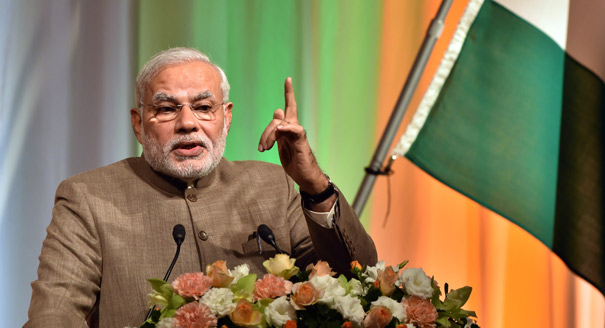
The India-Africa Summit can galvanize India’s security engagement with Africa.
Source: Indian Express
The focus of India’s ambitious African outreach this week is rightly on deepening economic and political partnerships. Security cooperation, whether it is in the maritime domain or counter-terrorism, is also expected to figure on Prime Minister Narendra Modi’s summit agenda. Facing a multitude of threats, the African nations are eager to expand defence and security cooperation with India. But the supply-side challenges in New Delhi have not been easy to overcome.
During the UPA years, Delhi often proclaimed itself as a “net security provider” in the Indian Ocean and beyond. Modi has certainly put security cooperation at the very heart of his regional diplomacy. But the institutional framework in Delhi for such cooperation remains to be developed. Meanwhile, the strategic salience of Africa has rapidly grown. North Africa, as part of the volatile Middle East, has always been an important part of international security concerns. Over the last decade and more, it has become difficult to ignore the geopolitics of sub-Saharan Africa.The continent’s expanding economic weight, the growing significance of its natural resources and the spread of violent extremism feeding on endemic conflict have drawn more intensive military attention from the major powers, especially France, the United States and China. A majority of UN peacekeeping operations — nine out of 16 — are in Africa. France has long been a major force in providing regional security. The US set up the Africa Command in 2008 as part of its global war on terror. If America’s focus has been on countering al-Qaeda and other extremist groups in Africa, China is developing a more comprehensive approach to African security.
The new imperative of protecting its growing trade and investments in Africa has seen a surge in China’s military profile on the continent. Expansive defence exchanges, military assistance, cultivation of special security partnerships and arms sales have become the main themes of China’s focus on Africa. China has also begun to take more interest in Africa’s wars. Beijing has begun to go beyond its traditional emphasis on “non-intervention” to a more active role in “conflict resolution”. It has begun to send combat troops to peacekeeping missions in Africa and to join regional efforts to counter non-traditional threats to security.
China’s naval presence in the waters of Africa has become more intensive and sustained. Beijing is said to be negotiating different kinds of access arrangements for its armed forces in Africa. The tiny but strategically located Djibouti has confirmed this summer that it is in talks with Beijing on the development of a base. Djibouti already hosts the military facilities of America, France and Japan.
India’s own security engagement with Africa has a longer tradition. During the colonial era, the armies of undivided India helped secure and stabilise the continent against internal and external threats. Underlining independent India’s responsibility for the maintenance of international peace and security, Jawaharlal Nehru chose to insert Indian armed forces for peacekeeping missions in Africa and the Middle East. Nehru also embarked on an expansive defence cooperation programme with some major regional partners. For example, Nehru tried to develop a jet engine and fighter aircraft with Egypt. Although the projects did not go too far, they demonstrated Nehru’s commitment to shaping the regional balance of power without aligning with any of the great powers.
As Africa entered the postcolonial phase in the 1960s, many countries in the continent turned to Delhi to build their armed forces. Although India accepted some training missions, Delhi’s political will for defence partnerships with Africa steadily eroded.
Over the last decade, though, India has sought to renew its security cooperation with Africa. The Indian navy, in particular began to step up its activities along the east African coast and the western Indian Ocean. But the overall performance of Indian security diplomacy has been underwhelming.
The ministry of defence is not equipped, either intellectually or institutionally, to respond to the growing African demand for military cooperation with India. The ministry of home affairs and the security agencies are even less prepared for purposeful international cooperation. The ministry of finance routinely blocks strategic projects.
The foreign office is focused on winning African support for India’s political positions on terrorism. While the collective rhetoric, for example on finalising a global convention on terrorism, might have a bit of diplomatic value, it is of no consequence in accelerating functional counter-terror cooperation between India and its African partners.
In his travels to East Asia, the Indian Ocean littoral and Central Asia, Modi put defence cooperation at the top of his agenda. The Africa summit provides the PM with an opportunity to think more boldly about India’s security engagement with Africa. But without structural reforms in India’s security sector, the shadow between India’s talk and action might only get darker.
This article was originally published in the Indian Express.
Former Nonresident Senior Fellow, Carnegie India
A leading analyst of India’s foreign policy, Mohan is also an expert on South Asian security, great-power relations in Asia, and arms control.
Recent Work

C. Raja Mohan, Darshana M. Baruah


Alexander Gabuev, Paul Haenle, C. Raja Mohan, …
Carnegie does not take institutional positions on public policy issues; the views represented herein are those of the author(s) and do not necessarily reflect the views of Carnegie, its staff, or its trustees.

The EU can impose sanctions but struggles to enforce them without the United States. With Washington increasingly disinterested in backing European interests, the bloc must now fend for itself.


Nicu Popescu, Tiago Antunes
Global and rising powers will need to engage with Africa’s priorities and agency in order to secure the continent’s increasingly attractive partnerships.

Fonteh Akum

Rubio’s recent visit brought welcome attention, but more capital requires governance changes that may be a hard sell for regional governments.

Jennifer B. Murtazashvili

America’s foreign-policy objectives have grown more demanding while Americans have demanded greater focus on their own affairs.

Stephen Wertheim

Japan’s long-term security policy is driven by concerns about China, and there is little appetite for (or interest in) pursuing a confrontation with Moscow.

James D.J. Brown