

Commentary
Perry Cammack, Cassia Bardos
{
  "authors": [
    "Perry Cammack"
  ],
  "type": "legacyinthemedia",
  "centerAffiliationAll": "dc",
  "centers": [
    "Carnegie Endowment for International Peace",
    "Malcolm H. Kerr Carnegie Middle East Center"
  ],
  "collections": [
    "Arab Awakening"
  ],
  "englishNewsletterAll": "menaTransitions",
  "nonEnglishNewsletterAll": "",
  "primaryCenter": "Carnegie Endowment for International Peace",
  "programAffiliation": "MEP",
  "programs": [
    "Middle East"
  ],
  "projects": [],
  "regions": [
    "Middle East",
    "Syria",
    "Levant"
  ],
  "topics": [
    "Political Reform",
    "Economy",
    "Security",
    "Military",
    "Foreign Policy"
  ]
}
Source: Getty
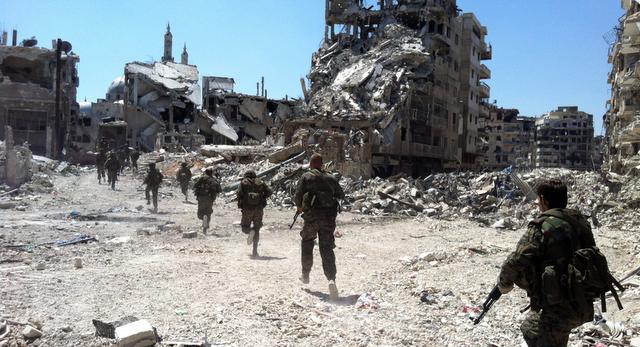
Five years of war in Syria have left large swathes of the country in ruin. While an end to the war is nowhere in sight, a reconstruction bill that is likely to run well over $100 billion means that planning for Syria's eventual rebuilding must start now.
Source: Syria Deeply
Five years of war in Syria have left large swathes of the country in ruin. And with the peace process on the brink of collapse, an end to the war is nowhere in sight. But with a reconstruction bill that is likely to run well over $100 billion, planning for Syria's eventual rebuilding must start now
The cataclysmic destruction of Syria challenges human comprehension. The old city of Aleppo, which like Damascus claims to be the oldest settlement on the planet, has been reduced to rubble. Homs was once the country’s third most populous city, but has mostly beendepopulated.
With the international Syria peace process teetering on the edge of collapse, a political solution seems distant. But every war must end. The rebirth of Dresden, Berlin, and Stalingrad (later renamed Volgograd) after the unthinkable destruction of World War II is a testament to human resiliency and a symbol of what may eventually be possible in Syria. Regardless of whether Syria can be stitched together as a unitary state or is instead permanently partitioned, rebuilding its infrastructure to even modest pre-war levels will require a generational effort...
Former Nonresident Fellow, Middle East Program
Perry Cammack was a nonresident fellow in the Middle East Program at the Carnegie Endowment for International Peace, where he focuses on long-term regional trends and their implications for American foreign policy.
Recent Work
Perry Cammack, Cassia Bardos
Perry Cammack
Carnegie does not take institutional positions on public policy issues; the views represented herein are those of the author(s) and do not necessarily reflect the views of Carnegie, its staff, or its trustees.

Are Germany’s economic, industrial, and political struggles becoming a liability for the EU’s ability to rise to the geopolitical moment?

Rym Momtaz, ed.

Russia’s ruling party would have benefited from Putin appearing as its distant patron, but as an active frontman imposing his views on the public, he has done nothing but harm both the party’s election campaign and the ruling system overall.

Andrey Pertsev

China’s police training infrastructure construction projects provide benefits to recipient countries, promote China’s image as a major global security provider, and are likely to reinforce alignment between Beijing’s security priorities and those of countries in the Global South.


Cameron Waltz, Sheena Chestnut Greitens, Kim Nguyen, …

The Bureau of Industry and Security needs to adjust its focus and practices to maintain its position as the U.S. government’s primary champion of international technological competition.

Geoffrey Irving
They face an uphill climb, but they could draw on a strategy that other diplomats have used in the past.


Shana Tabak, Alejandro Martin Rodriguez