

Paper
Renée DiResta, Rachel Kleinfeld, Margot Treadwell
{
  "authors": [
    "Rachel Kleinfeld"
  ],
  "type": "legacyinthemedia",
  "centerAffiliationAll": "dc",
  "centers": [
    "Carnegie Endowment for International Peace"
  ],
  "collections": [],
  "englishNewsletterAll": "democracy",
  "nonEnglishNewsletterAll": "",
  "primaryCenter": "Carnegie Endowment for International Peace",
  "programAffiliation": "DCG",
  "programs": [
    "Democracy, Conflict, and Governance"
  ],
  "projects": [],
  "regions": [
    "North America",
    "United States",
    "Middle East",
    "North Africa"
  ],
  "topics": [
    "Democracy",
    "Security",
    "Military",
    "Foreign Policy"
  ]
}
Source: Getty
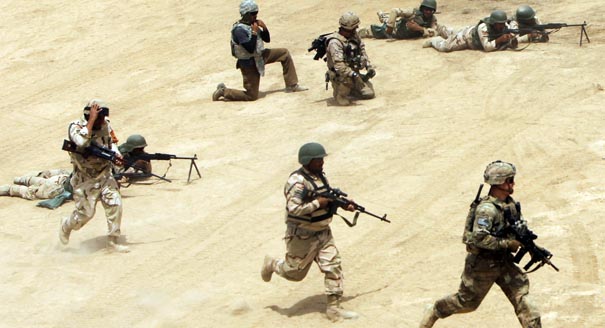
It’s time to require the Department of Defense and State Department to measure and evaluate its military aid and training programs, and learn from what worked, so that Washington can stop engaging in failed strategies and start succeeding.
Source: Hill
The Islamic State in Iraq and Syria (ISIS) has gained a 150-mile stretch of the Libyan coastline. The head of U.S. Special Operations in Africa has called for America to train and equip Libyan troops to root these terrorists out. But will it work? The track record suggests not. And that presents a much bigger problem than ISIS alone.
The U.S. can't be everywhere at once: We need a way to build partners overseas who can tackle military problems on their own. Therefore, since 9/11, Congress has increased the authorities and programs under which the Department of Defense (DOD) can engage other militaries. It's time to start tracking that money and evaluating what's working, and what's not.
The DOD now spends between $8 and $10 billion a year on scores of separate programs — atop the money already spent by the State Department, which formerly controlled all of our overseas military aid and financing. Altogether, these programs are costing taxpayers around $20 billion annually. But even the amounts are opaque, and none of the effects are known. While the DOD has fought every attempt to evaluate the efficacy of these programs, studying some of the more high profile attempts is sobering.After spending $25 billion and nearly a decade, U.S. attempts to train and equip Iraqi troops ended with a whimper when those soldiers melted away the moment ISIS attacks first began a few years ago. The U.S. training missing in Mali was heralded — until some of those we trained backed a coup and partnered with al Qaeda in the Sahel. Saudi Arabia, a major recipient of U.S. military training and equipment for decades, is mired in a war with little Yemen that is only getting worse. Burundi, also a recipient of U.S. military aid, threatened to turn its police on its own people, using the same code words that unleashed the genocide in neighboring Rwanda.
Why do we keep getting it wrong?
I've spent the last three years traveling to every settled continent to study countries that succeeded in freeing themselves from extreme, compounded violence such as what we face in Iraq, Libya or Yemen today. The lessons were clear.
Conventional wisdom assumes that countries facing extreme internal violence from terrorists, militias and other armed groups are simply too weak to fight back. The U.S. solution is to "build partner capacity" through training and providing equipment.
But the diagnosis is wrong. In the vast majority of countries facing extreme internal violence, like Iraq or Yemen, the problem is not weakness; it is government illegitimacy. These governments don't serve all their citizens: They are perceived as privileging a few. Their corruption renders their security services ineffective and disgruntled. Often, security services act as a praetorian guard to cut some countrymen out of their piece of the pie.
It shouldn't be a surprise that, faced with a brutal and corrupt government they can't trust, citizens turn to violent groups for succor — as Sunni Iraqis turned to ISIS. In other cases, well-trained militaries see themselves as more professional than the venal politicians, and launch a coup, as in Mali.
But it's a surprise to us. Over and over again, we provide training and equipment to governments, believing that they are just too weak to fight well. Most of our military assistance is focused narrowly on tactics and trigger pullers. Only two tiny Pentagon programs, known as DIRI (Defense Institutional Reform Initiative) and MODA (Ministry of Defense Advisers), even try to address the problems of legitimacy that are the way to fight violence.
In Colombia, the U.S. military believes it got things right: Plan Colombia was expensive, but it is credited with transforming Colombia from a near-failed state to a tourist destination today. But the popular story leaves a lot out. The U.S. provided military training and aid to Colombia off and on from the mid-1960s. It took more than 30 years, skyrocketing guerrilla recruitment, a new constitution and the disbandment of a deep well of corruption between parliamentarians and paramilitaries before Colombians created a government legitimate enough to use U.S. aid well.
The U.S. gives military aid and training to over 180 countries each year. We need it to work. It's time to require the DOD and State Department to measure and evaluate these programs, and learn from what worked, so that we can stop engaging in failed strategies and start succeeding.

Senior Fellow, Democracy, Conflict, and Governance Program
Rachel Kleinfeld is a senior fellow in Carnegie’s Democracy, Conflict, and Governance Program, where she focuses on issues of rule of law, security, and governance in democracies experiencing polarization, violence, and other governance problems.
Recent Work
Renée DiResta, Rachel Kleinfeld, Margot Treadwell
Political Violence Researchers, Rachel Kleinfeld, ed., Dalya Berkowitz, ed.
Carnegie does not take institutional positions on public policy issues; the views represented herein are those of the author(s) and do not necessarily reflect the views of Carnegie, its staff, or its trustees.

Fatima El Mansouri is the country’s first female prime minister. She’s also a privileged insider in a largely ceremonial position.

Sarah Yerkes

The acknowledgment has sparked fears of a new arms race with China and Russia.

Chris O’Meara

Smaller powers cannot go it alone, but Canadian history shows that integration with the United States will not always be benign.
Paul Samson

The European Commissioner for Trade is headed to China. But after President Xi’s bridge-building visit to Washington, can a more isolated EU overcome Beijing’s stranglehold on critical raw materials? Who will blink first?

Rym Momtaz, ed.

The summit may be remembered as a fatal blunder, when Washington, Beijing, and the AI industry collectively chose ceremony over action.

Jeffrey Prescott