

Q&A
- +1
Sheena Chestnut Greitens, Oriana Skylar Mastro, Yukon Huang, …
{
  "authors": [
    "Tong Zhao"
  ],
  "type": "legacyinthemedia",
  "centerAffiliationAll": "",
  "centers": [
    "Carnegie Endowment for International Peace",
    "Carnegie China"
  ],
  "collections": [],
  "englishNewsletterAll": "",
  "nonEnglishNewsletterAll": "",
  "primaryCenter": "Carnegie Endowment for International Peace",
  "programAffiliation": "",
  "programs": [],
  "projects": [],
  "regions": [
    "North America",
    "United States",
    "East Asia",
    "South Korea",
    "China"
  ],
  "topics": [
    "Arms Control",
    "Security",
    "Nuclear Policy"
  ]
}
Source: Getty
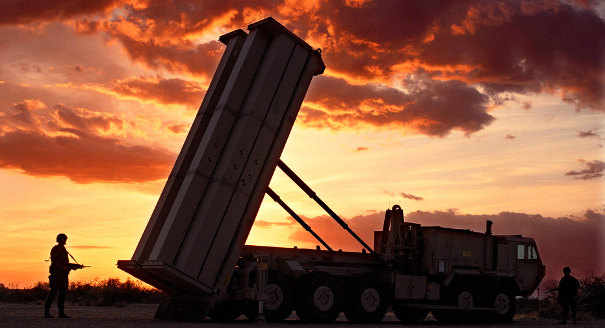
China's interests are best served by opening a dialogue with the United States on the possible deployment of a missile-defense system in South Korea.
Source: South China Morning Post
North Korea’s recent nuclear and missile tests have catalyzed negotiations between Washington and Seoul about deploying the Terminal High Altitude Area Defense (THAAD) system to South Korea. Washington and Seoul hope THAAD can provide an additional layer of protection for South Korea and the American troops stationed there by intercepting North Korean missiles at high altitudes, thus serving as a complement to South Korea’s existing low-altitude missile defense systems.
Beijing has long opposed such deployment out of concern that it is part of a U.S. strategy to build a regional missile defense network that could intercept Chinese missiles headed for the United States and hence blunt China’s nuclear retaliation capability and undermine deterrence.
In recent months Chinese official reaction to the U.S. and South Korean decision to move forward on THAAD negotiations has been particularly harsh. There is even discussion in China that if Washington and Seoul go ahead and deploy THAAD, China may need to further build up its nuclear capability, risking a counter-reaction from the United States. Avoiding this kind of negative action-reaction cycle is critical for regional stability. It is also a necessary precondition for these countries to work together to address the more pressing security challenge faced by everyone: North Korea’s growing nuclear threat.Many Chinese strategists seem to harbor major misunderstandings about what THAAD could do if deployed in South Korea. They believe that THAAD is best suited to intercept medium- and intermediate- range ballistic missiles, which have ranges of between 500 km and 5,500 km. Because the entire Korean Peninsula is only about 900 km from the north to south, these strategists argue that THAAD won’t be able to defend against the primary missile threat that South Korea faces – short-range missiles from North Korea. As a result, they suspect that THAAD deployment is really about undermining China’s strategic security interests. A particular concern is that the radar associated with THAAD system might be used to monitor Chinese intercontinental ballistic missiles launched from Northeastern China and from submarines in the Yellow Sea.
In fact, THAAD is designed to defeat both short- and medium- range missiles and most tests of the system have so far involved intercepting short-range missiles. Given that THAAD intercepts missiles at altitudes between 40 and 150 km, it can engage short-range missiles of 300 km range or longer. Besides, North Korea could use medium- or intermediate-range missiles to strike South Korean targets, by firing them at higher angle, like a lob shot in tennis. Missile attacks of this kind cannot be addressed by South Korea’s current defenses. To make matters worse, nuclear warheads on an incoming missile can be set to detonate at high altitude, but South Korea’s existing missile defense systems are capable only of conducting low altitude intercepts.
Chinese experts’ concerns about THAAD’s radar are not unfounded, but it is important that decision-makers in Beijing have an accurate understanding about the extent of the impact on China. With China deploying an increasing number of land-mobile intercontinental ballistic missiles (ICBMs) that are designed to penetrate U.S. missile defenses, the overall impact of the radar on China’s capability to strike the United States will be very limited. Moreover, the vast majority of China’s ICBMs are reportedly deployed in regions other than the Northeast, while China’s nuclear ballistic missile submarines are believed to be deployed mostly in the South China Sea. THAAD’s radar is incapable of monitoring any of these missiles.
For South Korea, the ever-increasing North Korean nuclear and missile threat is becoming a matter of life or death. With recent North Korean threats of a preemptive nuclear strike, the fear of North Korean’s nuclear missiles is greater than ever in the mind of South Koreans. Seoul has long wanted to fill the gap in its missile defenses. But its indigenous efforts won’t reach fruition until around 2023 at the earliest. THAAD can be deployed relatively quickly. Moreover, it is actually less capable than the alternative system of Standard Missile-3 interceptors that the United States might deploy in South Korea, showing that Seoul and Washington are indeed seeking to protect themselves rather than seeking to undermine China’s nuclear deterrent. Under these circumstances, China should avoid unnecessarily undermining its strategic relations with Seoul or Washington by showing more flexibility on the issue.
Washington recently invited Beijing to discuss issues related to the potential THAAD deployment and indicated willingness to offer a technical briefing. Beijing would benefit from accepting the offer. At the very least, China would not lose anything by attending such talks and would demonstrate its open and proactive attitudes towards seeking a diplomatic solution. In practice, the talks would provide China with an opportunity to gain valuable insights and perhaps even to exert some influence.
China could, for example, use such talks to put forward proposals that would mitigate the negative impact of THAAD on China’s interests. For instance, China could inquire about the technical feasibility of using South Korea’s existing radars to guide THAAD’s interceptors without introducing a new radar. Also, Washington has stated that the radar will be deployed in its “terminal” mode. Under this mode, the radar’s range will be much shorter than under the forward-based mode, which China feels is threatening. Beijing could therefore ask Washington to propose possible technical measures that could verifiably increase the difficulty of Washington or Seoul switching the radar from terminal mode to forward-based mode. Even if Washington cannot provide fully satisfactory solutions, Beijing could better understand Washington’s intentions by observing how U.S. officials respond to its inquiries.
Beijing could also seek useful clarifications about the future of missile defense on the peninsula. For example, if THAAD is introduced, will Seoul continue to develop its indigenous missile defense system? If the answer is yes, would THAAD deployment only be a stop-gap measure? How many THAAD systems will Washington and Seoul deploy in South Korea, and approximately where will they be deployed?
On balance, it is clearly in China’s interests to have a dialogue with Washington, and possibly Seoul as well, over THAAD. Discussions are the most promising way for these countries to find a common solution that helps break the stalemate and avoid a new cycle of costly and dangerous military deployments.
A version of this article was originally published by South China Morning Post.

Senior Fellow with the Nuclear Policy Program and Carnegie China
Tong Zhao is a senior fellow with the Nuclear Policy Program and Carnegie China, Carnegie’s East Asia-based research center on contemporary China. Formerly based in Beijing, he now conducts research in Washington on strategic security issues.
Recent Work



Sheena Chestnut Greitens, Oriana Skylar Mastro, Yukon Huang, …
Carnegie does not take institutional positions on public policy issues; the views represented herein are those of the author(s) and do not necessarily reflect the views of Carnegie, its staff, or its trustees.

Russia’s AI-driven propaganda campaigns operate in a fragmented, chaotic, and often illogical manner. That’s not necessarily a problem for the Kremlin, though: It’s much easier to mimic genuine public debate that way.

Ilya Klishin

Ahead of a tough winter for Ukraine, Donald Trump’s swing back toward Russia bodes ill. But instead of panicking, Kyiv’s European allies are focusing on action.

Rym Momtaz

Despite its flop at the box office, the film raises important questions for the climate community to answer.

Leonardo Martinez-Diaz

Russian strikes are weakening the economy sustaining Ukraine’s war effort. Closing the growing funding gap will require more European support and politically contentious reforms in Kyiv.

Balázs Jarábik

In an interview, Rozina Ali discusses her new book on the rise and manifestations of Islamophobia in the United States.

Michael Young