

Article
C. Raja Mohan, Darshana M. Baruah
{
  "authors": [
    "C. Raja Mohan"
  ],
  "type": "legacyinthemedia",
  "centerAffiliationAll": "dc",
  "centers": [
    "Carnegie Endowment for International Peace",
    "Carnegie China",
    "Carnegie India"
  ],
  "collections": [
    "China’s Foreign Relations"
  ],
  "englishNewsletterAll": "ctw",
  "nonEnglishNewsletterAll": "",
  "primaryCenter": "Carnegie India",
  "programAffiliation": "SAP",
  "programs": [
    "South Asia"
  ],
  "projects": [],
  "regions": [
    "Asia",
    "South Asia",
    "Pakistan",
    "India",
    "East Asia",
    "China"
  ],
  "topics": [
    "Foreign Policy",
    "Security",
    "Economy"
  ]
}
Source: Getty
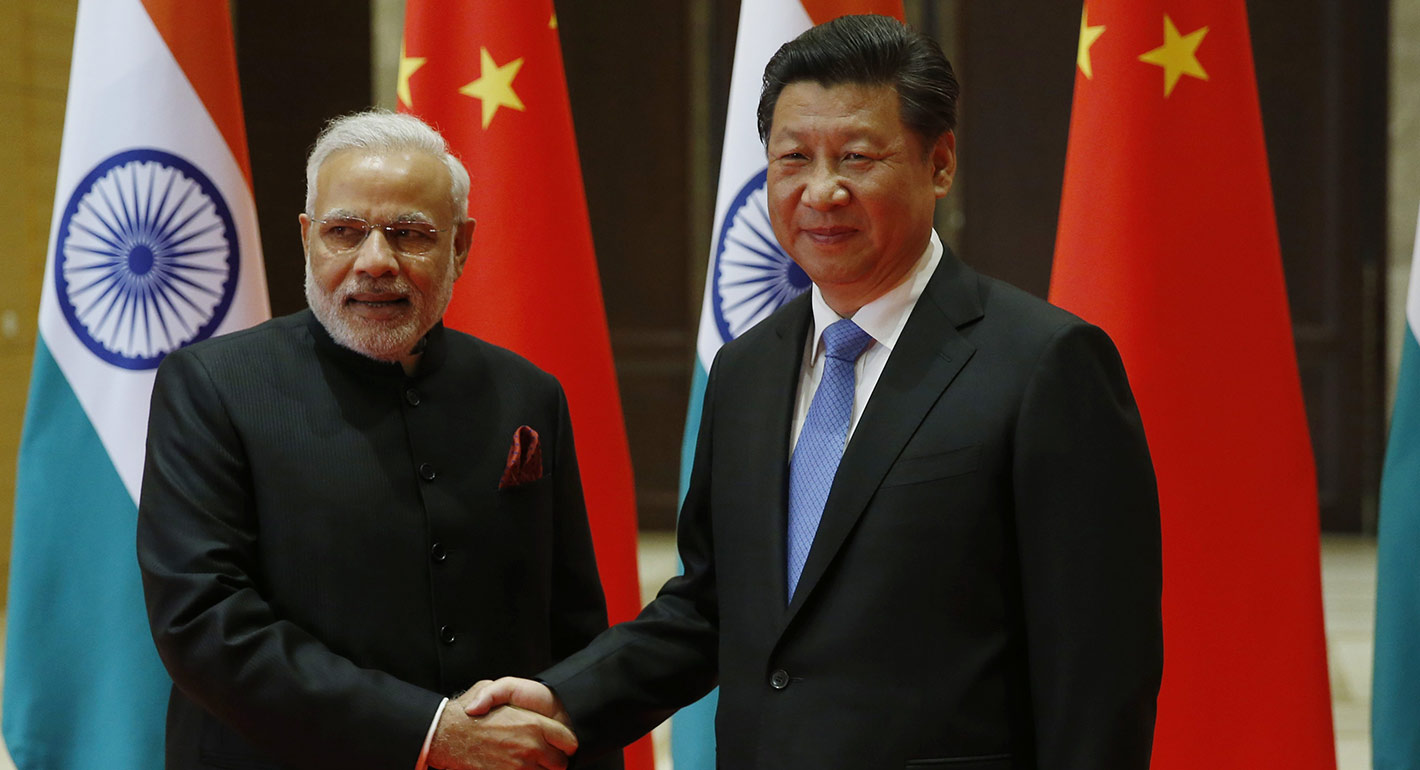
By seeking more space with China and Pakistan at the same time, some believe Prime Minster Modi could be creating a strategic nightmare for India. Others suggest the two fronts are no longer separate.
Source: Indian Express
What’s up with Prime Minister Narendra Modi’s policies towards Pakistan and China? The initial hopes for a significant transformation in India’s two most difficult relationships, under Modi, have soured badly. Two years ago, Modi reached out to Pakistan’s Nawaz Sharif and China’s Xi Jinping. He had invited Sharif to the inauguration of his administration in May 2014. And, in an effort to regenerate momentum in the bilateral relationship, when it had stalled over Kashmir and terrorism, Modi landed at Sharif’s residence near Lahore at short notice, last December. In September 2014, Modi walked with Xi on the banks of the Sabarmati and pushed hard against Delhi’s reluctant bureaucracy to promote economic relations with Beijing.
Yet, Pakistan seems unwilling to reciprocate the PM’s goodwill and China is reluctant to accommodate India’s core interests. If Modi took political risks to advance ties with Pakistan and China, two years ago, he may now be moving the other way to secure India’s interests. Modi’s call to expose Pakistan’s atrocities in Balochistan, his public arguments with China on India’s membership of the Nuclear Suppliers Group and and Delhi’s opposition to China’s economic corridor in Pakistan appear to be part of a shifting strategy towards Islamabad and Beijing. This change is rooted in the recognition that you can’t clap with one hand. Modi’s bet on a positive transformation of ties with Pakistan and China had inevitably run into the structural problems that beset India’s engagement with both the countries. These problems come together in Kashmir and Balochistan.
China, which occupies swathes of territory in Jammu and Kashmir that India claims, has ended its past neutrality in Delhi’s disputes with Islamabad over the province. The China-Pakistan Economic corridor runs through Gilgit Baltistan and connects with the sea in Balochistan. The prospect of a Chinese military base in Balochistan links India’s problems with Beijing in the Himalayas with the challenge of PLA’s rising maritime profile in the Indian Ocean. Throw in a fresh bout of turmoil in Srinagar into the mix, you have the explosive cocktail that is blowing up the traditional frameworks of India’s engagement with Pakistan and China.
India’s current China policy was set on course when the then prime minister, Rajiv Gandhi, visited Beijing in 1988 to normalise relations with China that were in deep chill since the 1962 border war. Since then, India has worked to stabilise the border, deepened economic cooperation, and enhanced support for Beijing in the global arena.
As China became more powerful, Delhi found Beijing’s empathy rather hard to get on issues of importance to India — limiting the trade deficit, support in getting membership to the Nuclear Suppliers Group or putting Pakistan in the dock for sponsoring terrorism. Unlike his predecessors, Modi is not willing to buy the Chinese argument that these differences are “minor” and should not be allowed to come in the way of strengthening the “strategic partnership”. In the past, Indian leaders were unwilling to express differences with China in public and hesitant to question in private those policies of Beijing that hurt Delhi.
Modi, however, is not willing to pretend all is well with Beijing. While Delhi may have, in the recent past, signaled that it could live with the China-Pakistan Economic Corridor, Modi is openly objecting to it. The PM also refuses to take Beijing’s “no” for an answer on NSG and on Pakistan-based terror.
With Pakistan too, Modi is trying to break out of the framework that emerged at the turn of the 1990s. Pakistan, emboldened by the impunity that its newly-acquired nuclear weapons gave it, launched a prolonged terror campaign in Kashmir and backed it with instruments for political intervention in the state. Under pressure, Delhi put Kashmir back on the negotiating table in the 1990s. During the mid-2000s, it negotiated, in good faith, a settlement on Kashmir. India also offered substantive economic cooperation. None of this seemed to bring a fundamental shift in Pakistan’s position. Delhi discovered that the initiative was always with Pakistan, which could ramp up terror whenever it wanted and pull back from carefully-negotiated agreements for cooperation when it chose. If all governments since the early 1990s believed that there was no option but to patiently engage Pakistan, Modi appears to be willing to explore alternatives.
Many in Delhi, who have negotiated with Islamabad and Beijing over the years, think any Indian attempt to change the terms of engagement with Pakistan and China is risky. They would add that the risk increases exponentially if India decides to probe both the fronts simultaneously. But that is precisely what Modi appears to be doing — seeking more space with both China and Pakistan at the same time. The idea of a contest on two fronts — with China and Pakistan — has long been a strategic nightmare for India. But some in Delhi insist these two fronts are no longer separate and that India has no option but to come to terms with their fusion — most notably in Kashmir and Balochistan.
Former Nonresident Senior Fellow, Carnegie India
A leading analyst of India’s foreign policy, Mohan is also an expert on South Asian security, great-power relations in Asia, and arms control.
Recent Work

C. Raja Mohan, Darshana M. Baruah


Alexander Gabuev, Paul Haenle, C. Raja Mohan, …
Carnegie does not take institutional positions on public policy issues; the views represented herein are those of the author(s) and do not necessarily reflect the views of Carnegie, its staff, or its trustees.

European states control several Overseas Countries and Territories around the world that carry strategic, economic, and environmental weight. As great powers challenge the rules-based order, defending them is a geopolitical imperative for Europe.

Marc Pierini
By focusing only on hard security, the Shield ignores the conditions that fuel cartel power.


Alejandro Martin Rodriguez, Kayly Ober

In any defense establishment, change is an ongoing process. However, despite the best of intentions, existing bureaucracies, bound by habit and years of socialization, have their limits in implementing transformative change.

Anit Mukherjee
The conflict has sent economic and political shock waves through a country with no representation at the negotiating table—and Kenya is not alone.

Georgia Schaefer-Brown, Jane Munga

China’s banking crisis in the 2000s was resolved by transferring the costs to households through financial repression—a decision that recapitalized the banks while exacerbating the structural imbalances that continue to shape the Chinese economy today.

Michael Pettis