

Q&A
Dara Massicot, Aaron David Miller, Andrew S. Weiss
{
  "authors": [
    "Andrew S. Weiss"
  ],
  "type": "legacyinthemedia",
  "centerAffiliationAll": "dc",
  "centers": [
    "Carnegie Endowment for International Peace"
  ],
  "collections": [],
  "englishNewsletterAll": "ctw",
  "nonEnglishNewsletterAll": "",
  "primaryCenter": "Carnegie Endowment for International Peace",
  "programAffiliation": "russia",
  "programs": [
    "Russia and Eurasia"
  ],
  "projects": [],
  "regions": [
    "North America",
    "United States",
    "Russia"
  ],
  "topics": [
    "Political Reform",
    "Democracy",
    "Security",
    "Foreign Policy"
  ]
}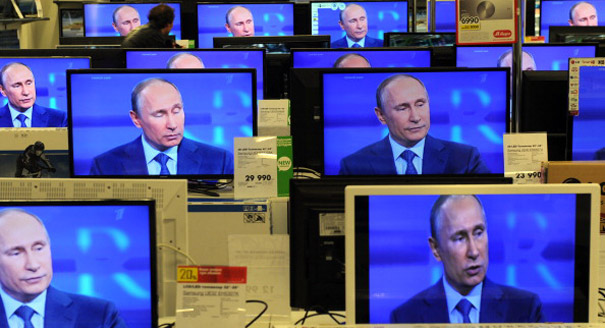
Source: Getty
It has become accepted wisdom that Russia’s interference in the presidential campaign represents a fundamentally new sort of intrusion into a modern democracy’s inner workings. But the Kremlin’s efforts are a revival of Soviet covert behavior that dates back to the Cold War.
Source: Wall Street Journal
Last month, former CIA Director Michael Hayden said that, during the 2016 election, the Kremlin had pulled off a “covert influence campaign” that “was probably the most successful in recorded history.” It has become accepted wisdom that Russia’s interference in the presidential campaign represents a fundamentally new sort of intrusion into a modern democracy’s inner workings.
But the Kremlin’s efforts—designed to help elect Donald Trump, according to the consensus view of the U.S. intelligence community—aren’t so new. In fact, they are a revival of Soviet covert behavior that dates back to the Cold War.
Recent Russian meddling has indeed involved some innovative techniques, including the release of troves of information collected clandestinely and the penetration of the Democratic National Committee’s email servers. The Kremlin has found a target-rich environment in a Facebook-dominated world where media narratives are easy to manipulate and public trust in traditional media is hitting rock bottom.
As the U.S. director of national intelligence explained in an unclassified report, these operations during the U.S. election “followed a longstanding Russian messaging strategy that blends covert intelligence operations—such as cyber activity—with overt efforts by Russian Government agencies, state-funded media, third-party intermediaries, and paid social media users or ‘trolls.’ ”
But the overall campaign should be familiar to any student of history. Similar efforts at subversion were rampant during the Cold War. The Soviets and their partners, including East Germany’s Stasi secret police, understood that such operations could effectively exploit the openness of Western democracies.
In the early 1980s, for instance, the KGB made a major covert push to stop the deployment of U.S. intermediate-range nuclear missiles in Western Europe. The Soviets did everything they could to encourage and manipulate the grass-roots European peace movement that had risen up in opposition to the new weapons.
According to declassified CIA reports, Moscow used a web of front groups, secret payments to activists and articles placed in the press. The Russians also carefully conveyed propaganda themes to sympathetic media outlets, peddled disinformation and produced damaging forgeries of official U.S. and NATO documents.
Resisting this ambitious covert campaign by the KGB galvanized the highest levels of the U.S. government. In January 1983, CIA Director William Casey sent a secret memo to President Ronald Reagan and his top advisers laying out his agency’s findings. Top Reagan officials decided the revelations were too explosive to keep to themselves. “We later published it and circulated it widely within the government and to the allies, and, finally, provided an unclassified version for public use,” wrote Robert Gates, then the head of the CIA’s analytical branch, in his 1996 memoir “From the Shadows.”
The KGB and its allied intelligence services also tried to tilt elections in the U.S., Western Europe and the Third World. At the height of the debate over the U.S. missile deployment in Europe, the Soviets organized what Chancellor Helmut Kohl’s government called a “massive propaganda campaign of interference in West German affairs” to force his ouster in the country’s March 1983 election. But the Soviet effort backfired. The crude Soviet “press commentaries” and staged “workers’ rallies” horrified Kohl’s party and even the opposition Social Democrats.
The heavy-handedness of similar campaigns in the 1970s and ’80s often undermined their effectiveness. As the KGB defector Vasili Mitrokhin explained in 1999, the KGB’s outposts in the U.S. were ordered in 1983 “to acquire contacts on the staff of all possible presidential candidates and in both party headquarters…Residencies around the world were ordered to popularize the slogan ‘Reagan Means War!’ ” The operations were a dud, and Reagan cruised to reelection in 1984.
Other KGB efforts in Africa, Asia, the Middle East and Latin America were more successful, using Soviet propaganda tools and forged documents to hurt U.S. interests. In the mid-1980s, the Soviets circulated a fake National Security Council directive purporting to show the Reagan administration’s hope to develop a nuclear first-strike capability. In the pre-internet age, such disinformation could circulate in many places for years.
According to State Department veterans and intelligence historians, Soviet fake-news specialists also concocted reports that Pentagon bioweapons scientists had created HIV, that wealthy Americans were secretly importing children from Latin America for use in organ transplants and that the CIA was responsible for the 1981 assassination attempt on Pope John Paul II.
Such tactics echo today’s headlines. In France, Emmanuel Macron, who hopes to defeat Kremlin favorite Marine Le Pen in May’s presidential election, has endured a whispering campaign claiming that he is secretly gay, fanned in part by online trolls and outlets close to Ms. Le Pen’s xenophobic National Front. The “story” went viral this month after it ran on Sputnik, a Kremlin-controlled news agency, which asserted that Mr. Macron has a “very wealthy gay lobby behind him.”
In the 1960s and ’70s, the KGB spread similar rumors about two of the Soviet Union’s legendary nemeses, FBI chief J. Edgar Hoover and Sen. Henry “Scoop” Jackson. As Mitrokhin, the KGB defector, later wrote, the KGB tried to spread rumors in the U.S. media that Hoover had promoted “homosexuals from whom he expected sexual favors.” In a 1976 operation against Jackson, the KGB forged a memo in which Hoover “reported” in 1940 that the senator was gay and sent it to newspapers and Jimmy Carter’s presidential campaign.
With elections also coming up this year in Germany, the Netherlands and perhaps Italy, the Kremlin’s willingness to use its KGB-style tool kit has put intelligence services across the continent on alert. In Germany, for instance, a high-profile January 2016 fake-news story about an attempted sexual assault on a Russian-German teenager by Middle Eastern refugees, which was also spread by Russian Foreign Minister Sergei Lavrov, stoked popular anger toward Chancellor Angela Merkel—probably Mr. Putin’s most prominent foreign foe.
The Kremlin is conspicuously unembarrassed about its handiwork, as seen in Mr. Putin’s smirking, I-know-that-you-know-that-I’m-lying handling of questions about the hacking of the DNC and Clinton campaign emails. “Listen, does it even matter who hacked this data?” he said last September. “The important thing is the content that was given to the public.”
The West, in other words, finds itself on an all-too-familiar playing field with the Russians. In the Reagan era, a major enterprise within the U.S. government was dedicated to thwarting Moscow’s propaganda and influence operations, staffed by the State Department, the CIA, the U.S. Information Agency and others. It is past time we remembered how to play this game ourselves.
This article was originally published in the Wall Street Journal.

James Family Chair, Vice President for Studies
Andrew S. Weiss is the James Family Chair and vice president for studies at the Carnegie Endowment for International Peace, where he oversees research on Russia, Ukraine, and Eurasia. His graphic novel biography of Vladimir Putin, Accidental Czar: the Life and Lies of Vladimir Putin, was published by First Second/Macmillan in 2022.
Recent Work


Dara Massicot, Aaron David Miller, Andrew S. Weiss

Frances Z. Brown, Nate Reynolds, Priyal Singh, …
Carnegie does not take institutional positions on public policy issues; the views represented herein are those of the author(s) and do not necessarily reflect the views of Carnegie, its staff, or its trustees.
It should address the shortcomings of previous crisis communication efforts and adapt to the demands of frontier AI.

Lucy Luo

If the Russian-speaking community in Latvia cannot articulate their interests without being seen as disloyal, they could end up embracing a pro-Kremlin agenda.

Sergejs Potapkins
Washington’s decision to support some UN functions while letting others wither is pulling the organization apart at the seams.

Stewart Patrick, Theodore Zaritsky

While there are notable demographic, economic, and geographic divides over AI, there is also substantial alignment between Republicans and Democrats.



Ian Klaus, Mark Baldassare, Rachel George, …

Are Germany’s economic, industrial, and political struggles becoming a liability for the EU’s ability to rise to the geopolitical moment?

Rym Momtaz, ed.