It is one of the busiest months for Sino-European relations in recent memory. In an annual summit on April 9 that promises to be anything but cordial, EU leaders will host Chinese Premier Li Keqiang in Brussels. Europeans are increasingly leery of China’s state-led economic and governance practices, and the associated security risks. This wariness is converging with U.S. concerns, opening the door for greater transatlantic diplomatic coordination.
A Hardening EU Posture
Instead of the polite conversations typical of the past twenty years, EU representatives will be armed with a different agenda at this summit. A new EU document calls China “a negotiating partner with whom the EU needs to find a balance of interests, an economic competitor in the pursuit of technological leadership and a systemic rival promoting alternative models of governance.” The EU’s characterization of China as a “systemic rival” was remarkable, since European documents are not known for being blunt. But it came as no surprise to those who have paid close attention to the shifting mood in Brussels.
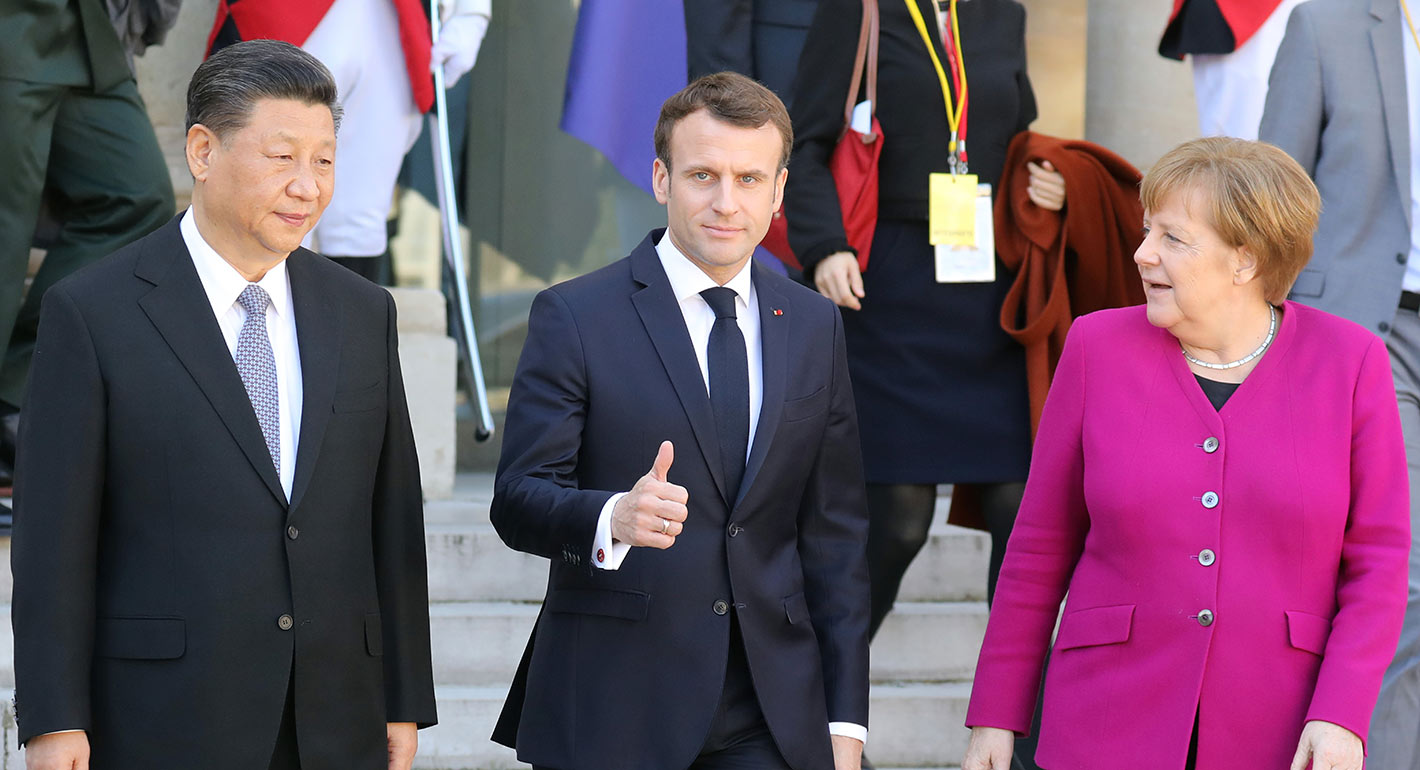
After years of insipid dialogues, the EU leadership has changed its tune. Outgoing European Commission President Jean-Claude Juncker has teamed up with a reinvigorated European alliance led by German Chancellor Angela Merkel and French President Emmanuel Macron. It is no coincidence that all three of them together—for the first time ever—met Chinese President Xi Jinping during his March 2019 visit to Paris. That meeting came days after the Commission published a much-publicized document, which advised caution toward China.
A Shrinking U.S.-Europe Gap on China Policy
The United States should take notice. Washington’s policy community has long considered Europe an unreliable partner when it comes to China. For years, the EU was too preoccupied with its own internal problems and too focused on getting trade deals with Beijing. Europe’s lack of strategic interests and military assets in the Asia Pacific have made Europe slower than the United States in hardening its posture toward China, a contrast evident from former president Barack Obama’s efforts at a rebalance.
Under President Donald Trump, the United States has doubled down on its combative stance. Trump has declared that he is going to strike tougher deals with various Asian powers, including Australia, China, India, Japan, North Korea, and South Korea. He has repeatedly accused China of having stolen “tens of thousands of American jobs.” The U.S.-China trade dispute continues, although there are signs of a potential deal in the next few months.
Now, to Washington’s surprise, Brussels has begun to mount its own response to China’s global rise. In 2016, the French defense minister proposed sending EU naval forces to patrol the South China Sea. The UK, Europe’s other major naval power, soon followed suit with a similar commitment.
Still, the EU has reacted most strongly to China’s economic inroads, following a stunning 40 percent annual rise in Chinese investment acquisitions throughout Europe in 2016. In 2017, Germany, France, and Italy asked the European Commission to address Chinese strategic investments in European technology and infrastructure. This led to a rapid examination process. Since April 5, a new EU screening mechanism on foreign investments is in place.
Things took an even more sudden turn over the past year, as Brussels began reacting more skeptically to China’s global economic offensive in Europe and throughout the rest of the world. Although some countries such as Greece and Hungary have insisted on not offending China, the majority of EU members agree on the tough new policy. Even Italy’s populist government, which agreed recently to sign on to China’s efforts to fund overseas infrastructure through the Belt and Road Initiative, has not stood in the way.
All these political maneuvers have led to palpable tensions in the run-up to this week’s EU-China summit. Several European countries are threatening not to sign a joint communique, due to China’s lack of progress on European demands to improve its record on human rights, market reciprocity, technology transfers, and proposals to reform the WTO. Although the summits in 2016 and 2017 also failed to produce a joint statement, what is different this time around is the EU’s more pointed posture and declining patience with perceived Chinese dithering.
On a more positive note, this is the first time that Americans and Europeans openly agree in broad terms on how to address China’s ambitious economic expansion. Both the EU and the United States are demanding more access to the Chinese market and are being critical of “the distortive effects of foreign state ownership and state financing.” Washington and Brussels are both insisting on a rules-based international order. They are negotiating with China on bilateral agreements to set rules for foreign investment (although the Trump administration has been far more willing than Europe to apply unilateral tariffs on Beijing).
It is high time Europe and the United States pursue a coordinated transatlantic strategy toward China.