In early February 2020, U.S. President Donald Trump took to Twitter to hail his excellent call with Chinese President Xi Jinping about the coronavirus outbreak. Trump called Xi a “strong, sharp and powerfully focused” leader who was successfully eradicating the coronavirus. That same day, Secretary of State Mike Pompeo announced that Washington would spend up to $100 million to help Beijing curtail the virus, in addition to the nearly eighteen tons in medical supplies it had already sent to China.
Twenty-four hours later, however, Pompeo stood in front of the U.S. National Governors Association with a very different message. In his latest China speech, Pompeo warned of competition with Beijing that threatens “the very basic freedoms that every one of us [U.S. governors] values.” Just days later at the Munich Security Conference, Chinese Foreign Minister Wang Yi said that U.S. “accusations against China are lies and not based on facts.”
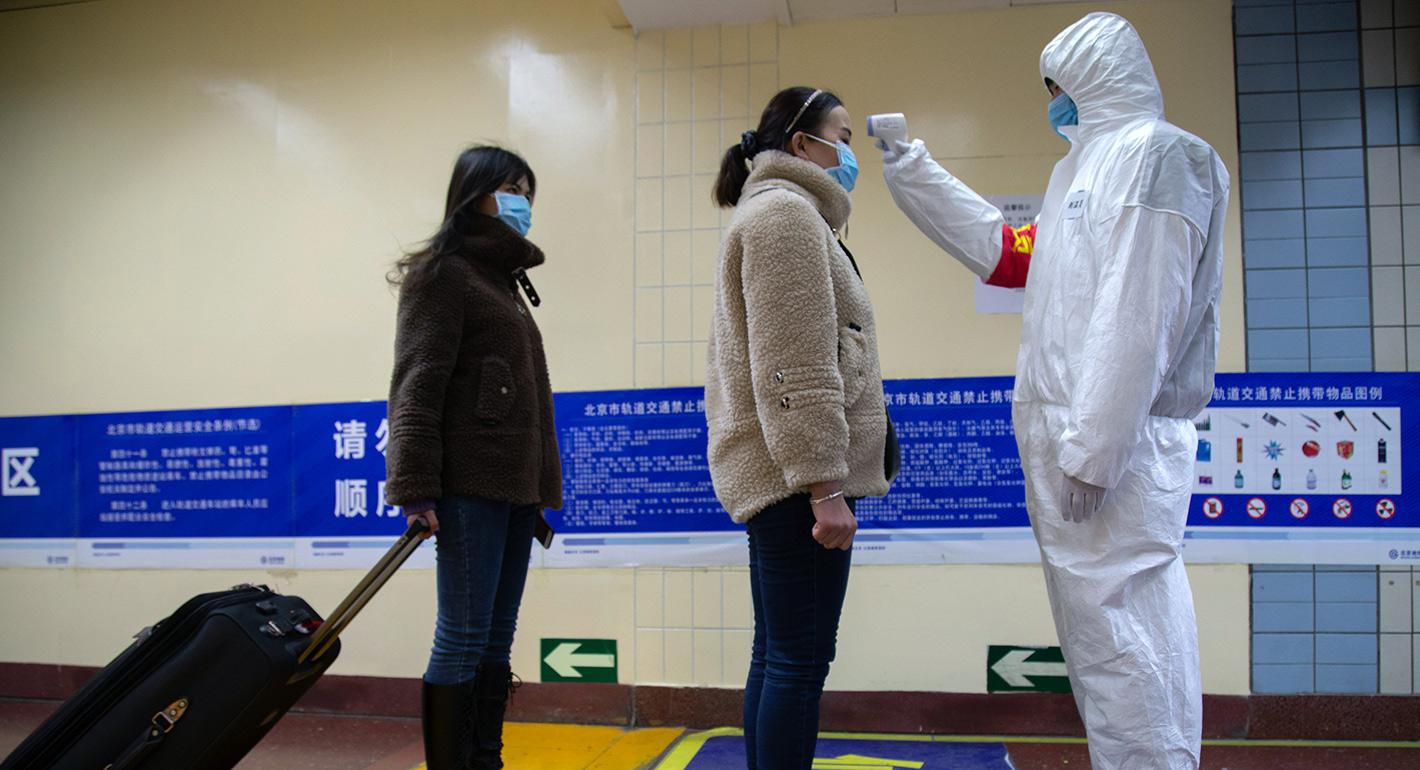
The discrete messaging over a matter of days highlighted the sharp downturn in U.S.-China ties and reinforced the increasingly competitive, contentious, and antagonistic state of the relationship. Beijing’s lack of transparency has exacerbated a global health crisis and limited cooperation, while Washington’s focus on competition has fueled greater mistrust. The coronavirus has exposed just how difficult it’s becoming for the two countries to cooperate on issues that are of mutual interest—even ones that threaten the lives of their own citizens.
Competitive Coexistence
As China emerged from the 2002–2003 Severe Acute Respiratory Syndrome (SARS) pandemic, there was hope that the outbreak could foster greater cooperation on tackling global health challenges. In recent testimony before the U.S. House Foreign Affairs Committee, researcher Jennifer Bouey highlighted that “increased U.S.-China collaboration on global health was an important result of the SARS response.” In the nearly two decades following SARS, in which other global health crises involving the H1N1 influenza strain and the Ebola virus unfolded, Washington and Beijing demonstrated a growing willingness to manage threats to global health, stability, and economic growth together.
Indeed, epidemics are often seen as nonsensitive areas for U.S.-China cooperation. Even amid contentious track 2 dialogues at the nadir of the relationship, experts readily agreed that Washington and Beijing should consult more often on epidemic and disease control. The coronavirus, however, has demonstrated just how low bilateral ties have sunk. Washington and Beijing might still be willing to cooperate when other nations experience epidemics, but what happens when one of them experiences their own has been another story.
This observation is not meant to ignore the assistance the U.S. government has given to this point. Beyond the pledges of financial aid and shipments of medical equipment, the Center for Disease Control (CDC) has also offered to send an emergency response team to China to advise on dealing with the virus. But, to date, this pandemic has not led to greater U.S.-China cooperation on the whole. This crisis has generated little goodwill in an already soured relationship, and these cooperative developments have been overshadowed by more contentious rhetoric.
Beijing has not yet responded to the CDC’s offer. There could be several reasons for this. It’s possible that China does not want to appear unable to manage the virus on its own, or perhaps Chinese officials fear that letting in the CDC might limit their ability to control the flow of information, or maybe a general distrust of the United States is the cause. Beijing was even initially hesitant to give access to teams from the World Health Organization. Furthermore, the Chinese Ministry of Foreign Affairs criticized Washington for being unhelpful and overreacting, while Hu Xijin, the Trump-like editor-in-chief of the Global Times and Twitter provocateur, has claimed that the United States has provided empty rhetoric and little action. Beijing has yet to acknowledge its critical error in covering up knowledge of the virus and its spread, remains opaque in its reporting of coronavirus figures, and is still hesitant to accept international cooperation to limit the further spread of the disease.
In Washington, there has been minimal effort to tone down the heated and antagonistic rhetoric fueling a more contentious relationship. Across nearly every U.S. government agency, senior officials are highlighting the many threats Beijing poses. Pompeo’s speech to U.S. governors on the grave economic and national security risks China represents to each of their states was followed by a speech at the Munich Security Conference villainizing Beijing and comparing the challenge China embodies to “radical Islamic terrorism” and the “global financial crisis.” Early on in the outbreak, Secretary of Commerce Wilbur Ross framed the coronavirus as something that would “accelerate the return of jobs to North America.” Senator Tom Cotton has been outspoken in his legitimate criticism of Beijing’s lack of transparency, but he also has promulgated the rumor that the virus originated in a Chinese military laboratory.
Where Do Things Go From Here?
U.S.-China collaboration to eradicate the coronavirus is a chance for both countries to demonstrate they can still cooperate in times of crisis. There are compelling humanitarian and moral reasons for both sides to look past their differences and work together. Furthermore, the outbreak comes just after Beijing and Washington reached a phase-one trade deal that eased bilateral tensions and halted the downward spiral in the relationship. For Beijing to meet its phase-one import commitments and Trump to convincingly argue that his trade deal is a success, the Chinese economy will need to get back to work quickly.
For Beijing, the crisis highlights its lack of international credibility. Many countries—not just the United States—have shuttered their borders to Chinese citizens. Beijing’s continued opacity has only fueled further speculation over the true origins of the crisis and the extent of its spread. Few believe the number of infections and deaths coming out of China, a fact that partly explains the widespread, comprehensive travel bans.
This outbreak will have significant economic repercussions for Beijing. Both Chinese and international companies will be wary to return to business as usual until they truly feel safe, which may not necessarily be when the Chinese government says so. Especially as its economy is already experiencing a slowdown and is in the midst of an important economic transition, China’s inability to reassert confidence and resume business as usual could have major repercussions for the country’s growth trajectory. To ensure that China and the international community are in the best position to handle this crisis, Beijing should prioritize transparency and welcome international assistance.
As for Washington, policymakers should be careful not to neglect an opportunity to demonstrate goodwill. It is in the United States’ interests to prevent the epidemic from becoming a global pandemic. Especially during this uncertain and challenging time for the bilateral relationship, it is vital that channels of communication stay wide open and that the United States puts its best foot forward. Despite the rapid downturn in relations in recent years, the Trump administration continues to assert that its actions are focused on making the relationship fairer and more reciprocal. This is a chance to show that is truly the case—that neither side is interested in kicking the other while it is down.
Past crises have generated new opportunities for Washington and Beijing to work together on issues of common concern. This was the case after the September 11, 2001, terrorist attacks and during the global financial crisis. But the climate in both capitals today indicates that this may not be the case anymore. This is regrettable to say the least. Once the crisis subsides, bilateral security and economic tensions will once again dominate headlines. Neither side is likely to be willing to sincerely engage in negotiations on sensitive matters, including a phase-two trade deal, if it feels the other will only pounce when it is weak.