

Commentary
What happens next can lessen the damage or compound it.
Mariano-Florentino (Tino) Cuéllar
{
  "authors": [
    "Robert Greene"
  ],
  "type": "commentary",
  "centerAffiliationAll": "",
  "centers": [
    "Carnegie Endowment for International Peace"
  ],
  "collections": [
    "China and the World",
    "Economic Risk in Asia"
  ],
  "englishNewsletterAll": "",
  "nonEnglishNewsletterAll": "",
  "primaryCenter": "Carnegie Endowment for International Peace",
  "programAffiliation": "",
  "programs": [
    "Asia"
  ],
  "projects": [],
  "regions": [
    "North America",
    "United States",
    "East Asia",
    "China",
    "Russia",
    "Eastern Europe",
    "Ukraine",
    "Western Europe",
    "United Kingdom",
    "France",
    "Germany"
  ],
  "topics": [
    "Economy",
    "Trade"
  ]
}
Source: Getty
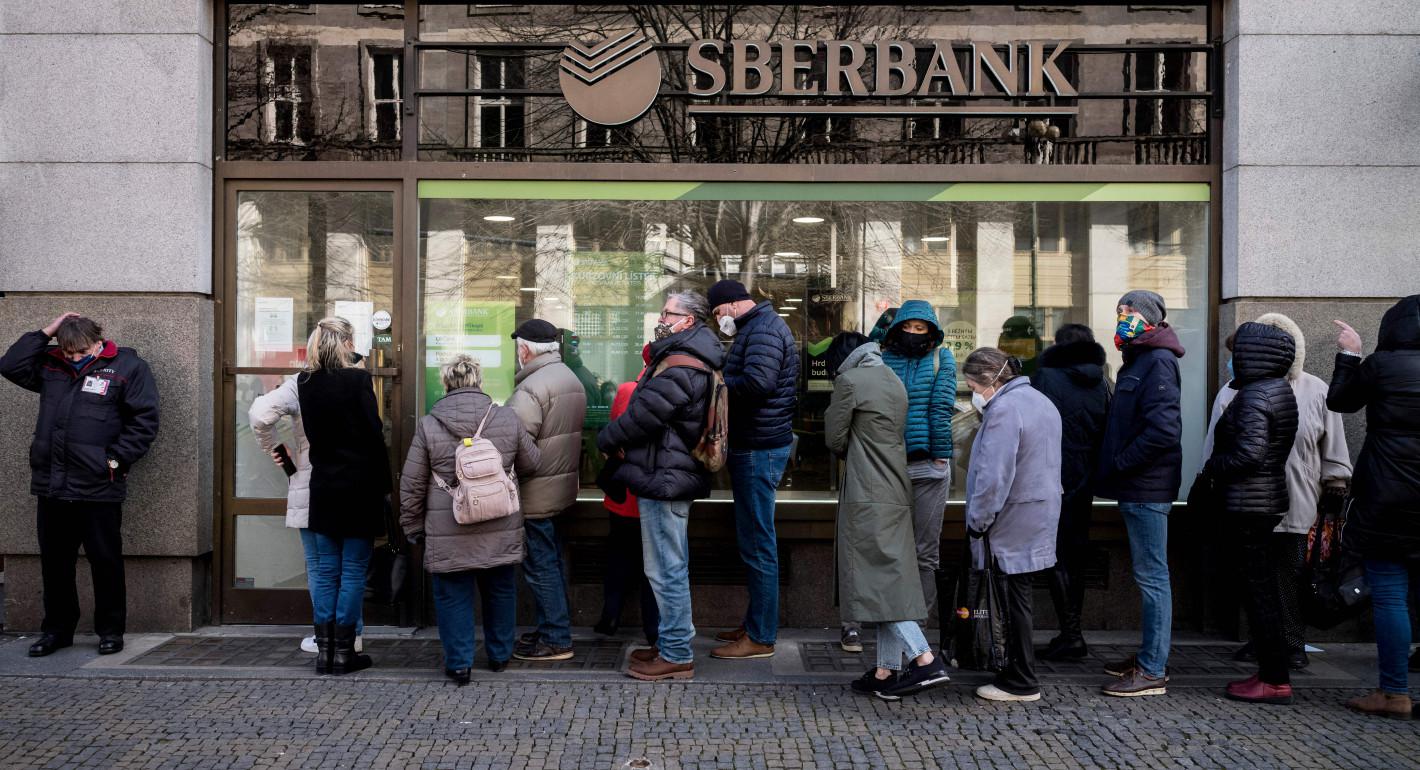
Beijing sees the Ukraine crisis as its opportunity to gain influence over financial markets.
This week, in response to Russia’s invasion of Ukraine, the European Commission decidedto disconnect seven Russian banks from the Belgium-based Society for Worldwide Interbank Financial Telecommunication (SWIFT), a messaging service used to facilitate most commercial cross-border payments between firms banked in different countries. In advance of the move, leaders in the United States, the United Kingdom, Japan, and other countriesendorsed disconnecting “selected” Russian financial firms from SWIFT. In addition, U.S. President Joe Biden’s administration announced sanctions against Russia’s two largest financial institutions, which it says are intended to cut off major parts of the Russian financial system from the U.S. dollar, as well as sanctions against Russia’s central bank. Europe also approved sanctioning Russia’s central bank and recently announced sanctions on various Russian financial firms.
Taken together, these actions will likely fundamentally change the geopolitics of cross-border payments. However, the short-term impacts of these sanctions are constrained by the fact that they largely do notimpact transactions to Russia’s energy sector, the country’s lifeblood, and because the EU has not sanctioned some of Russia’s largest banks. As a result, euro- and dollar-denominated payments can continue to flow through Russia’s economic engines. That could change if stricter sanctions are implemented and Russian firms are widely disconnected from SWIFT, but Brussels and Washington appear reluctant to implement such measures. And even if Russia’s banking sector is largely unplugged from SWIFT, Beijing as well as some in Europe may use alternative payments channels to keep euro and renminbi payments flowing to Russia; already, more than half of Russian exports are not dollar-denominated.
In the longer term, however, no matter what course of action the United States and the EU take, the events of the past few weeks play into thedeepconcerns in Beijing that China could one day be disconnected from U.S.- and EU-led payments channels. Beijing is poised to dramatically accelerate efforts aimed at building out China-led, renminbi-denominated payments channels across Asia—including in Russia—that are largely impervious to U.S. sanctions and less reliant on SWIFT. It is critical for Washington to monitor and work with allies to mitigate the growing security risks posed by these efforts.
About 300 Russian financial institutions use SWIFT, which boasts more than 11,000 members in 200 countries, is co-owned by over 2,000 banks, and is governed by a board comprised of global financial executives. Most SWIFT transactions are for dollar-, euro-, and sterling-denominated payments (40 percent, 37 percent, and 6 percent, respectively); in January, the renminbi became the network’s fourth-most-used currency, accounting for 3 percent of payments. SWIFT reportedly transmits $140 trillion in payments each year. For comparison, China’s Cross-Border Interbank Payments System (CIPS)—which both competes with and uses SWIFT—combined with Russia’s SWIFT competitor together facilitated transactions worth less than half of a percent of SWIFT’s volume.
Transactions transmitted via SWIFT are actually settled by payments systems that facilitate much larger volumes than SWIFT itself. For example, the U.S.’s Clearing House Interbank Payments System (CHIPS)—which is owned by large U.S., European, and Japanese banks and facilitates most large-value, cross-border, dollar-denominated payments—enabled $407 trillion of transactions in 2021. Similarly, TARGET2, a European Central Bank–run payment system, facilitated over 466 trillion euros (about $520 trillion) in transactions in 2020. The China National Advanced Payment System (CNAPS) reportedly processed over 5 quadrillion renminbi (around $800 trillion) in payments in 2019. These systems have internal messaging systems to facilitate payments without relying on SWIFT, but a largeshare of high-value, cross-border payments involve a SWIFT message.
If Russia’s financial system is largely disconnected from SWIFT, then facilitating cross-border payments will become much more inefficient for Moscow. But under the existing U.S. and EU sanctions approach, alternative messaging systems could presumably still be used to send payment instructions that reach TARGET2 and CHIPS for transactions involving many Russian banks. If important Russian banks stay connected to SWIFT, are not sanctioned by the EU, continue to receive a wide range of carveouts from U.S. sanctions, and remain TARGET2 participants—as is currently the case—then sizable flows of dollar- and euro-denominated cross-border payments will continue in and out of Russia. Washington and Brussels appear unwilling to take actions that would more severely constrict these payments channels.
One reason for this reluctance appears to be a fear that completely disconnecting Russia’s banks from SWIFT will raise the price of energy, thus benefiting Russia’s government. Russia’s invasion of Ukraine is already dramatically increasing energy prices, so without broadly disconnecting Russian banks from SWIFT and taking actions to block payments flows through CHIPS, payments for the two-thirds of Russian petrochemical exports that are dollar-denominated will continue to flow to Russia’s energy sector, which reportedly accounts for over 60 percent of Russian exports as well as more than one-third of Russia’s national budget.
Another reason that Brussels and the Biden administration may fear fully disconnecting most Russian banks from SWIFT is concern over the potential for escalatory retaliatory responses by Russia. Some Russian government officials say that such an action would be equivalent to a declaration of war. Others in Europe have more parochial concerns, fearing that strict sanctions and a broad SWIFT disconnect would lead to troubles at EU banks, which reportedly had more than $76 billion in outstanding Russian loans as of late last year. And some in the United States worry that disconnecting most Russian banks from SWIFT or implementing harsher sanctions will drive Russia to rely on Chinese financial market infrastructure.
Recent data suggest that about 60 percent of China’s exports to Russia were dollar-denominated in 2020, while two-thirds of Russian exports to China were denominated in euros, and most of the rest were dollar-denominated. If Russian banks are ultimately largely disconnected from U.S. and EU payment infrastructure, trade between Russia and its largest trading partner, China, will have to go through other channels. Given the ruble’s ongoing free fall, the renminbi would likely be chosen. Several options exist to facilitate renminbi-denominated payments without using SWIFT.
For starters, the U.S.-sanctioned VTB Bank—Russia’s second-largest financial institution, which is set to be disconnected from SWIFT—is a participant in CNAPS, suggesting that it can easily avoid using SWIFT when facilitating renminbi-denominated payments between Russian and Chinese firms. Special communication lines to circumvent SWIFT are also likely already in place between Russian banks and Chinese financial institutions. Additionally, Russian firms with accounts at Chinese state-owned banks can presumably send and receive renminbi-denominated payments to other entities banked by Chinese depositories that circumvent SWIFT. Last year in Myanmar, Beijing signaled its willingness to use state-owned bank affiliates in a similar way to bypass U.S. sanctions. Notably, China’s CIPS still largely relies on SWIFT for payments not involving domestic banks, so its ability to help EU- and U.S.-sanctioned Russian banks conduct renminbi-denominated transactions would be impeded, were these institutions to be largely disconnected from SWIFT.
All of these renminbi-denominated off-ramps could in theory be blocked if the Biden administration’s sanctions against the Russian financial system were part of a so-called secondary sanctions regime, whereby overseas entities doing business with sanctioned individuals or countries are threatened with being disconnected from dollar-denominated payments channels if they transact with parties under U.S. sanctions. The enforcement of these types of sanctions arguably had a bigger impact on Iran’s economy than disconnecting Iranian banks from SWIFT. But taking such an approach against Russia would necessitate that the Biden administration display a willingness to sanction Chinese banks for serving U.S.-sanctioned Russian banks, which it appears unlikely to do.
So would more completely disconnecting Russian banks from SWIFT and implementing stricter sanctions drive China and Russia closer together? The fact is that, no matter what Brussels and Washington decide to do next, Beijing sees recent events as reason for dramatically accelerating efforts aimed at developing renminbi-denominated payments channels impervious to U.S. sanctions. In Beijing’s eyes, the United States’ and EU’s sanctions already—as research from one major Chinese state-owned financial institution recently articulated—constitute a “financial nuclear weapon.”
In response, analysesfrom prominent Chinese state-owned firms and commentators suggest Beijing will speed up efforts to reduce China’s SWIFT usage and increase renminbi cross-border payments flow. China’s central bank and other financial regulators just announced a plan to this effect, and a senior researcher at one Chinese state-owned conglomerate suggested this week that Beijing will accelerate the rollout of cross-border capabilities for China’s central bank digital currency (CBDC). Beijing’s central bank chief also just pledged support to help de-dollarize trade in Southeast Asia. And in December, just as the EU Parliament passed a nonbinding resolution threatening to disconnect Russia from SWIFT in the event of a Ukraine invasion, Russian President Vladimir Putin and Chinese President Xi Jinping discussed “accelerating efforts on the formation of independent financial infrastructure for servicing trading operations between Russia and China,” according to a readout.
Obstacles to all of these initiatives exist: as one leading Chinese economist recently noted, SWIFT has been used for decades, “making it difficult to shake its dominance . . . in a short time.” Likewise, both the dollar’s and euro’s heavy use in global finance and trade is self-reinforced, leading to each’s high liquidity and abundant availability in foreign exchange markets that will be difficult for the renminbi to chip away at, particularly given China’s regulations on cross-border usage of its currency—although Beijing plans to “steadily and prudently” loosen these rules and regional renminbi-denominated trade is growing. Also, China’s cross-border CBDC payments ambitions face governance challenges.
Nevertheless, as leaders in Brussels and Washington contemplate additional sanctions against Russian banks, they should also not lose sight of the fact that Beijing is set to invest considerable resources in systems that could dramatically reduce the power of U.S. and EU sanctions within years. Worse yet, as another Carnegie expert recently noted, Chinese officials are likely taking notes on how they could leverage the growing influence that Chinese institutions have in financial markets to achieve geopolitical aims. It is critical for Washington and Brussels to respond to the security risks presented by Beijing’s initiatives to transform cross-border payments and better understand the role that European and U.S. firms are playing in these efforts. Ultimately, if Brussels and Washington cede their leadership roles in global payments, then policy options such as those being utilized against Russia will be more limited when future crises emerge.
Carnegie does not take institutional positions on public policy issues; the views represented herein are those of the author(s) and do not necessarily reflect the views of Carnegie, its staff, or its trustees.

What happens next can lessen the damage or compound it.

Mariano-Florentino (Tino) Cuéllar

The uprisings showed that foreign military intervention rarely produced democratic breakthroughs.


Amr Hamzawy, Sarah Yerkes
An Armenia-Azerbaijan settlement may be the only realistic test case for making glossy promises a reality.

Garo Paylan

China has found a unique niche for itself within the global security ecosystem, eschewing military alliances to instead bolster countries’ internal stability using law enforcement. Authoritarian regimes from the Central African Republic to Uzbekistan are signing up.

Temur Umarov
In return for a trade deal and the release of political prisoners, the United States has lifted sanctions on Belarus, breaking the previous Western policy consensus. Should Europeans follow suit, using their leverage to extract concessions from Lukashenko, or continue to isolate a key Kremlin ally?

Thomas de Waal, ed.