

Commentary
Chung Min Lee
{
  "authors": [
    "Chung Min Lee"
  ],
  "type": "commentary",
  "centerAffiliationAll": "dc",
  "centers": [
    "Carnegie Endowment for International Peace"
  ],
  "collections": [
    "Korea: Emerging Player"
  ],
  "englishNewsletterAll": "asia",
  "nonEnglishNewsletterAll": "",
  "primaryCenter": "Carnegie Endowment for International Peace",
  "programAffiliation": "AP",
  "programs": [
    "Asia"
  ],
  "projects": [],
  "regions": [
    "East Asia",
    "South Korea"
  ],
  "topics": [
    "Economy",
    "Security",
    "Foreign Policy"
  ]
}
Source: Getty
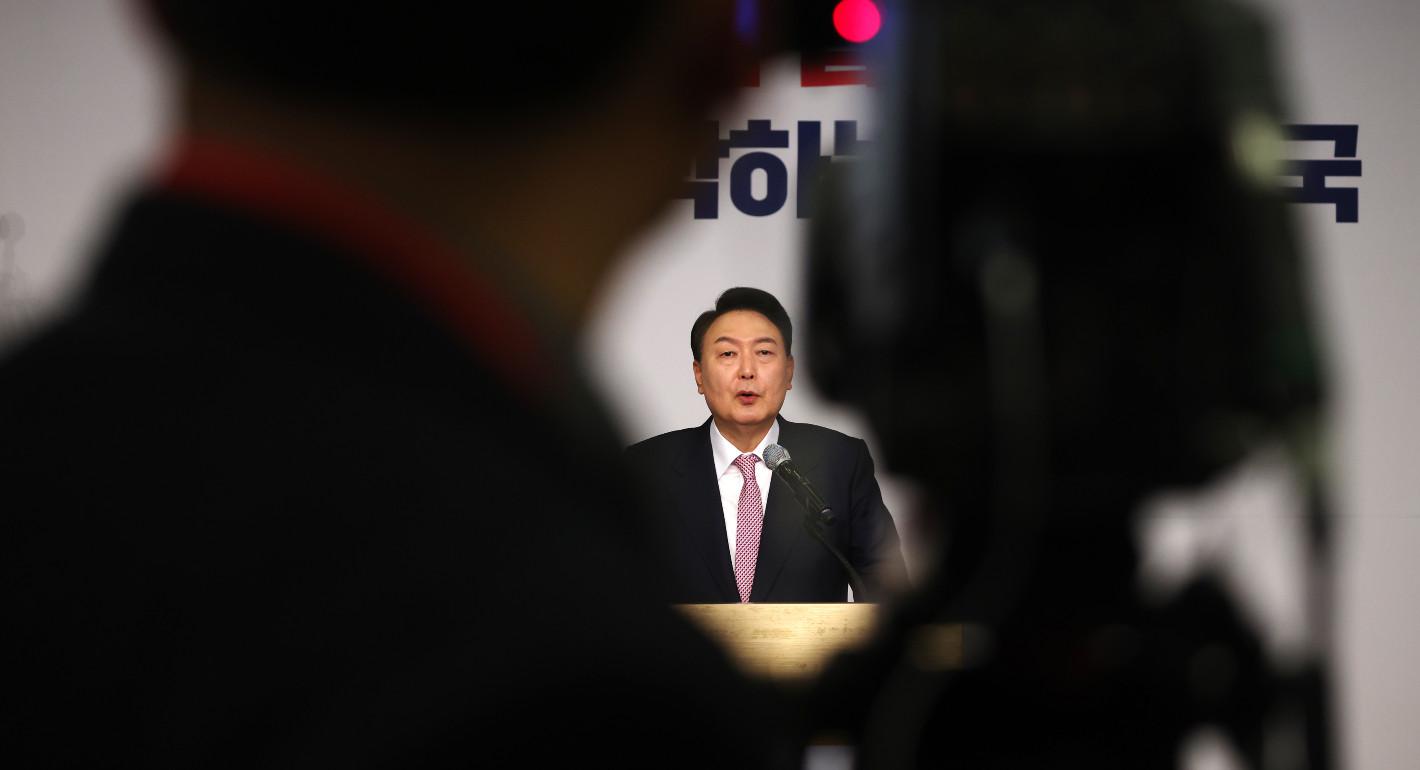
Yoon Suk-yeol’s unrelenting pragmatism can guide him through key foreign policy and national security challenges.
Last week, South Koreans chose Yoon Suk-yeol from the conservative People Power Party (PPP) as their next president in the closest election since the restoration of democracy in 1987. A former prosecutor-general who catapulted into the political arena only a year ago, Yoon carried the election against Lee Jae-myung of the ruling Democratic Party (DP) with a razor-thin margin of 247,000 votes. While Yoon faces enormous challenges at home and abroad, he is also a political maverick unbeholden to political bosses and factions as well as interest groups.
His victory was an earthquake not only because it was a verdict on outgoing President Moon Jae-in and his party’s candidate but also because Yoon is likely to shatter many long-established traditions. Korean presidents serve a single five-year term, and since 1987, changes between the right and the left have occurred after the end of two presidencies. This time, however, Moon’s party failed to regain the presidency. And despite a sharply negative and bruising campaign, as soon as the tallies showed that Yoon was going to win, Lee conceded immediately. Korean democracy survived another key litmus test and is stronger because of it.
Yoon can also use his unexpected presidency to correct Korea’s endemic cycle of retribution politics, transform decisionmaking processes with greater transparency, and devolve power to the cabinet and other important agencies, including key intelligence organizations. Pundits are saying that Yoon faces very steep challenges and must traverse key obstacles. There are those who say that the temptation to unleash presidential power to go after his adversaries is too great, given his background as a hardnosed prosecutor. But Yoon didn’t rise to the presidency by following precedent. Precisely because he is so aware of political corruption and politicians’ empty promises, his biggest weapon is going to be his unrelenting pragmatism. But as he prepares to enter office, Yoon faces three key foreign policy and national security tasks.
First, North Korea’s accelerating nuclear weapons and ballistic missile capabilities call for resetting Seoul’s countermeasures and North Korea policy. Since January, Pyongyang has conducted nine missile tests, including a de facto intercontinental ballistic missile on March 9, just four days before South Korea’s presidential election.
In his first press conference, Yoon noted that he wants to bolster South Korea’s defense capabilities and strengthen deterrence although he was willing to talk with the North. He also wants to boost trilateral security cooperation with the United States and Japan while deepening the Seoul-Washington alliance. If U.S. President Joe Biden visits Seoul after his Quad leaders’ meeting in Tokyo in May, both leaders will be able to formulate common pathways very early on in Yoon’s administration.
After Yoon’s phone call with Biden on March 10, he also received a call from Japanese Prime Minister Kishida Fumio on March 11, where he stressed the importance of improving bilateral ties and trilateral security cooperation. While ties between Seoul and Tokyo have been in a deep freeze over ongoing historical disputes, Yoon stressed the need to move forward. Kishida also agrees. For Biden, this is music to his ears, given that the two countries are America’s most important Asian allies and major global technology powers.
Second, as the ongoing war in Ukraine demonstrates, the world faces a Eurasian threat belt that includes China, Iran, North Korea, and Russia. Each poses different risks and military challenges. While Seoul rightly focuses on meeting an array of threats from North Korea, it also faces rising strategic challenges from China and Russia. In November, seven Russian and two Chinese warplanes entered South Korea’s air defense identification zone (KADIZ). This wasn’t the first time that Russian and Chinese planes flew into the KADIZ without notice. Strengthening trilateral security and defense cooperation between the United States, Korea, and Japan is a key step toward enhancing integrated deterrence capabilities.
Third, as South Korea faces daunting military manpower shortages due to falling demographics, it has no choice but to accelerate high-tech weapons programs, including offensive and defense capabilities to more effectively counter North Korea’s growing nuclear arsenal. It has to also shore up key national security supply chains and elevate trilateral security cooperation between the United States, Korea, and Japan. This calls for significantly beefing up intelligence, surveillance, and reconnaissance (ISR) capabilities with critical collaboration with the United States. This is especially the case with space-based assets, where the United States continues to be a world leader.
South Korea’s key national security policies must withstand enormous political headwinds, bureaucratic inertia, and overcoming geopolitical realities to be successful. As a result, the time is ripe for Yoon to stress four key points: unparalleled high-technology cooperation with the United States, including more advanced ISR space-based assets; closer alignment with the West and the United States on key security issues such as addressing the challenges posed by an increasingly powerful China, including opening up the possibility of joining the Quad; building technology platforms to ensure longer-term growth but to also enable South Korea to emerge as a major global technology player; and enhancing intelligence capabilities, including stronger counterintelligence assets.
Yoon is a political novice with limited national security experience. But if he delivers on his promise to lead by not micromanaging policies from the presidential office and practicing a more open and horizontal work culture, he is likely to surprise detractors. All incoming presidents since the late 1980s promised to eradicate vestiges of an imperial presidency. None succeeded, because once presidents were inaugurated, it was difficult not to be tempted by exercising the massive powers of the presidency. Yoon wants to downsize the president’s staff by 30 percent and abolish the post of senior secretaries, who ran all ministries.
Throughout his career, Yoon emphasized that his loyalty was always to the constitution, rather than specific leaders, including presidents. As the new commander in chief, he can expect no less from those who will join his administration. If he succeeds, that will be a true political revolution in Asia’s most vibrant democracy, the world’s tenth-largest economy, and America’s critical Asian ally.
Senior Fellow, Asia Program
Chung Min Lee is a senior fellow in Carnegie’s Asia Program. He is an expert on Korean and Northeast Asian security, defense, intelligence, and crisis management.
Recent Work
Chung Min Lee
Carnegie does not take institutional positions on public policy issues; the views represented herein are those of the author(s) and do not necessarily reflect the views of Carnegie, its staff, or its trustees.

Japan’s long-term security policy is driven by concerns about China, and there is little appetite for (or interest in) pursuing a confrontation with Moscow.

James D.J. Brown

Russia is testing the waters of NATO’s mutual defense clause. What do strikes in Romanian territorial waters mean for the alliance’s posture toward Moscow?

Dimitar Bechev

China has showcased its engineering prowess with small modular reactor demonstration projects. But turning these technological achievements into commercial success will be a greater challenge.

Tong Zhao
Why Pakistan, Saudi Arabia, and Turkey are joining forces on regional security.


Alper Coşkun, Amr Hamzawy

The truth of the strategic situation is that Europe and Russia are extremely unlikely to be able to “turn the page” on their confrontation within the next two decades.

Arkady Moshes