

Paper
Bentley Allan, Jonas Goldman
{
  "authors": [
    "Bentley Allan"
  ],
  "type": "commentary",
  "centerAffiliationAll": "dc",
  "centers": [
    "Carnegie Endowment for International Peace"
  ],
  "collections": [],
  "englishNewsletterAll": "ctw",
  "nonEnglishNewsletterAll": "",
  "primaryCenter": "Carnegie Endowment for International Peace",
  "programAffiliation": "SCP",
  "programs": [
    "Sustainability, Climate, and Geopolitics"
  ],
  "projects": [
    "The U.S. Foreign Policy for Clean Energy Taskforce"
  ],
  "regions": [
    "North America",
    "United States"
  ],
  "topics": [
    "Economy",
    "Trade",
    "Climate Change"
  ]
}
Source: Getty
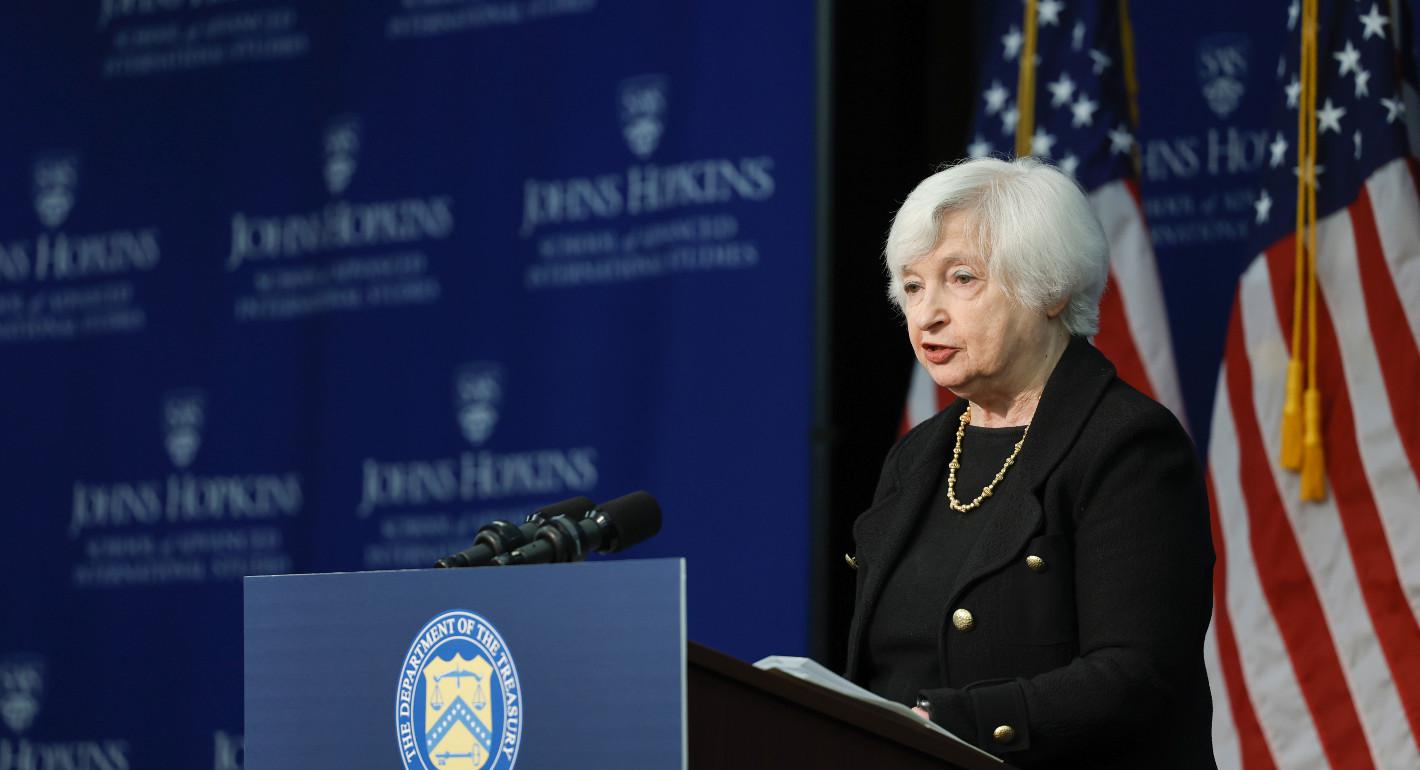
Janet Yellen and Jake Sullivan have recently argued that pursuing industrial policy at home is compatible with an open and fair global economic order.
In two landmark speeches in recent weeks, Treasury Secretary Janet Yellen and National Security Advisor Jake Sullivan articulated the core principles of a new international economic order centered on industrial policy. In this vision, the U.S. government will take an active role in reshaping supply chains to ensure its national security, fight climate change, and reduce inequality. Contrary to common conception, Yellen and Sullivan argued, pursuing industrial policy at home is compatible with an open, fair, and cooperative global economic order.
The two speeches declared the intent of President Joe Biden’s administration to revise the rules and practices that drive global trade and investment. However, a number of questions surround the strategy and vision that Yellen and Sullivan tabled.
Industrial policy is any intentional government effort to bolster priority industries or create structural economic change. It has been an integral part of climate politics since China pushed to increase its market share of wind and solar manufacturing in the 1990s. Yellen’s and Sullivan’s speeches took industrial strategy global. They expressed a goal of drawing countries into new efforts to create rules and investments that will drive decarbonization and increase geopolitical resilience, among other aims.
Two kinds of global industrial policy are emerging: foreign industrial policy and joint industrial policy. Foreign industrial policy refers to countries using the tools of foreign policy to advance their domestic industrial policies abroad. Joint industrial policy is when countries align their domestic strategies through international coordination. Both varieties were highlighted in the speeches and are currently being advanced by U.S. officials and agencies.
U.S. foreign industrial policy involves using its existing foreign policy apparatus—diplomatic, financial, and trade tools—to friendshore global supply chains. One key goal is to strategically deploy finance so that other countries can contribute to U.S. industrial strategy goals, such as diversifying the battery supply chain. For example, Washington is seeking to focus its overseas financing through the Partnership for Global Infrastructure and Investment, which funds clean energy and semiconductor supply chain projects overseas. And Washington has used the International Development Finance Corporation to make an equity investment in a nickel and cobalt mining facility in Piaui, Brazil.
Institutions and agreements that coordinate domestic industrial policies are the key drivers of U.S. joint industrial policy. Examples include the Global Arrangement on Sustainable Steel and Aluminum with the European Union, the U.S.-EU Trade and Technology Council, the Minerals Security Partnership, as well as a host of bilateral and trilateral initiatives. Such partnerships seek to allow countries to pursue and focus industrial policy at home without driving subsidy competition abroad.
The basic structure of international economic order has been in disrepair since former president Donald Trump’s administration, which neglected the order’s core institutions and challenged its principles. Biden’s administration has taken up a leadership role, but the Inflation Reduction Act (IRA) and other policy initiatives that disregard the World Trade Organization have challenged the trading order anew. The IRA led allies and competitors alike to question whether Washington was turning inward and was only out to bolster its own economy.
The two speeches contested this, arguing that industrial policy at home is compatible with internationalism abroad. If all states engage in smart, fair industrial policy, then active government support for clean energy deployment can create a positive-sum global dynamic. The key premise of the argument is Yellen’s “modern supply-side economics,” in which the government makes strategic investments to expand potential economic output. If productivity increases, then the economic pie increases too—eliminating the need for zero-sum competition.
In addition, the world requires so much investment and innovation to build the global net-zero economy that there is room for everyone in global value chains for clean energy technologies for batteries—whether that's designing batteries, mining minerals, or assembly the batteries in automobiles. As Sullivan put it, “We’re nowhere near the global saturation point of investments needed, public or private.” But the key is to ensure that everyone engages in smart, fair industrial policy.
Finally, policymakers’ nationalist intentions notwithstanding, firms tend to create what Jonas Nahm, my colleague at Johns Hopkins University, calls collaborative supply chains, in which different countries find niches in complex global production networks. These chains distribute economic value-added across the globe, giving multiple countries an opportunity to benefit.
The argument for a positive-sum dynamic makes sense in principle. But Yellen’s comments that the United States will benefit from healthy economic competition without seeking “competitive economic advantage” are somewhat confusing. Perhaps what Yellen meant is that the United States will not seek a structural or unfair advantage—which raises the question of what constitutes fair and unfair advantages in a world of industrial policy.
Yellen noted a number of “unfair” practices: aggressive use of state-owned enterprises, intellectual property theft, barriers to market access, and economic retaliation for diplomatic disputes. At best, this is a list of practices that do not have clear boundaries. Even friends are wont to disagree where the lines lie. At worst, this list will seem disingenuous because the United States itself engages in some of these practices, such as economic retaliation.
Drawing the boundaries will require considerable intellectual and diplomatic work, and whatever the principles end up being, they need to be clear and defensible. For example, the United States’ and Europe’s efforts to forge a steel deal that allows green industrial policy at home while creating a shared international market for low-carbon steel are critical. Similarly, a proposal for coordinated production subsidies among certain partners would allow countries to bolster specific sectors without creating subsidy races.
The positive-sum argument can only serve as the basis for international order if all countries, including those in the Global South, can see places for themselves within it.
This will mean different things to different countries, but since World War II, developing and emerging economies’ participation in U.S.-led international order has been premised on the promise of capitalist development. The most effective strategies for development have involved the use of industrial strategy, as in the manufacturing-led drives of Japan, South Korea, Vietnam, Taiwan, and China. If the United States and Europe are seeking to bring manufacturing home, the industrial policy route could appear closed to the Global South. Moreover, African countries have struggled to copy the “Asian tiger” model, since they have more agricultural land and resources than the low-wage labor that Asian manufacturers and exporters capitalized on.
Nonetheless, the proposed U.S. vision must create space for the use of industrial strategy in developing and emerging economies. One key will be reforming the International Monetary Fund and World Bank so that they respect rather than close the political and fiscal space for industrial policy in these economies. Another will be ensuring that new institutions, such as the EU’s carbon border adjustment mechanism, do not kick away the ladder.
Enter, for example, resource nationalism in countries such as Chile, Indonesia, and Zimbabwe. All three seek to use their mineral resources as a means to add value to their economies and secure public revenues, with Indonesia banning the export of raw nickel, Zimbabwe banning the export of lithium, and Chile announcing that the state would play a larger role in lithium projects. Indonesia aims to leverage its nickel resources to increase domestic battery processing, so that more of the highest-value parts of the battery supply chain stay within its borders. By securing foreign direct investment backstopped by the ban on raw nickel exports, Indonesia hopes to achieve technology transfer based on the Chinese and Korean models. Zimbabwe aims to do the same with lithium. Chile’s strategy is to secure stronger state equity positions in the next round of lithium investment.
There are many ways for developing countries to benefit from mining resources, but not all countries can be competitive players in the battery supply chain. This supply chain is mature and dominated by large, sophisticated firms. Only smart industrial policies that target sectors in which countries have a real potential advantage are likely to work.
The positive-sum vision hinges on countries engaging in smart industrial policies that make good interventions to bolster clean energy technologies. But in complex areas, such as clean energy supply chains, this is easier said than done.
Criticisms of industrial policy are usually posed against an outdated straw man conception of industrial policy as some version of static centralized planning. However, far from being centralized, modern industrial policy involves open collaboration between the government and industry. Moreover, modern industrial policy involves deploying a mix of regulations and investments in a dynamic, experimental way. Setting up a good learning process is crucial to success.
That process starts with specific objectives and clear strategies for building critical industries and supply chains. Those strategies have to be based on a realistic analysis of what is possible for a country to achieve in competitive global supply chains. Both strategy and implementation must be developed as part of a constructive collaboration between government and industry. Involving and empowering independent expertise is critical to success. States will need to invest in the analytical and regulatory capacity to develop effective industrial strategies. However, these very investments have been discouraged over the last three decades of neoliberalism. Reinvestment must begin now.
Each of these questions surrounding the new vision requires intellectual and diplomatic work. But in many cases, they cannot yet be answered in the abstract. Instead, they must be worked out through brave sectoral experiments that show creative ways to forge global coalitions for the green transition, global public health, and more.

Nonresident Scholar, Sustainability, Climate, and Geopolitics Program
Bentley Allan is a nonresident scholar in the Sustainability, Climate, and Geopolitics Program at the Carnegie Endowment for International Peace.
Recent Work

Bentley Allan, Jonas Goldman
Bentley Allan, Jonas Goldman, Daniel Helmeci
Carnegie does not take institutional positions on public policy issues; the views represented herein are those of the author(s) and do not necessarily reflect the views of Carnegie, its staff, or its trustees.

Despite public disputes over trade and immigration, the strategic partnership’s foundations remain sturdy.

Sameer Lalwani

It signals a new era of tech diffusion and warfare.

Steve Feldstein

With its public finances in shambles, the far right polling at 35 percent ahead of the 2027 presidential election, and a growing protest movement, is France’s crisis a threat to the EU’s geopolitical awakening?

Rym Momtaz, ed.

Ahead of a tough winter for Ukraine, Donald Trump’s swing back toward Russia bodes ill. But instead of panicking, Kyiv’s European allies are focusing on action.
Rym Momtaz

Without a ceasefire with Ukraine on attacking each other’s energy infrastructure—to which the Kremlin is unlikely to agree—the diesel agreement between Putin and Trump is largely for show, rather than representing a genuine increase in the volumes of Russian diesel on the global market.

Sergey Vakulenko