

Q&A
Dara Massicot, Aaron David Miller, Andrew S. Weiss
{
  "authors": [
    "Aaron David Miller"
  ],
  "type": "commentary",
  "centerAffiliationAll": "dc",
  "centers": [
    "Carnegie Endowment for International Peace"
  ],
  "collections": [],
  "englishNewsletterAll": "americanStatecraft",
  "nonEnglishNewsletterAll": "",
  "primaryCenter": "Carnegie Endowment for International Peace",
  "programAffiliation": "ASP",
  "programs": [
    "American Statecraft"
  ],
  "projects": [],
  "regions": [
    "North America",
    "United States",
    "Middle East",
    "Israel"
  ],
  "topics": [
    "Democracy",
    "Foreign Policy"
  ]
}
Source: Getty
Tensions abound as the two leaders meet on the UN General Assembly sidelines.
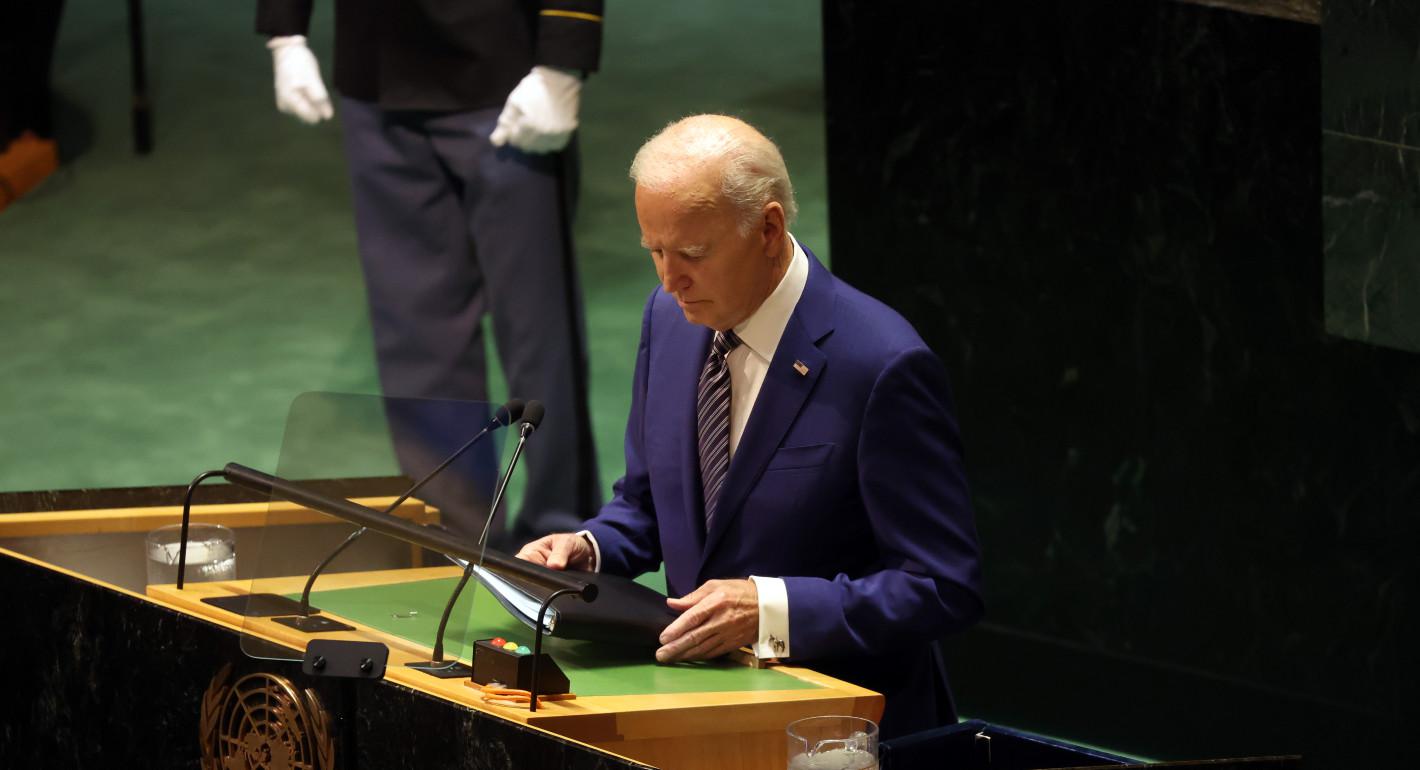
When U.S. President Joe Biden sits down with Israeli Prime Minister Benjamin Netanyahu on Wednesday in New York on the margins of the UN General Assembly opening, their private thoughts might not exactly reflect their public talking points.
“I wish Trump were president,” Netanyahu might be thinking.
“I can’t believe this guy’s still around,” Biden may muse. “Can’t Israel come up with a better prime minister?”
Smiles and warm words will almost certainly be on display. But those gestures will mask a growing divergence between a staunchly pro-Israel U.S. president and an Israeli prime minister. The latter is the longest serving in the country’s history, who is on trial for bribery, fraud, and breach of trust and who has become desperate to remain in power even at the expense of presiding over the most extreme and fundamentalist government in Israel’s history.
Nonetheless, Biden—driven by his own personal regard for Israel, domestic politics, and matters of state—isn’t prepared to go to war with Netanyahu or to fully embrace him. Indeed, Biden is the only president since Jimmy Carter who has not met an Israeli prime minister at the White House during an Israeli leader’s first year. A White House meeting might be possible by the year’s end if the judicial overhaul Netanyahu is pursuing goes into a deep freeze or if the Biden administration’s megadeal normalizing Israeli-Saudi relations—requiring Netanyahu’s close cooperation and concessions—moves forward.
For the Biden administration, after a rather easy relationship with the Bennett–Lapid rotational Israeli government, the inauguration of Netanyahu’s government in December was an unwelcome surprise. The Bennett–Lapid government— composed of parties from the right to the left, including the participation of an Israeli Arab party formally within the government—was risk-averse and cautious. Now, the new Netanyahu government is risk-ready in the extreme.
Netanyahu put together a coalition of right-wing religious Zionists and ultra-Orthodox parties, enabling him to return to power and perhaps find a way to undermine or even cancel his ongoing trial. His government—largely driven by the agendas of three right-wing extremist ministers—set into motion a series of radical policies designed to create and ensure permanent Israeli control of the West Bank and Jerusalem. On the domestic side, the coalition aimed to restructure the balance between the government and the judiciary, effectively ending any judicial oversight and an independent judiciary.
The threat to the judicial system produced the largest, most organized, and most sustained protests—now in their eighth month—in the history of Israel. Once seen as a cautious and careful reader of public opinion, Netanyahu now seems unchained, desperate, and hostage to a government he is responsibile for creating. Polls indicate that if elections were held today, Netanyahu could not form a government. He knows he has little choice but to go with the radicals—at least for now.
The last thing the Biden administration needed—given Russia’s invasion of Ukraine, a muscular China, and a busy legislative agenda—was a disruptive Israeli government, serious violence in the West Bank, or a major crisis with Iran on the nuclear issue. In several rare, public interventions and at least one more pointed call with the prime minister, Biden spoke out in favor of the common democratic values that bound Israel and the United States, in an implicit criticism of the Israeli government’s judicial overhaul. But by and large, the president allowed the Israelis in the streets to do the walking and the talking on what was seen to be a domestic issue.
Biden isn’t looking for a fight with Netanyahu but isn’t prepared to embrace him either. Three reasons stand out.
First, the president’s persona. The model here for Biden isn’t Barack Obama but Bill Clinton. Support—even love—of Israel is deeply embedded in Biden’s emotional DNA. His first instinct isn’t to confront Netanyahu but to find a way to work with him.
Second is domestic politics. Presidents don’t like to fight with Israeli prime ministers. It’s distracting, messy, awkward, and potentially politically costly. The Republican Party has set itself up as the Israel-Right-or-Wrong Party and is eager to paint Biden as anti-Israel. This is the last place the president wishes to be, especially entering what will likely be a close election running against a former president who styles himself as the most pro-Israel president ever.
And finally there’s policy. Netanyahu stands at the center on two issues: the Iran nuclear issue and Israel–Saudi Arabia normalization. One is potential crisis, and the other a major opportunity. And Biden needs Netanyahu’s cooperation on both.
All of this leads to one inescapable conclusion. Despite what divides them, neither Biden nor Netanyahu can afford a bad meeting. Netanyahu will press Biden on toughening U.S. policy on Iran, and Biden will look for Israeli concessions on the Palestinian issue that will help him sell a Saudi deal. Biden will also remind Netanyahu that his judicial overhaul needs to find a compromise solution, lest it impact the shared democratic values that bind the two countries together.
But all of this is largely performative. The readouts of the meeting may differ slightly, with the Israeli leader putting out a warmer, more effusive to tone. But no one will be fooled. Biden is increasingly frustrated and annoyed with Netanyahu, but the U.S.–Israel relationship is too big and important to fail. In the end, it seems Biden can’t live with Netanyahu, but he can’t live without him either.

Senior Fellow, American Statecraft Program
Aaron David Miller is a senior fellow at the Carnegie Endowment for International Peace, focusing on U.S. foreign policy.
Recent Work


Dara Massicot, Aaron David Miller, Andrew S. Weiss


Sophia Besch, Eric Ciaramella, Steve Feldstein, …
Carnegie does not take institutional positions on public policy issues; the views represented herein are those of the author(s) and do not necessarily reflect the views of Carnegie, its staff, or its trustees.

The EU can impose sanctions but struggles to enforce them without the United States. With Washington increasingly disinterested in backing European interests, the bloc must now fend for itself.


Nicu Popescu, Tiago Antunes
Global and rising powers will need to engage with Africa’s priorities and agency in order to secure the continent’s increasingly attractive partnerships.

Fonteh Akum

Rubio’s recent visit brought welcome attention, but more capital requires governance changes that may be a hard sell for regional governments.

Jennifer B. Murtazashvili

America’s foreign-policy objectives have grown more demanding while Americans have demanded greater focus on their own affairs.

Stephen Wertheim

Japan’s long-term security policy is driven by concerns about China, and there is little appetite for (or interest in) pursuing a confrontation with Moscow.

James D.J. Brown