

Commentary
Michael Pettis
{
  "authors": [
    "Michael Pettis"
  ],
  "type": "commentary",
  "centerAffiliationAll": "",
  "centers": [
    "Carnegie Endowment for International Peace",
    "Carnegie China"
  ],
  "collections": [
    "Carnegie China Commentaries"
  ],
  "englishNewsletterAll": "",
  "nonEnglishNewsletterAll": "",
  "primaryCenter": "Carnegie China",
  "programAffiliation": "",
  "programs": [],
  "projects": [
    "China’s Reform Imperative"
  ],
  "regions": [
    "China"
  ],
  "topics": [
    "Economy"
  ]
}
Source: Getty
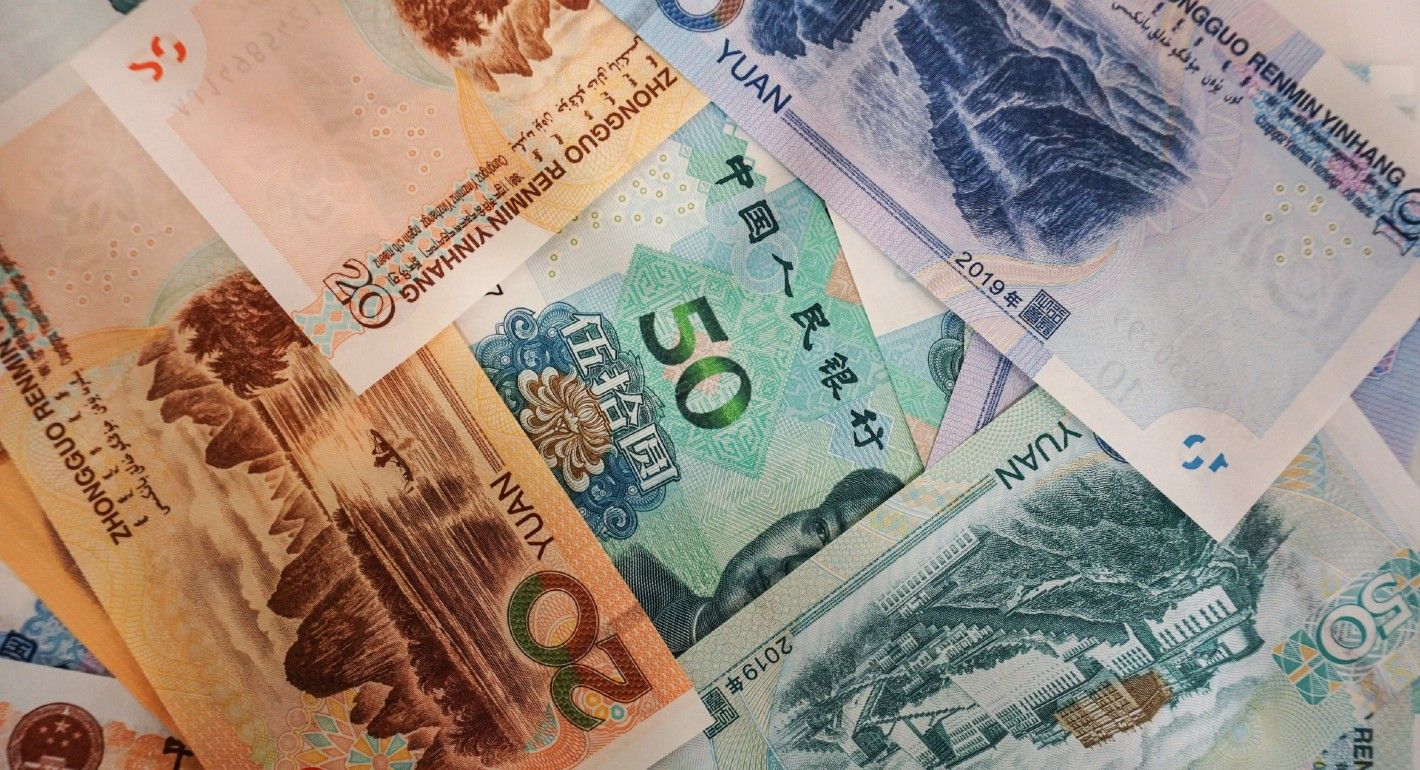
A quick look at the complexities behind Beijing’s enduring Catch-22 situation with revaluing the Renminbi, despite advantages of a stronger currency.
In a recent piece for the Financial Times, Gerard Lyons, a British economist who sits on the board of the Bank of China (UK), argued that China’s currency, the renminbi, is undervalued, and that by encouraging it to appreciate, China would help raise its international profile. While many analysts have made similar arguments, it is not at all clear that a rising renminbi would indeed increase its international role. Even though the renminbi rose steadily in the decade after July 2009, its international role during that time barely rose. In fact, it declined relative to the sharp rise in China’s share of global GDP and global trade.
There are nonetheless very good economic reasons for China to revalue its currency, along with reasons why a serious revaluation is likely to be difficult. In any economy, an appreciating currency effectively subsidizes consumption by reducing the price of imports, while taxing production by making production of tradable goods less competitive globally. With its persistent excess production and under-consumption, a revalued renminbi would help correct some of the deep structural distortions in the Chinese economy by shifting the distribution of total domestic income from businesses to households.
China’s excess production and under-consumption reflects the fact that, for the past three decades, income has shifted in the opposite direction—households have effectively subsidized the rest of the economy through a series of implicit and explicit transfers, including suppressed wage growth, low interest rates, overspending on logistical infrastructure, and an undervalued currency. These mechanisms all work the same way: they directly or indirectly transfer income away from the household sector to subsidize investment and manufacturing.
As these mechanisms force down the household share of GDP to some of the lowest levels seen in any country, they have also forced households to consume a declining share of everything they have produced. It is this very low household share of GDP that mainly explains China’s extraordinarily low consumption share of GDP.
In recent years, Beijing has increasingly recognized the nature of the problem. While it has pledged to do all it can to raise the consumption share of the country’s GDP, Beijing has been singularly unsuccessful in doing so, and for many of the same reasons that make it hard to revalue its currency. By allowing the renminbi to rise, Beijing would be redistributing income back to households and reorienting the economy in the direction it claims to want.
A stronger currency is exactly what the Chinese growth model has difficulty tolerating. The Chinese macroeconomic system is still deeply reliant on investment and manufacturing to drive growth. With the property sector still reeling, and local government infrastructure investment no longer able to absorb the economy’s excess capacity, China has pivoted toward manufacturing exports to maintain GDP growth. One result is that manufacturing plays a disproportionately large share in the Chinese economy.
That is why a stronger renminbi becomes a problem—it would erode the competitiveness of Chinese manufacturers just as Beijing has become more dependent on them for employment and economic activity. The critical point that analysts often miss is that China’s global manufacturing competitiveness and its very weak domestic consumption are not separate characteristics of the Chinese economy. Each is the flip side of the other—Chinese manufacturing competitiveness is the result of the same transfers that result in China’s very low household share of GDP, so that raising the latter is the same as undermining the former.
And while it would boost the role of domestic consumption in absorbing Chinese production, the risk is that at first a rising currency would reduce export demand more quickly than it increases domestic demand, mainly because the shift from export demand to domestic demand would require that factories retooled and redirected the goods they produced, something that could take years to complete. The result in the short term could be job losses, falling industrial profits, and renewed financial stress—particularly in heavily indebted manufacturing provinces.
There are additional constraints, both political and financial. If Beijing were to push the renminbi higher, there would likely be political pushback from powerful export-oriented interests who rely on currency competitiveness to stay afloat. Furthermore, should the People’s Bank of China sell foreign reserves to strengthen the currency, it would tighten liquidity and risk a rise in interest rates, which would further raise already-high debt servicing costs. In a country where debt-to-GDP is already over 300%, that kind of monetary tightening could have dangerous ripple effects.
However, none of this is to say that appreciation isn’t necessary. Like most other forms of rebalancing, it is very difficult to manage in the short term. In the long run, China must shift its growth model toward one in which domestic consumption plays a greater role, but the only sustainable way to increase the consumption share of GDP is to increase the relative GDP share of the household sector. This, in turn, requires shifting resources either from the business sector or from the government sector. The inherent problem is that the former would reduce economic growth in the short term, while the latter would almost certainly require changes in political institutions.
In the end, China’s currency dilemma reflects a broader truth: unsustainable models can persist for far longer than anyone expects, mainly because the costs of adjustment are immediate and the benefits generally accrue only over the longer term. But failure to adjust makes the overall system more fragile, further increasing the long-term costs of a failure to adjust while also further increasing the short-term costs of adjustment. As always with China, the right long-term policy is clear. What’s unclear is how—or whether—it will be politically feasible in the short term.

Nonresident Senior Fellow, Carnegie China
Michael Pettis is a nonresident senior fellow at the Carnegie Endowment for International Peace. An expert on China’s economy, Pettis is professor of finance at Peking University’s Guanghua School of Management, where he specializes in Chinese financial markets.
Recent Work
Michael Pettis
Michael Pettis

Russian strikes are weakening the economy sustaining Ukraine’s war effort. Closing the growing funding gap will require more European support and politically contentious reforms in Kyiv.

Balázs Jarábik

While the EU and European governments are embracing the much-lauded middle-power moment, this entails three difficult conundrums.

Richard Youngs

Europe is facing rising populism internally as well as external pressures from Russia, China, Turkey, and the United States.

Dimitar Bechev

Economic recovery has brought Sri Lanka a modicum of stability, but domestic strains and great-power rivalry could test how long it lasts.

Avinash Paliwal

Policy proposals on sovereign debt must both match the scale of the challenge and be implementable within existing political constraints.

David McNair