

Commentary
Huawei pushed hard to enter the Egyptian data centers market, until the Americans made a better offer.
Angie Omar
{
  "authors": [
    "Nguyễn Khắc Giang"
  ],
  "type": "commentary",
  "centerAffiliationAll": "",
  "centers": [
    "Carnegie Endowment for International Peace",
    "Carnegie China"
  ],
  "collections": [
    "Carnegie China Commentaries"
  ],
  "englishNewsletterAll": "",
  "nonEnglishNewsletterAll": "",
  "primaryCenter": "Carnegie China",
  "programAffiliation": "",
  "programs": [],
  "projects": [],
  "regions": [
    "China",
    "Southeast Asia"
  ],
  "topics": [
    "Military",
    "Foreign Policy"
  ]
}
Source: Getty
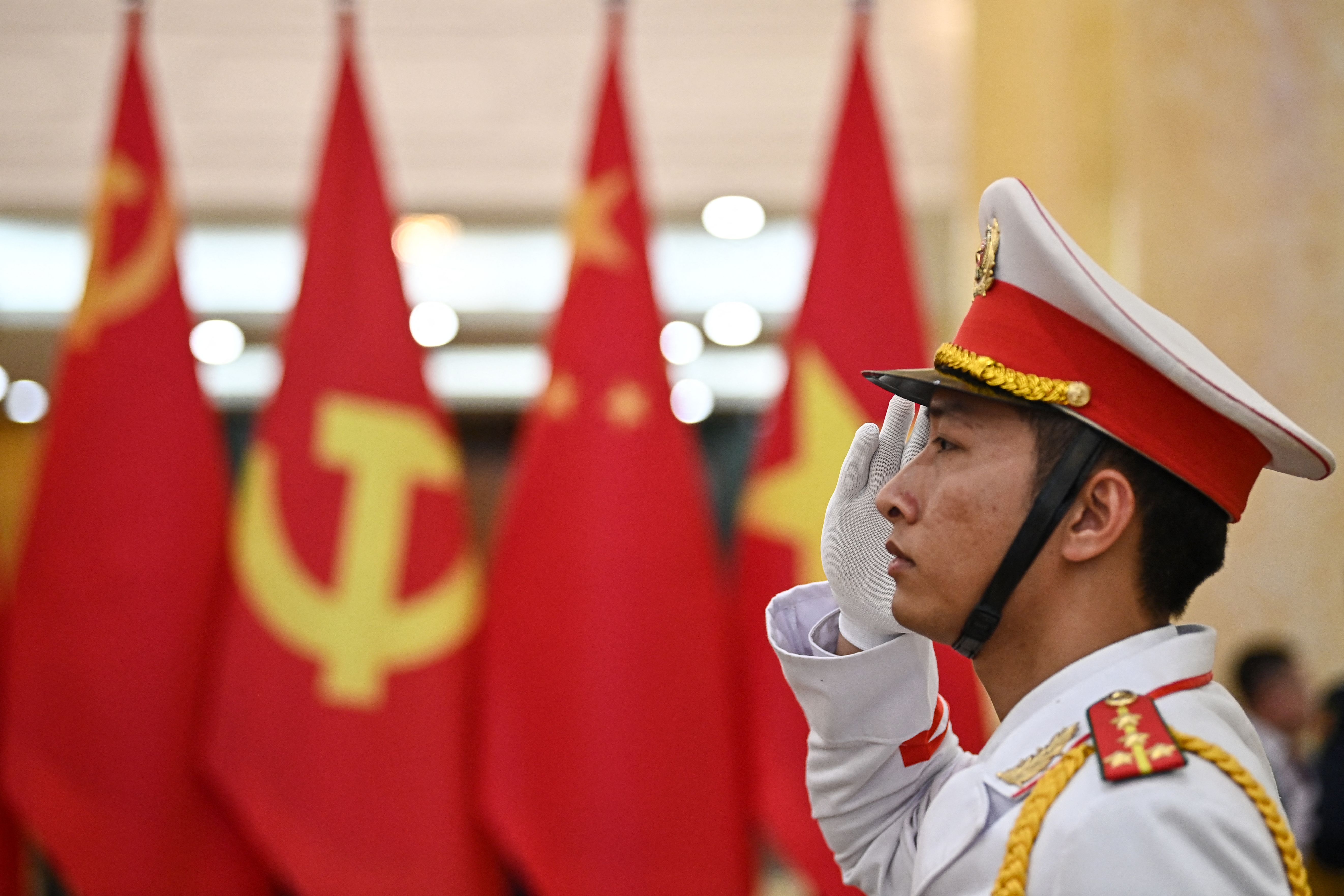
In July 2025, Vietnam and China held their first joint army drill, a modest but symbolic move reflecting Hanoi’s strategic hedging amid U.S.–China rivalry.
This publication is a product of Carnegie China. For more work by Carnegie China, click here.
This past July, Vietnamese and Chinese soldiers marched side by side for the first time since the two communist neighbors fought a short but brutal war in 1979. Officially named “Hand‑in‑Hand 2025” (携手同行2025 in Chinese and Chung tay đồng hành 2025 in Vietnamese), the two countries’ first-ever army training exercise took place from 22–30 July in China’s Guangxi Zhuang Autonomous Region. On the surface, it looked like a modest confidence‑building exercise focused on border patrol. Yet the event has generated debates because of what it might mean for Vietnam’s long‑standing hedging strategy in the growing U.S.–China rivalry. This piece works to interpret the military exercise and contextualize it within the evolving relationship between Hanoi and Beijing.
From the start, the location of the drill was intriguing. Guangxi, one of China’s autonomous regions, abuts Vietnam’s northern border and was a major staging area for the People’s Liberation Army during the 1979 border war. Hosting Vietnamese troops there sends a message about reconciliation and a desire to move beyond a conflict that still resonates in Vietnamese society. The two armies have held joint naval patrols in the Gulf of Tonkin since 2005 and have occasionally exchanged patrols along the land border, but never before had they conducted a joint army exercise. This makes “Hand‑in‑Hand 2025” a clear departure from past practice.
Understanding why Hanoi agreed to the drill requires unpacking its broader strategic calculus. Vietnamese security thinking has long been dualistic. In 2003, Vietnam’s National Security Strategy introduced the concepts of “partners” (đối tác) and “objects of struggle” (đối tượng) instead of the binary “friend or foe” approach used during the Cold War era. A country can be both a partner and an object of struggle depending on specific issues.
For Vietnam, China is a partner in regime security—an ideological ally that shares interests in resisting Western pressure—while simultaneously being a primary threat to national sovereignty because of maritime disputes and historical invasions. Conversely, the United States is a partner in balancing China’s regional dominance, yet it is viewed as a threat to regime security because of its promotion of human rights and democratic governance—suspected in Hanoi as a Western plot to destabilize the communist regime. This duality underpins what Sheena Chestnut Greitens and Isaac Kardon term security hybridization, in which Vietnam’s national security and regime security often pull in opposite directions with different partners.
Viewed through this lens, Hand-in-Hand 2025 was largely performative, but it also marked a modest upgrade in Vietnam–China defense ties.
On the ground, Chinese accounts suggest the two sides trained together on practical tasks, with Vietnamese troops operating Chinese drones, light weapons, and vehicles—exercises that went beyond handshake diplomacy and could enhance small-unit interoperability. Still, the scale was deliberately modest: just 140 soldiers and some twenty vehicles were involved. The contrast in coverage was equally revealing—muted reports in Hanoi’s tightly controlled press versus positive headlines in Beijing.
Caution drove these choices. Vietnam’s “bamboo diplomacy” hinges on flexibility without compromising autonomy, codified in the “Four Nos”: No military alliances, no foreign bases, no siding with one power against another, and no use or threat of force. Hanoi has historically dialed up defense cooperation with China only during moments of domestic strain or when seeking to blunt Beijing’s reaction to closer ties with Washington—such as the 2023 “double upgrade” that elevated the U.S. to parity with China in Vietnam’s diplomatic hierarchy. By that logic, the 2025 drill was a low-cost way to reassure Beijing without breaching Vietnam’s non-alignment commitments.
The broader context also matters. During Vietnamese Communist Party chief To Lam’s visit to Beijing in August 2024 and Chinese President Xi Jinping’s return trip to Hanoi in April 2025, the two sides proclaimed themselves “comrades and brothers,” signed dozens of agreements, and launched a “3+3” dialogue mechanism linking diplomacy, defense, and public security. Hanoi even signed onto Xi’s Community with a Shared Future as well as China’s Global Security and Civilization Initiatives—one of the last Southeast Asian countries to do so. Against this backdrop, the July exercise underscored that the once-frosty neighbors are inching toward greater strategic trust.
But the most significant cooperation is occurring far from military training grounds. Vietnamese security officials make no secret of their admiration for Chinese surveillance capabilities. Vietnam’s 2018 Cybersecurity Law mirrors Chinese legislation, requiring foreign tech companies to store data domestically while granting authorities sweeping censorship powers. Various Vietnamese government regulations in the past decade have severely restricted foreign funding while subjecting NGOs to intrusive oversight, that directly echoes Beijing’s civil society crackdown. High-level delegations from Vietnam’s Ministry of Public Security, Central Internal Affairs Commission, and Central Inspection Commission regularly visit China to study surveillance techniques and political control methods, with Chinese security officials making reciprocal visits to share expertise. This authoritarian learning network represents far deeper integration than occasional military exercises.
Yet domestic constraints limit how far Hanoi can tilt toward Beijing. Overseas Vietnamese media have condemned the drill as “attempting to erase historical memory,” questioning whether the government was sanitizing history by training alongside Chinese troops in areas once used to stage an invasion of Vietnam. Inside the country, public reaction was muted—unsurprising in an environment of tight internet controls—but social media still showed hints of dissatisfaction.
In Vietnam, where nationalism often substitutes for political participation and is frequently expressed as thoát Trung (“escaping China’s orbit”), such sentiments matter. The Communist Party of Vietnam’s legitimacy rests partly on its role as a defender of Vietnamese sovereignty against foreign aggression—historically, principally, Chinese aggression. Too visible an embrace of Beijing risks undermining this carefully constructed narrative.
In addition, the South China Sea dispute casts the longest shadow over any military cooperation. China’s nine-dash line encompasses 80% of the South China Sea, including large swaths of Vietnam's exclusive economic zone. Beijing’s coercive tactics have escalated—Chinese Coast Guard vessels regularly harass Vietnamese fishing boats and survey ships near disputed features, with enforcement authorities attacking Vietnamese fishermen as recently as October 2024. China’s militarization of artificial islands and declaration of the South China Sea as a “core interest” directly threatens Vietnam’s economic lifelines and sovereignty. Neither side shows any willingness to compromise on fundamental sovereignty claims, this structural conflict places a hard ceiling on the deepening of military cooperation between the two countries—Vietnam cannot participate in extensive joint exercises that might legitimize Chinese maritime positions without undermining its own claims and alarming fellow ASEAN claimants.
Vietnam’s defense focus lies elsewhere: Diversifying partnerships to avoid dependence on any single power. During To Lam’s recent Seoul visit, Hanoi made its first major arms purchase from South Korea—$250 million worth of K-9 self-propelled howitzers. This marks a significant shift from traditional reliance on Russian weaponry, which still comprises around 80 percent of Vietnam’s arsenal. The message is unmistakable: Vietnam will modernize its military on its own terms, drawing from multiple sources to maintain strategic autonomy.
Nevertheless, for Washington—viewing Vietnam as a pivotal “swing state” in Asia—the drill was a reality check. Vietnam will not choose sides in any scenario short of direct Chinese aggression. President Trump’s mix of tariff pressure and diminished security commitments in the region has weakened U.S. leverage, stripping away economic incentives while offering little strategic reassurance. Vietnam’s position reflects a wider middle-power dilemma in the Indo-Pacific: How to preserve autonomy and avoid bandwagoning with either camp in an increasingly uncertain environment. Beijing, meanwhile, is well placed to exploit any openings with counteroffers of its own.
Looking ahead, we should expect more of this carefully calibrated engagement. Vietnam will likely keep small-scale exercises with China while simultaneously deepening maritime cooperation with the U.S. and its regional allies like Japan, South Korea, and Australia—vindicating its security hybridization.
Meanwhile, Chinese commentators have suggested institutionalizing land exercises to complement long-standing naval patrols in the Gulf of Tonkin. If future drills expand beyond border security to include combined arms maneuvers or air-defense training, that would signal a substantive shift. But given the structural constraints—domestic skepticism, maritime disputes, and Vietnam’s commitment to strategic autonomy—this scenario seems unlikely.
What “Hand-in-Hand 2025” ultimately reveals is not Vietnam choosing sides but rather the sophisticated hedging strategy that Southeast Asian states must strengthen in an era of renewed great power competition. The exercise also reflects the trajectory of Vietnam’s foreign policy under its new leadership. Unlike Nguyen Phu Trong—the doctrinal custodian of party orthodoxy—To Lam comes out of the security apparatus but governs as a pragmatic operator. His deep security background might suggest closer alignment with Beijing—and indeed, the drill occurred on his watch after his August 2024 Beijing visit. Yet Lam is much less constrained by Marxist-Leninist orthodoxy than his predecessor. His marquee narrative of an “Era of National Rise” casts foreign policy as an instrument of national strength, not ideological alignment.
This shift matters. Where Trong saw ideology as paramount, often deferring to Beijing on matters of communist solidarity, Lam appears to view China through a more transactional lens: useful for regime security techniques, dangerous as a regional hegemon, valuable as an economic partner, but never to be trusted completely. The modest scale of the July drill reflects this calculation. Lam wants Chinese cooperation without Chinese dominance, American investment without American influence, Russian weapons without Russian dependence.
Hanoi’s communist leadership understands something Washington often forgets: In Asia’s interconnected landscape, exclusive partnerships are luxuries that countries like Vietnam cannot afford. Its turbulent history—centuries of resisting Chinese domination, decades of war with France and America, a brief but traumatic border conflict with China—has taught harsh lessons about the costs of becoming anyone’s proxy. Under Lam’s pragmatic nationalism, Vietnam is expected to be even more assertive in extracting maximum benefit from all sides while committing to none. The hand extended to China in July was firm enough to signal cooperation but light enough to withdraw when needed.
For Washington, this presents both opportunities and challenges. The new Vietnam will likely prove a more transactional but also more predictable partner—one that considers interests on issue by issue rather than through ideological lenses. While this rules out the anti-China alliance some American strategists envision, it also opens space for deeper cooperation where interests genuinely align: supply chain resilience, maritime security, technological development.
This recalibration actually serves U.S. interests better than Washington might initially recognize. A Vietnam that maintains working relationships with Beijing while strengthening its own capabilities contributes more to regional balance than one forced into explicit alignment that could trigger Chinese preemptive pressure. In a multipolar Asia, where middle powers increasingly write their own scripts, Vietnam’s strategic autonomy—frustrating as it may sometimes seem—creates more room for maneuver than rigid blocs. The question isn’t whether Vietnam will side with America against China, but whether Washington can adapt to a partnership model where shared interests, not shared adversaries, drive cooperation.

Nguyễn Khắc Giang
Visiting Fellow, ISEAS–Yusof Ishak Institute
Nguyễn Khắc Giang is a visiting fellow with the Vietnam Studies Programme at the ISEAS – Yusof Ishak Institute in Singapore and previously head of the Political Research Unit at the Vietnam Institute for Economic and Policy Research in Hanoi.
Carnegie does not take institutional positions on public policy issues; the views represented herein are those of the author(s) and do not necessarily reflect the views of Carnegie, its staff, or its trustees.

Huawei pushed hard to enter the Egyptian data centers market, until the Americans made a better offer.

Angie Omar

The books, podcasts, and films that explain the world it made.

Andrew Leber
U.S. trading partners in Asia are closely watching the dispute for signs of how it may affect their own interests.

Barbara Weisel

The aftermath of the Ceuta crisis shows Europe has drawn the wrong lessons. Rather than doubling down on failed migration policies, the EU needs to address the underlying roots of such episodes.

Richard Youngs
By abandoning past U.S. pro-democracy policies and adopting several lines of pro-autocratic action, the Trump administration has fundamentally repositioned the United States vis-à-vis democracy in the world.

Thomas Carothers