

Event
January 14, 2026
{
  "authors": [
    "Nathalie Tocci",
    "Jan Techau"
  ],
  "type": "commentary",
  "centerAffiliationAll": "",
  "centers": [
    "Carnegie Endowment for International Peace",
    "Carnegie Europe"
  ],
  "englishNewsletterAll": "",
  "nonEnglishNewsletterAll": "",
  "primaryCenter": "Carnegie Europe",
  "programAffiliation": "",
  "programs": [],
  "projects": [
    "Europe Head-to-Head"
  ],
  "regions": [
    "United States",
    "Europe"
  ],
  "topics": [
    "EU",
    "Foreign Policy",
    "Defense",
    "Security",
    "NATO",
    "Trade",
    "Military",
    "Nuclear Policy"
  ]
}
Source: Getty
In Donald Trump’s second term in office, the transatlantic relationship that helped define the postwar European project and global order appears broken. Is it time for Brussels to chart its own path?
Director, Istituto Affari Internazionali & Professor of Practice, Johns Hopkins SAIS
Europe clearly cannot trust the United States under President Donald Trump. Beyond this, Brussels should arguably not trust the country as long as it is led by any representative of the Make America Great Again (MAGA) movement, even after the current administration ends. However, while the transatlantic relationship has changed permanently and Washington can no longer be relied upon, this does not mean that America cannot be trusted again in future.
Trump’s imperial ambitions in the Western hemisphere have been made amply clear by the toppling of Venezuela’s authoritarian leader Nicolas Maduro, threats against other Latin American countries, as well as the increasingly aggressive remarks made about Greenland. His disdain for alliances is also well known: He shows little regard for NATO and its founding principle of collective defense. His sympathy and admiration for Russia and its President Vladimir Putin—Europe’s adversary—are also evident, demonstrated by his unabashed support for Moscow in its imperial war against Ukraine. There is an even more acute disregard for the EU, which Trump believes was founded with the purpose of “screwing” the United States. Indeed, a united and integrated Europe cannot be as easily subjugated as a collection of divided countries. It is no surprise, then, that Trump has backed those far-right parties and governments that, under the false promise of nationalism, have championed the hollowing out of the European project.
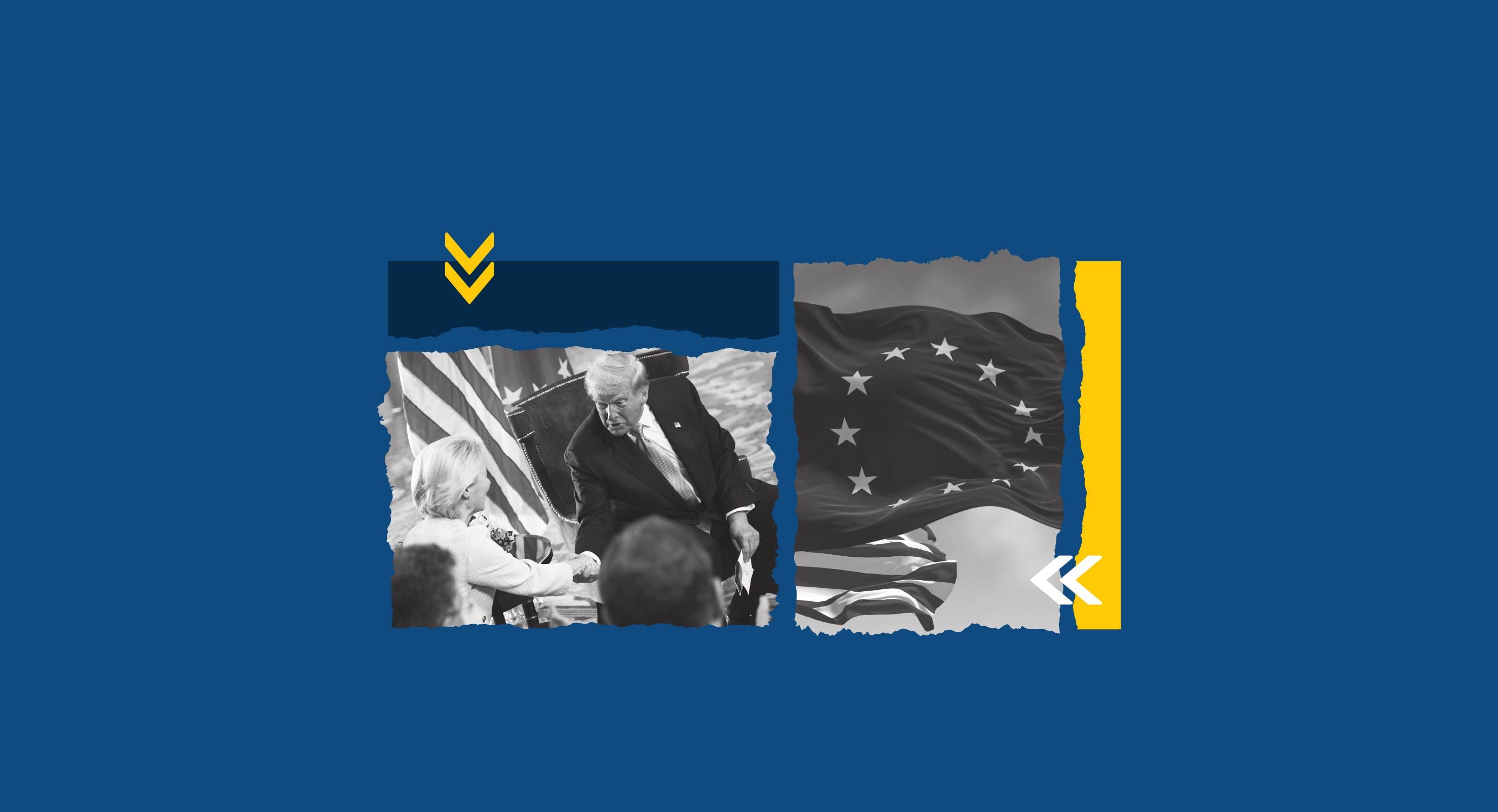
The president’s delight in blackmailing a weak and divided Europe—even in areas like trade where unity should have been strongest—was encapsulated in the sorry scene of European Commission President Ursula von der Leyen uneasily smiling next to a gleeful Trump in Turnberry, Scotland, after he had imposed a shockingly unfair deal on the EU. Regardless of what Trump may say or promise to Europeans, it would be madness for them to trust him.
Beyond the narcissism and whims of the president, however, lies the wider contempt the MAGA movement holds toward Europe. This was best illustrated by the Signal scandal in the early months of the administration, where private group chats between senior officials revealed deep antipathy. For MAGA, helping the EU is not just a low priority; it is actively resented and resisted, even when transatlanticism is recognized as being in the United States’ own national interest. As long as the nationalist populism embodied by the movement is in power, Washington cannot be trusted.
Yet nothing lasts forever, and both Trump and his movement will one day fade. Will Europe be able to trust the United States then, as it has over the past eight decades? It would be naïve to believe so without significant changes. Europe and America may remain friends—even partners—in the future, but the transatlantic societal, political, economic, and security ties have profoundly changed. In this respect, Trump and MAGA should be seen both as a symptom and an accelerator of a structural trend. The United States is no longer the world’s hegemon: its relative power has declined, and its security priorities now lie elsewhere. Europe, meanwhile, will remain primarily concerned with its own continent, Africa, and western Asia for years to come.
The distancing and disengagement of the United States from Europe—especially in matters of security—are here to stay. But while Washington may no longer be the continent’s main security provider or guarantor, this does not mean it cannot be trusted in the future. If priorities are communicated clearly, commitments (even if downscaled) are honored, and joint action is pursued in areas of common concern, trust may—and likely will—be reestablished. But that time is not now. All Europeans can do for the moment is work toward their own autonomy, which is also the necessary, albeit insufficient, condition to make a future trust-based relationship possible.
Director, Europe Team, Eurasia Group
For the moment, the answer to the question is no. Europe cannot trust the United States again. But nothing is ever static in international affairs. U.S. policy will eventually change, and trust can perhaps return over time. The more decisive question for Europeans is another one: can they trust each other?
Trust is the crucial ingredient in international alliances and large-scale systems of order. Its absence devalues all parts of a relationship, undermines the system’s credibility, and renders it obsolete over time. The once rock-solid interest of the United States in keeping Europe stable, free, and within its sphere of influence was a fundamental tenet of Washington’s foreign policy, underpinned by a bipartisan domestic consensus and reinforced by deep historical and cultural ties. It was also the primary source of trust in the transatlantic relationship for eight decades.
Today, it is unclear whether the United States remains strongly interested in “owning” Europe. American conventional and nuclear assets remain in Europe, but their presence has been—and will likely continue to be—reduced despite the continent’s apparent inability to fully guarantee its own security and defense. More importantly, Trump (in a textbook divide-and-conquer move) has openly declared his goal to undermine and destroy the EU and has waged a destructive trade war to this end. Washington openly supports illiberal, ethno-nationalist movements across the continent aiming at undermining democratic, pluralistic, and inclusive institutions and policies.
As a consequence, trust across the Atlantic has eroded. What is left of European trust in America’s security guarantee is mostly based on sheer necessity. As long as the continent remains dependent on U.S. military services for its own security, no alternative protection and deterrence can be created. So rhetorically, governments reconfirm traditional transatlantic creeds knowing full well that Trump could throw them under the bus at any moment. In the meantime, they hope to build up their own militaries quickly enough to establish a degree of independence that would make the United States less relevant.
We are nowhere near that moment, so this diplomatic spectacle will continue for some time to come. The only positive aspect is that Europe’s largest adversaries—Russia and China—who cannot wait to fill the vacuum a U.S. withdrawal would create, cannot be entirely certain themselves to what extent Washington is already gone. Strategic ambiguity is what keeps Europe safe, not trust based on reliability.
But that is not the end of the story. The one thing Europeans can fully trust is that Trumpism will fail. Killing an international trade system that gave you huge advantages is a failing policy. Throwing away an empire and all its tools and insignia, from soft power to multilateral institutions, from diplomatic craftsmanship to development aid, from universities to Radio Free Europe, is not a winning proposition. Making adversaries like Russia and China more powerful is self-defeating.
MAGA-Trumpism in its current, most radical form has a few more years to run, but it is already losing steam. After a period of doubling down on a losing bet, the United States will begin to reassess. Sober policy analysis will likely replace spiteful anger as the key policy driver.
Then, if there is a Europe left that can play (and that Washington can rely on), transatlantic relations can restart and trust can be rebuilt. It will, of course, never be the same again, but a renewed realization that we are in this fight together could unleash a new spirit and power.
In the meantime, there is an even more pressing question for the Europeans: Can they trust one another? The historic answer to this has regularly been no. Europe has always been a low-trust environment. The EU is no evidence to the contrary. Europeans were only able to build their wondrous and historically unprecedented integration project because the United States, by being the continent’s dominant military power, had removed the oldest question of all: who is Europe’s hegemon?
Europeans must now answer that question in a way that does not reawaken old rivalries and jealousies. Can we avoid falling back into old habits? If not, Europe as a political concept and institutional setup will disappear. Ultimately, internal trust is more important than trust in the United States.

Nathalie Tocci
Professor of Practice, Johns Hopkins SAIS
Tocci is professor of practice at Johns Hopkins SAIS. She has been Special Advisor to EU High Representatives Federica Mogherini and Josep Borrell. In that capacity, she wrote the European Global Strategy and worked on its implementation.

Director, Europe Team, Eurasia Group
Techau is director with Eurasia Group's Europe team, covering Germany and European security from Berlin. Previously, he was director of Carnegie Europe.
Carnegie does not take institutional positions on public policy issues; the views represented herein are those of the author(s) and do not necessarily reflect the views of Carnegie, its staff, or its trustees.
The U.S. midterm elections signal the opening of a narrow window for bold Saudi diplomacy on Palestine.


Andrew Leber, Zaha Hassan

A leak of Russian gas price data helps establish that China is paying Russia far less than Central Asian countries and Gazprom’s former European customers.

Sergey Vakulenko

The EU can impose sanctions but struggles to enforce them without the United States. With Washington increasingly disinterested in backing European interests, the bloc must now fend for itself.


Nicu Popescu, Tiago Antunes
Global and rising powers will need to engage with Africa’s priorities and agency in order to secure the continent’s increasingly attractive partnerships.

Fonteh Akum

Rubio’s recent visit brought welcome attention, but more capital requires governance changes that may be a hard sell for regional governments.

Jennifer B. Murtazashvili