• Research
  • Emissary
  • About
  • Experts
Carnegie Global logoCarnegie lettermark logo
DemocracyIran
  • Donate
Confronting the Weakest Link: Aiding Political Parties in New Democracies
Book

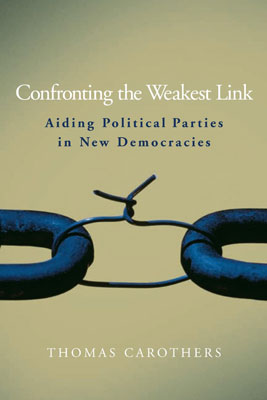
Confronting the Weakest Link: Aiding Political Parties in New Democracies

Political parties are the weakest link in many democratic transitions around the world—frequently beset with persistent problems of self-interest, corruption, ideological incoherence, and narrow electoralism. Thomas Carothers draws on extensive field research to diagnose deficiencies in party aid, assess its overall impact, and offer practical ideas for doing better.

Link Copied
By Thomas Carothers
Published on Oct 23, 2006

Additional Links

IndexChapter OneTable of ContentsBook Review in International Politics and SocietyHardback - $57.95Kindle - $11.99Nook - $10.43Paperback - $22.95iTunes - $11.99
Program mobile hero image

Program

Democracy, Conflict, and Governance

The Democracy, Conflict, and Governance Program is a leading source of independent policy research, writing, and outreach on global democracy, conflict, and governance. It analyzes and seeks to improve international efforts to reduce democratic backsliding, mitigate conflict and violence, overcome political polarization, promote gender equality, and advance pro-democratic uses of new technologies.

Learn More

Source: Washington

Political parties are the weakest link in many democratic transitions around the world—frequently beset with persistent problems of self-interest, corruption, ideological incoherence, and narrow electoralism.  A large and ever-growing number of U.S., European, and multilateral assistance programs seek to help parties become effective prodemocratic actors.  But given the depth of the problems, is success possible?

Confronting the Weakest Link is a pathbreaking study of international aid for political parties.  Beginning with a penetrating analysis of party shortcomings in developing and postcommunist countries, Thomas Carothers draws on extensive field research to diagnose deficiencies in party aid, assess its overall impact, and offer practical ideas for doing better.  This broad ranging analysis, which spans Latin America, Central and Eastern Europe, the former Soviet Union, Africa, the Middle East, and Asia, sheds invaluable light on a major element of the contemporary challenge of democracy-building, a subject now occupying center stage in the international policy arena.

Thomas Carothers is vice president for international politics and governance at the Carnegie Endowment for International Peace and founder and director of the Endowment’s Democracy and Rule of Law Project.
 

Advance Praise

"Carothers brings an extremely detailed and informed perspective to the topic. Highly recommended."
—CHOICE

"This book is a required reading for all who deal with the assistance of parties and democracies, no matter if scientifically or practically."
—International Politics and Society

"Confronting the Weakest Link is the first systematic, independent assessment of the burgeoning field of international aid to political parties. Carothers’ masterful, searching account is critical and sobering, yet also sympathetic and constructive."
—Larry Diamond, Hoover Institution, Stanford University

"A timely, original study that illuminates not only international aid for political parties but also the dynamics of political party development generally. Carothers goes well beyond the standard laments and prescriptions about the troubled state of political parties in the world to offer new insights and approaches that will stir scholars and provoke practitioners."
—Christopher Sabatini, Americas Society/Council of the Americas

About the Author

Thomas Carothers

Harvey V. Fineberg Chair for Democracy Studies; Director, Democracy, Conflict, and Governance Program

Thomas Carothers, director of the Carnegie Endowment for International Peace’s Democracy, Conflict, and Governance Program, is a leading expert on comparative democratization and international support for democracy.

    Recent Work

  • Commentary
    When Do Mass Protests Topple Autocrats?
      • McKenzie Carrier

      Thomas Carothers, McKenzie Carrier

  • Article
    The Trump Administration’s Tangled Talk About Democracy Abroad
      • McKenzie Carrier

      Thomas Carothers, McKenzie Carrier

Thomas Carothers
Harvey V. Fineberg Chair for Democracy Studies; Director, Democracy, Conflict, and Governance Program
Thomas Carothers
Middle EastCaucasusEastern EuropeBelarusPolitical ReformDemocracy

Carnegie does not take institutional positions on public policy issues; the views represented herein are those of the author(s) and do not necessarily reflect the views of Carnegie, its staff, or its trustees.

More Work from Carnegie Endowment for International Peace

  • Heavily armed security personnel standing atop an armored vehicle
    Commentary
    Emissary
    When Do Mass Protests Topple Autocrats?

    The recent record of citizen uprisings in autocracies spells caution for the hope that a new wave of Iranian protests may break the regime’s hold on power.

      • McKenzie Carrier

      Thomas Carothers, McKenzie Carrier

  • Commentary
    Strategic Europe
    The EU Needs a Third Way in Iran

    European reactions to the war in Iran have lost sight of wider political dynamics. The EU must position itself for the next phase of the crisis without giving up on its principles.

      Richard Youngs

  • High-tech data center with server racks
    Article
    The Architecture of Digital Repression

    Internet service providers can facilitate internet access but also draconian control.

      Irene Poetranto

  • Commentary
    Carnegie Politika
    Georgia’s Fall From U.S. Favor Heralds South Caucasus Realignment

    With the White House only interested in economic dealmaking, Georgia finds itself eclipsed by what Armenia and Azerbaijan can offer.

      Bashir Kitachaev

  • Crowds holding Iranian flags and photos of the late Khamenei
    Commentary
    Emissary
    Who Will Be Iran’s Next Supreme Leader?

    If the succession process can be carried out as Khamenei intended, it will likely bring a hardliner into power.

      • Eric Lob

      Eric Lob

Get more news and analysis from
Carnegie Endowment for International Peace
Carnegie global logo, stacked
1779 Massachusetts Avenue NWWashington, DC, 20036-2103Phone: 202 483 7600Fax: 202 483 1840
  • Research
  • Emissary
  • About
  • Experts
  • Donate
  • Programs
  • Events
  • Blogs
  • Podcasts
  • Contact
  • Annual Reports
  • Careers
  • Privacy
  • For Media
  • Government Resources
Get more news and analysis from
Carnegie Endowment for International Peace
© 2026 Carnegie Endowment for International Peace. All rights reserved.