• Research
  • Emissary
  • About
  • Experts
Carnegie Global logoCarnegie lettermark logo
DemocracyIran
  • Donate
European Conflict Management in the Middle East: Toward a More Effective Approach

Source: Getty

Paper
Malcolm H. Kerr Carnegie Middle East Center

European Conflict Management in the Middle East: Toward a More Effective Approach

For the EU to be an effective player in the Middle East, it should seek an efficient division of labor with the United States and pursue greater political engagement in the Palestinian territories, Syria, and Lebanon.

Link Copied
By Muriel Asseburg
Published on Mar 5, 2009

Additional Links

Full Text - English
Program mobile hero image

Program

Middle East

The Middle East Program in Washington combines in-depth regional knowledge with incisive comparative analysis to provide deeply informed recommendations. With expertise in the Gulf, North Africa, Iran, and Israel/Palestine, we examine crosscutting themes of political, economic, and social change in both English and Arabic.

Learn More

Although Europe actively tries to manage Middle East crises it undermines its economic, political, and security interests by assuming a secondary role to the United States and following its policy line. For the EU to be an effective player in the Middle East peace process, it must pursue greater political engagement on three tracks: the Palestinian territories, Syria, and Lebanon.

Drawing on interviews with EU delegations and European embassies as well as a wealth of local actors in Lebanon, Syria, and the Palestinian territories, Muriel Asseburg assesses Europe’s on the ground efforts in conflict management and recommends a more effective European approach to the Arab–Israeli conflict.

Key Conclusions:

  • The Israeli–Palestinian negotiations must be the EU’s main priority in the region. The EU should support Palestinian efforts to reach a new power-sharing agreement and send clear signals that it is ready to cooperate with a Palestinian consensus government backed by all factions, including Hamas.
     
  • Efforts should concentrate on re-opening Gaza’s border crossings to allow for humanitarian aid, reconstruction, and a sustained economic upturn.
     
  • The EU should move towards ratification of its Association Agreement with Syria and encourage Israeli–Syrian talks, but recognize that U.S. security guarantees are essential for moving the talks forward.
     
  • The EU should not push for direct negotiations on the Israeli–Lebanon track. Rather, it should work on Syrian–Lebanese relations and push for an early exchange of ambassadors between Damascus and Beirut, for border demarcation, and cooperation on border control.

Asseburg concludes:

“It is time for Europeans to rethink their policy approaches, refocus their activities, and seek a more effective coordination and division of labor with the new U.S. administration. Not only are intensified efforts needed to reinvigorate the Israeli–Palestinian negotiations, Europeans should also stand ready to help advance the other tracks of the peace process. In the end, for Europeans, it is not about claiming a role as a ‘player,’ but about assuming that role and engaging in politics.”
 

About the Author

Muriel Asseburg

Former Visiting Scholar, Middle East Center

Asseburg's current research focuses on the Middle East conflict, German and Middle East politics, the Euro–Mediterranean Partnership, and state building, political reform, and political Islam in the Middle East. She was previously with the Friedrich Ebert Foundation’s office in Jerusalem.

    Recent Work

  • Other
    Governing Gaza After the War: The International Perspectives
      • +4

      Ilana Feldman, Frederic Wehrey, Andrew Bonney, …
  • Commentary
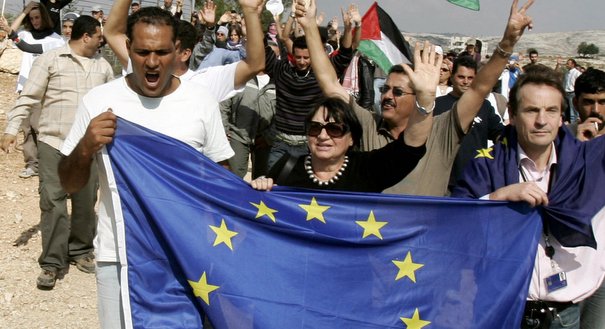
    Engaging Europe on Behalf of Middle East Peace

      Muriel Asseburg

Muriel Asseburg
Former Visiting Scholar, Middle East Center
Muriel Asseburg
North AmericaUnited StatesMiddle EastIsraelLebanonPalestineSyriaWestern EuropeUnited KingdomFranceGermany

Carnegie does not take institutional positions on public policy issues; the views represented herein are those of the author(s) and do not necessarily reflect the views of Carnegie, its staff, or its trustees.
More Work from Carnegie Endowment for International Peace

  • Satellite of a damaged oil refinery
    Commentary
    Emissary
    Iran Is Pushing Its Neighbors Toward the United States

    Tehran’s attacks are reshaping the security situation in the Middle East—and forcing the region’s clock to tick backward once again.

      Amr Hamzawy

  • A boat, with smoke in the background
    Commentary
    Emissary
    The Gulf Monarchies Are Caught Between Iran’s Desperation and the U.S.’s Recklessness

    Only collective security can protect fragile economic models.

      • Andrew Leber

      Andrew Leber

  • Commentary
    Sada
    Duqm at the Crossroads: Oman’s Strategic Port and Its Role in Vision 2040

    In a volatile Middle East, the Omani port of Duqm offers stability, neutrality, and opportunity. Could this hidden port become the ultimate safe harbor for global trade?

      Giorgio Cafiero, Samuel Ramani

  • Commentary
    Strategic Europe
    Europe on Iran: Gone with the Wind

    Europe’s reaction to the war in Iran has been disunited and meek, a far cry from its previously leading role in diplomacy with Tehran. To avoid being condemned to the sidelines while escalation continues, Brussels needs to stand up for international law.

      Pierre Vimont

  • Photo of cracked dry earth.
    Article
    Lessons Learned from the Biden Administration’s Initial Efforts on Climate Migration

    In 2021, the U.S. government began to consider how to address climate migration. The outcomes of that process offer useful takeaways for other governments.

      • Jennifer DeCesaro

      Jennifer DeCesaro

Get more news and analysis from
Carnegie Endowment for International Peace
Carnegie global logo, stacked
1779 Massachusetts Avenue NWWashington, DC, 20036-2103Phone: 202 483 7600Fax: 202 483 1840
  • Research
  • Emissary
  • About
  • Experts
  • Donate
  • Programs
  • Events
  • Blogs
  • Podcasts
  • Contact
  • Annual Reports
  • Careers
  • Privacy
  • For Media
  • Government Resources
Get more news and analysis from
Carnegie Endowment for International Peace
© 2026 Carnegie Endowment for International Peace. All rights reserved.