• Research
  • Emissary
  • About
  • Experts
Carnegie Global logoCarnegie lettermark logo
DemocracyIran
  • Donate
The Political Challenge of Yemen's Southern Movement

Source: Getty

Paper

The Political Challenge of Yemen's Southern Movement

Yemen’s secessionist Southern Movement threatens the country’s stability, but a military campaign against it would only further inflame its supporters and increase support for al-Qaeda in the Arabian Peninsula. A political solution is required.

Link Copied
By Stephen Day
Published on Mar 23, 2010

Additional Links

Full Text
Program mobile hero image

Program

Middle East

The Middle East Program in Washington combines in-depth regional knowledge with incisive comparative analysis to provide deeply informed recommendations. With expertise in the Gulf, North Africa, Iran, and Israel/Palestine, we examine crosscutting themes of political, economic, and social change in both English and Arabic.

Learn More

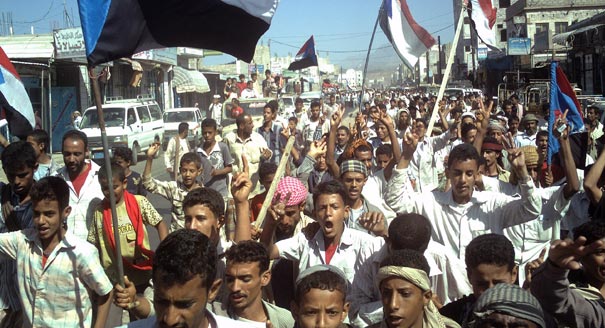
Yemen’s secessionist Southern Movement is undergoing a radical transformation that threatens the country’s stability. But a military campaign against the movement would only further inflame its supporters and increase support for al-Qaeda in the Arabian Peninsula. A political solution is required that addresses the unresolved problems from the country’s poorly-executed unification in the early 1990s.

Map: Yemen

Map of Yemen
  • view map
Map of Yemen showing current governorate boundaries and former North/South boundary.

Key Conclusions:

  • The demands of the southern leaders were originally moderate calls for equality, but a severe response from Yemeni President Saleh (who used government media to create scandals about the movement’s leaders and arrested religious figures) pushed the movement to demand secession.
     
  • Al-Qaeda’s leader in Yemen, Nasser al-Wahayshi, has declared support for the Southern Movement, but Southern leaders have thus far rejected his endorsement.
     
  • The primary problem in the South is not links between al-Qaeda and the Southern Movement, but unrest fueled by widespread opposition to the government and the perception of economic exploitation by the military and security forces.  

Policy Recommendations:

  • Arab leadership. Arab countries should lead the push for Yemen’s government to negotiate with southerners, improve economic development, and begin national reconciliation. Western-backed initiatives will only increase mistrust of the central government.
     
  • Reconciliation. Yemen’s government and representatives of the Southern Movement should commence national reconciliation talks. The talks must include domestic political opponents, southern women, and exiled southern leaders and members of the business community.
     
  • Address root causes. Instead of a military crackdown on the Southern Movement, the government needs to reduce corruption, respect human rights, and allow political opponents to peacefully organize.
     
  • Presidential transition. Saleh’s presidential term ends in 2013. Stepping down peacefully, and refusing to install a member of his family in his place, would go a long way in convincing the Southern Movement to drop its plans for secession.


“The success of the political effort in the South will require steady, outside pressure and effective mediation, preferably by an Arab leader like Jordan’s late King Hussein, who tried to assist Yemenis in 1994,” writes Day. But “ultimately, the success of such an effort will depend on Yemeni leaders on all sides, and their willingness to tackle problems left unsolved since the 1990s.”

About the Author

Stephen Day

Stephen Day
Middle EastYemenGulfPolitical ReformSecurityForeign Policy

Carnegie does not take institutional positions on public policy issues; the views represented herein are those of the author(s) and do not necessarily reflect the views of Carnegie, its staff, or its trustees.
More Work from Carnegie Endowment for International Peace

  • Commentary
    Carnegie Politika
    Who Does Azerbaijan Want to See Win Armenia’s Elections?

    By fueling the arguments of both supporters and opponents of Armenian Prime Minister Nikol Pashinyan, Azerbaijan wants to ensure he is re-elected with a weaker mandate.

      Bashir Kitachaev

  • Commentary
    Carnegie Politika
    Russia’s Elite Conflict Over Internet Restrictions Does Not Herald Regime Collapse

    A much-discussed disagreement over internet restrictions in Russia was never an existential threat for Putin: It was about elite groups protecting their interests.  

      Alexandra Prokopenko

  • Article
    Managing Divergence: India’s BRICS Presidency in 2026

    This piece argues that India’s central challenge is not managing a single flashpoint but resolving the underlying tension between expansion and institutional coherency of the BRICS grouping.

      Vrinda Sahai

  • Commentary
    Strategic Europe
    In the Middle East, Europeans Bow Down to the United States

    Europe seems to have accepted its sidelining in the Middle East. The EU must reassert its support for the international rules-based order and step up engagement.

      • Rym Momtaz

      Rym Momtaz

  • Commentary
    Carnegie Politika
    Is Belarus Really Set to Return to the Ukraine War?

    By reminding the world that Lukashenko is a threat to NATO and Ukraine, Kyiv is trying to return the focus to why the Belarusian regime needs to be contained rather than rewarded.

      Artyom Shraibman

Get more news and analysis from
Carnegie Endowment for International Peace
Carnegie global logo, stacked
1779 Massachusetts Avenue NWWashington, DC, 20036-2103Phone: 202 483 7600
  • Research
  • Emissary
  • About
  • Experts
  • Donate
  • Programs
  • Events
  • Blogs
  • Podcasts
  • Contact
  • Annual Reports
  • Careers
  • Privacy
  • For Media
  • Government Resources
Get more news and analysis from
Carnegie Endowment for International Peace
© 2026 Carnegie Endowment for International Peace. All rights reserved.