

Paper
Douglas H. Paal
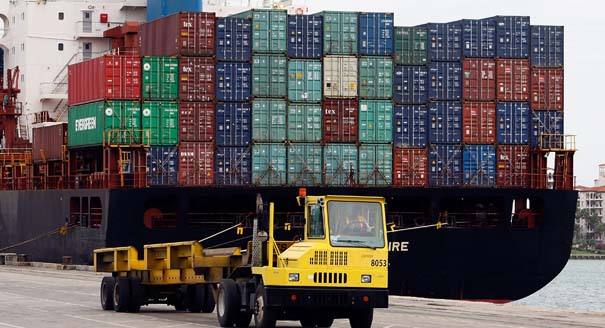
Source: Getty
Pending U.S. Congressional legislation that targets China’s currency policies is evidence of a broader trend toward protectionism, as countries seek to bolster domestic employment while avoiding the consequences of trade retaliation.
Global trade is under strain. You can hear the acid of protectionism starting to drip-drip-drip on the mechanism of global trade. It hasn’t penetrated the structure yet, but it is starting to stain the surface. While the free trade system—with World Trade Organization commitments in place—may prove durable even in the face of looming protectionism and retaliation, the corrosion will limit growth.
Washington did its part last week. In Congress, the House Ways and Means Committee passed new legislation for a modified China currency bill authorizing the Department of Commerce to determine whether undervalued currencies—clearly meaning the Chinese renminbi—constitute trade subsidies that justify countervailing duties. The draft legislation was modified to avoid clashing with past WTO rulings.
There are undoubtedly two purposes of the bill. The first is to strengthen the Obama administration’s credibility in trying to persuade China’s leaders that continuing to repress the value of the currency will lead to unwelcome consequences. The second is to show voters ahead of the midterm elections that the President and Congress are doing everything they can to protect American jobs.
With few legislative days remaining, many insiders—especially from the Senate—believe this legislation stands little to no chance of becoming law this year. Rather, it’s intended to put Congress in the role of the “bad cop” threatening China, while the administration’s offer of a positive state visit for President Hu Jintao early next year puts it in the position of being the “good cop” seeking cooperation.
The relevant officials in the Obama administration certainly understand that currency misalignments are a symptom, not the underlying causes of the huge trade imbalances seen over the past decade. But the symptom has become the political symbol of the U.S. trade deficit and American officials are frustrated—especially Treasury Secretary Timothy Geithner, who faces Congressional hearings and outrage—that China has allowed its currency to move up only about 1.5 percent since de-pegging from the dollar in June.
Comparing today’s situation with the 20 percent rise in the renminbi that occurred from 2005 to 2007, it would be reasonable to estimate that the Obama administration is looking for another 5 percent appreciation between now and President Hu’s visit. This would not significantly stress China’s export performance and GDP growth—and it would disarm some of the critics.
China’s vocal resistance and counter-arguments to appreciating its currency are not going down well in the U.S. market. With unemployment in the United States hovering close to 10 percent, China’s expressed fears of costing its own people jobs sound increasingly like special pleading. Beijing would do better if it explained how its imminent five-year plan (for the 2011-2015 time period) is going to shift the country’s investment-led growth to more sustainable consumption-led growth—if that, indeed, is what the plan will include.
As Michael Pettis, a financial and economic expert in China and senior associate at the Carnegie Endowment, has argued, consumption as a share of GDP will need to rise and investment shrink in order to reduce the huge global imbalances of the surplus economies. With the social costs perceived to be so high, surplus economies will only gradually shift to a greater reliance on consumption. Whether democracies facing upcoming elections and a Chinese Communist Party with its own internal rhythms can sustain a process of gradual accommodation is the big question. And this is obviously a more urgent question for uncomfortable deficit countries than comfortable surplus ones.
It increasingly looks like the answer will be that governments will try to get away with protecting their own workers while avoiding the consequences of getting caught. This is the paradoxical good news embedded in the structures of trade that prevail today. If countries try methods that are illegal under WTO rules, they will pay a price in penalties and equity market reactions. And if countries nonetheless continue to try to violate the rules, they will lose the markets that keep their people employed. So, countries are trapped in the global trade structure and cannot escape at an acceptable price.
There will be tremendous creativity over the coming years as countries try to have it both ways—such as China’s recent use of “indigenous innovation” and the threatened legislation in the U.S. Congress. These are likely to poison the political atmospheres in both surplus and deficit countries and will make future global trade liberalization difficult until stable employment returns. This is not to say there won’t be some steps forward—possibly the free trade agreement between Korea and the United States will be revived when President Obama visits the country later this year—but the pressures of protectionism will resist this progress, even as they succumb to the practical realities of a globalized economy.
Distinguished Fellow, Asia Program
Paal previously served as vice chairman of JPMorgan Chase International and as unofficial U.S. representative to Taiwan as director of the American Institute in Taiwan.
Recent Work
Douglas H. Paal


Douglas H. Paal, Tong Zhao, Chen Qi, …
Carnegie does not take institutional positions on public policy issues; the views represented herein are those of the author(s) and do not necessarily reflect the views of Carnegie, its staff, or its trustees.

The European Commissioner for Trade is headed to China. But after President Xi’s bridge-building visit to Washington, can a more isolated EU overcome Beijing’s stranglehold on critical raw materials? Who will blink first?

Rym Momtaz, ed.

The summit may be remembered as a fatal blunder, when Washington, Beijing, and the AI industry collectively chose ceremony over action.

Jeffrey Prescott

European NATO countries are wrestling with the possibility of U.S. disengagement from the alliance. With the continent’s security increasingly uncertain, governments must restore the credibility of their collective defense.



Hans-Dieter Lucas, Adam Thomson, Pierre Vimont

Cargo traffic through Russia’s Northern Sea Route has increased because of the disruption caused by the conflict in the Middle East, the Ukraine war, and U.S.-China tensions.

Mikhail Korostikov

The domestic impacts of how long it is taking to end the war in Ukraine have pushed the French electorate to the political extremes and compromised the country’s diplomatic capacity.
Rym Momtaz