

Commentary
Dmitri Trenin
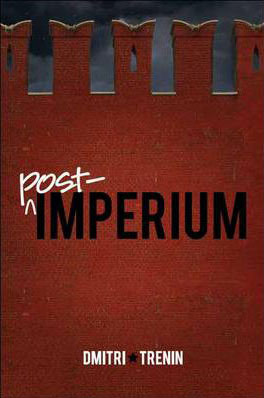
Moscow needs to drop the notion of creating an exclusive power center in the post-Soviet space. Like other former European empires, Russia has no choice but to reinvent itself as a global player and as part of a wider community.
Source: Washington
The war in Georgia. Tensions with Ukraine and other nearby countries. Moscow's bid to consolidate its "zone of privileged interests" over former Soviet republics. These volatile situations all raise questions about the nature of Russia’s relations with its neighbors and prospects for future regional stability.
In Post-Imperium: A Eurasian Story, also available in Russian, Dmitri Trenin argues that Moscow needs to drop the notion of creating an exclusive power center in the post-Soviet space. Like other former European empires, Russia has no choice but to reinvent itself as a global player and as part of a wider community.
Trenin’s vision for Russia is a changed, open Euro-Pacific country that is savvy in its use of soft power and fully reconciled with its former dependents. While acknowledging that this scenario may sound too optimistic, Trenin warns that the alternative is not a new version of the historic empire but ultimately the marginalization of Russia in international affairs.
"... as Mr Trenin convincingly argues, Russia is not a neo-imperialist state, but a post-imperialist one that lacks both vision and appeal, and the economic and human resources for any expansion."
—The Economist, December 3, 2011
Former Director, Carnegie Moscow Center
Trenin was director of the Carnegie Moscow Center from 2008 to early 2022.
Recent Work
Dmitri Trenin
Dmitri Trenin
Carnegie does not take institutional positions on public policy issues; the views represented herein are those of the author(s) and do not necessarily reflect the views of Carnegie, its staff, or its trustees.

Despite a new textbook, an influx of Russian teachers and managers, and an end to the teaching of Ukrainian, the Kremlin is unlikely to have “reprogrammed” locals.

Konstantin Skorkin

For every ruble allocated to social policy, health, and education in 2027, double that amount is earmarked for the army, the police, and the security services.

Alexandra Prokopenko

The acknowledgment has sparked fears of a new arms race with China and Russia.

Chris O’Meara
Smaller powers cannot go it alone, but Canadian history shows that integration with the United States will not always be benign.
Paul Samson

The European Commissioner for Trade is headed to China. But after President Xi’s bridge-building visit to Washington, can a more isolated EU overcome Beijing’s stranglehold on critical raw materials? Who will blink first?

Rym Momtaz, ed.