

Commentary
Oliver Stuenkel, Adrian Feinberg
Source: Getty
The startling spread of illiberal populism in democracies around the world raises the question of how damaged democracies can heal themselves.
This publication is from Carnegie’s Rising Democracies Network.
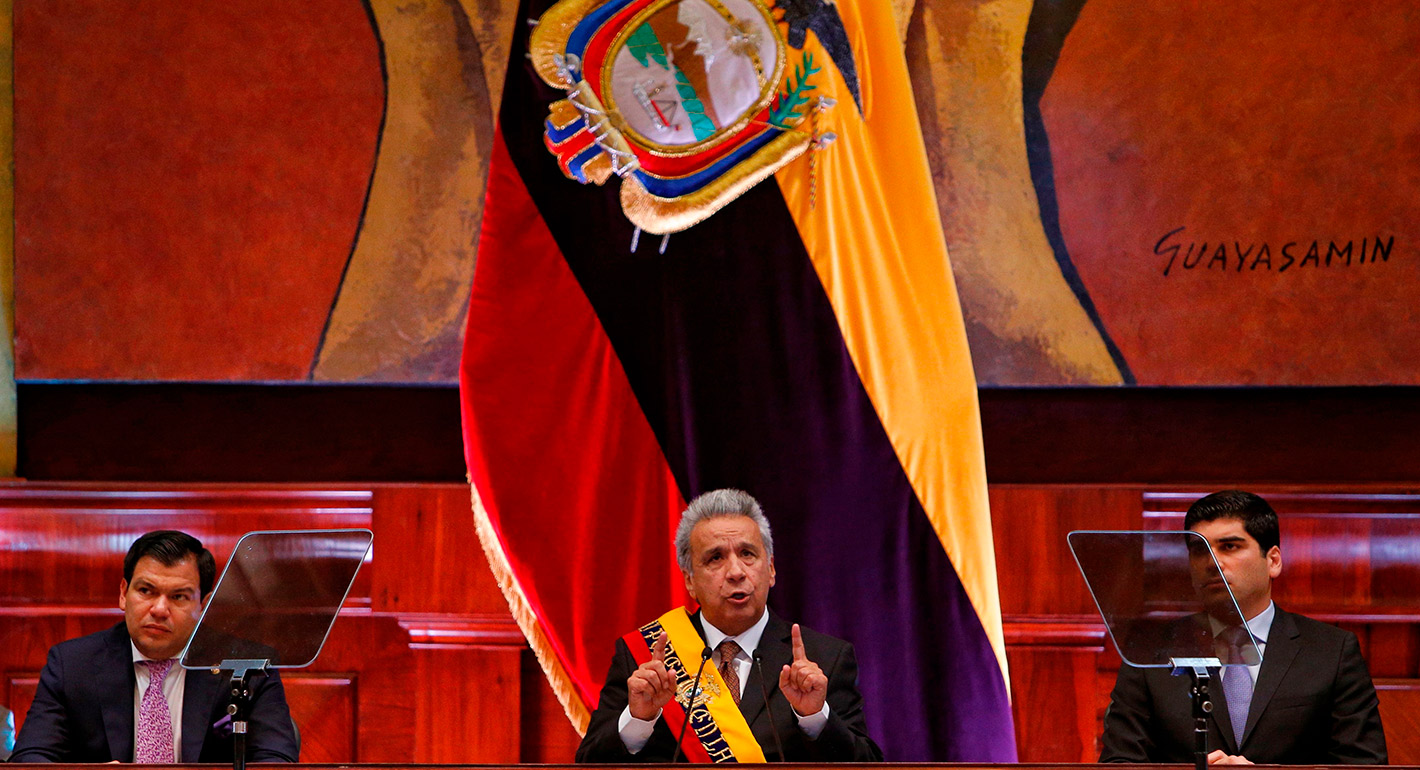
In democracies around the world—from Brazil, Bolivia, and the United States to Hungary, Italy, and Poland—populist leaders with a nationalist message and authoritarian tendencies have risen to power. Now, observers are looking to understand how successor governments can help reverse the damage left by populist authoritarianism, from deep polarization and the closing of civic space to strains on checks and balances and attacks on the rule of law. With the populist wave still rising, there are few case studies for how states should pick up the pieces after a populist-led erosion of democracy. But one country seems to have successfully recovered: Ecuador, under President Lenín Moreno, has rebounded from its turn toward populism under former president Rafael Correa. Can Quito’s current trajectory guide other moderates seeking to succeed radical populists and heal political wounds?
During the ten-year presidency of Rafael Correa, from 2007 to 2017, Ecuador witnessed unprecedented political stability, solid economic growth, and a remarkable reduction in poverty. Social spending rose sharply, including in key areas such as health and education, temporarily making Correa one of Latin America’s most popular leaders. However, emboldened by an oil bonanza and high approval ratings, the president ultimately overreached and eroded the country’s democratic institutions. The most powerful symbol of this process was 2013’s notorious Organic Law on Communications, also known as the Ley Mordaza or gag law, which was used to intimidate Ecuador’s independent media. A newly created media watchdog, the powerful Superintendency of Communication and Information, or Supercom, systematically investigated and fined critical media outlets. While the law’s objective—obliging journalists to provide accurate information—seemed laudable, its vague language allowed the government to punish critical reporting. As a consequence, it generated widespread fear and was largely seen as one of the most repressive media laws in the Western Hemisphere. Correa also used a provision intended for national emergencies to require all radio and TV channels to carry his broadcasts (called Enlace Ciudadano, or Citizen Connection), a move that recalled his Venezuelan counterpart Hugo Chávez.
Yet while Correa’s war against the free media generated the greatest international visibility, his authoritarian tendencies manifested in other important ways. He convinced the National Congress to scrap term limits, approved a new constitution that granted him more power—a controversial process that involved disqualifying fifty-seven legislators opposed to the constitutional assembly—and tilting the electoral playing field by appointing a trusted ally as head of the National Electoral Council and changing voting districts and electoral laws to favor his coalition. He exerted conformist political pressure on certain universities and reformed the judiciary in order to appoint judges loyal to him. For example, Correa made his former private secretary, Gustavo Jalkh, the head of the Judicial Council. Similarly damaging was Correa’s confrontational populist rhetoric, which framed Ecuadorian politics as a battle between “the people” and a small elite—made up of the traditional media, banks, career politicians, and even several social and indigenous movements—bent on undermining the country’s progress and sovereignty. Rather than seeking compromise, he depicted these groups as enemies that needed to be forcefully confronted.
Correa’s handpicked successor, Lenín Moreno, was elected to the presidency in 2017. Yet Moreno soon asserted his independence and, to the surprise of many observers, began to roll back some of Correa’s initiatives that had degraded Ecuador’s democracy. He ended the alliance Correa had established with Venezuelan President Nicolás Maduro. He welcomed reforms to the Organic Law on Communications; in a big step forward, Ecuador’s National Assembly voted to eliminate SuperCom in December 2018. Moreno celebrated “the recovery of freedom of expression and thought” and reminded Ecuadorans on social media that “with those liberties come responsibilities.” Some nongovernmental organizations (NGOs) have pointed out, however, that the regulatory body that remains, the Council for Regulation, Development and Promotion of Information and Communication (or Cordicom), still does not have the technical and apolitical composition it should. Moreno has also signaled that he does not plan to stay in power perpetually, often warning about the excesses of fellow Latin American presidents like Maduro or Nicaragua’s Daniel Ortega.
Perhaps most importantly, in 2018, Moreno promoted a referendum on whether to reinstate presidential term limits. Ecuadorans overturned the constitutional amendment that had eliminated term limits, essentially ensuring that Correa would not return to politics. From the very beginning of his presidency, Moreno said that he would stop meddling with universities, NGOs, and newspapers, and would seek to reestablish checks and balances, particularly by relinquishing executive influence over the judiciary. Moreno’s overall rhetorical approach has been less confrontational than Correa’s, and he has crafted a narrative around the idea that he has prevented Ecuador’s descent into authoritarianism. In February 2018, he declared in a televised address that “thanks to the firm decisions I have made, we are not what Venezuela is today. . . . We have recovered democracy.”
Yet even if Moreno were seeking a second term, he would most likely not be reelected. His approval rating sank precipitously from 80 percent in 2018 to 30 percent by mid-2019—largely due to a challenging economic context and his overall performance, which experts, journalists, and former policymakers interviewed characterize as lackluster, indecisive, and aloof. Restoring checks and balances, moving to the center, and overcoming polarization have thus far not paid off politically. Ecuadorans who still admire Correa for helping the poor contend that the current president has betrayed the country. At the same time, many of Correa’s detractors believe that Moreno is not doing enough to reverse the former president’s legacy. Merely undoing his predecessor’s worst policies is not enough for many Ecuadorans, who bemoan that Moreno does not offer a fresh vision for the future. They may, at the same time, overlook that Moreno inherited a state apparatus stuffed with Correa loyalists—a harsh reality he cannot change easily. In a polarized political context, seeking the middle ground may guarantee Moreno an honorable place in history, but it does little to ensure his popularity.
Prosecuting Correa loyalists for corruption has proved equally tricky. Moreno risks being accused of staging a witch hunt against the opposition—reinforcing precisely the kind of polarization that he seeks to overcome. In addition, Moreno has imposed austerity measures to stabilize the economy after Correa’s profligate spending (the former president increased public spending from 20 percent to 40 percent of GDP and doubled public sector wages). This risks cementing the public association between strongman politics and strong economic growth, and Moreno has had to spend countless hours justifying the painful measures to irate constituencies across the country.
To what extent, then, is Ecuador a good case study for recovering from populist authoritarianism?
Even though Moreno is unpopular and Ecuadorans are mostly concerned about the worsening economic outlook, the president’s first two years in power are nevertheless a useful example of how to conduct post-populist politics: Moreno has depersonalized day-to-day governing by emphasizing the importance of institutions rather than individuals, appearing on TV far less often than his predecessor, and adopting an easygoing style that has helped Ecuadorans establish a more typical relationship with their head of state. Although the public political discourse—from newspapers and blogs to NGOs and social movements—is far livelier today than it was under Correa, who actively demobilized political activists, it will take more time for newspapers to regain their confidence after they stopped investigating corruption for fear of being punished under Correa. Still, Moreno is helping Ecuadorian democracy overcome Correa’s authoritarian legacy. His actions—and Ecuador’s story—should be considered in the global debate about the challenges and pitfalls of post-populist politics.
But Moreno’s reversal of Correa’s populist authoritarian tendencies was not the result of a popular decision to end Correa’s political project. Indeed, somewhat akin to Russian President Vladimir Putin’s decision to install Dmitry Medvedev as president for a term, Correa was thought to regard Moreno as little more than a placeholder before he would return to the presidency. Overcoming Correa’s populist legacy was thus a top-down decision that offers few lessons for how citizens elsewhere can reverse authoritarian tendencies through bottom-up action. In contexts where the political playing field is tilted against opposition candidates—including a judiciary aligned with the executive, pressure on independent media outlets, and electoral rules that heavily favor the incumbent—achieving change through the ballot box may be more difficult.
Oliver Stuenkel is an associate professor of international relations at the Getúlio Vargas Foundation in São Paulo, where he coordinates the São Paulo branch of the School of History and Social Science and the executive program in international relations.
Senior Fellow, Democracy, Conflict, and Governance Program
Oliver Stuenkel is an associate professor at the School of International Relations at Fundação Getulio Vargas (FGV) in São Paulo, Brazil. He is also a senior fellow affiliated with the Democracy, Conflict, and Governance Program at the Carnegie Endowment for International Peace.
Recent Work
Oliver Stuenkel, Adrian Feinberg
Oliver Stuenkel, Adrian Feinberg
Carnegie does not take institutional positions on public policy issues; the views represented herein are those of the author(s) and do not necessarily reflect the views of Carnegie, its staff, or its trustees.

With its public finances in shambles, the far right polling at 35 percent ahead of the 2027 presidential election, and a growing protest movement, is France’s crisis a threat to the EU’s geopolitical awakening?

Rym Momtaz, ed.

Putin’s conservative staffing policies and search for ever greater control have cemented parliament’s transformation into a bureaucratic appendage of the executive branch.

Andrey Pertsev
International law has a PR problem.


Federica Du Pasquier, Oona A. Hathaway, Stewart Patrick

Russia’s AI-driven propaganda campaigns operate in a fragmented, chaotic, and often illogical manner. That’s not necessarily a problem for the Kremlin, though: It’s much easier to mimic genuine public debate that way.

Ilya Klishin

Ahead of a tough winter for Ukraine, Donald Trump’s swing back toward Russia bodes ill. But instead of panicking, Kyiv’s European allies are focusing on action.
Rym Momtaz