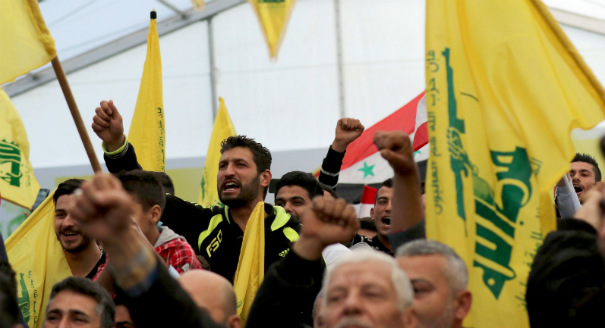
Hezbollah has been a useful non-state partner to Russian forces in Syria. The Lebanese Shia militia and Iranian proxy currently fields between 6,000 and 8,000 fighters in that country’s civil war, with some estimates as high as 10,000. Having suffered roughly 2,000 deaths and over 5,000 injured since their involvement in the conflict, Hezbollah has continued to be a stalwart ally of the Assad regime, fighting as far away as Deir ez-Zor. Since September 2015 this has included working closely with the Russian military, which intervened in an apparently effective attempt to save the Assad regime. Hezbollah’s success on the ground in Syria has been noted by Moscow, which views it as a capable ally that has strongly contributed to the survival of the Syrian government. But as the regime’s fortunes improve, Russia is signaling its willingness to rebels and their foreign backers to find a negotiated solution to the conflict, calculating that the regime’s current ascendancy will give it more leverage at the negotiating table to secure a favorable deal. Yet in the long term this solution may also limit Hezbollah’s influence in a post-conflict Syria.
In late December, a YouTube video showed an alleged Russian special operations soldier wearing Hezbollah insignia. The footage, taken in Aleppo, shows two special operations members inspecting a body alongside pro-regime fighters. A Hezbollah commander stationed in Aleppo confirmed that his organization has been working closely with the Russians in Syria’s former industrial hub. “Our relationship with the Russians is better than excellent,” he said—so close that Russian officers accompany Hezbollah fighters to watch them in active combat. “In some parts of Aleppo, Russian officers are present. They go to strategic areas overlooking the battlefield and watch Hezbollah engage with rebel forces and carry out reconnaissance missions. Sometimes they film these operations.” The video seems to confirm this close military relationship, of which Hezbollah fighters are undoubtedly proud. “The Russians come to see us—our maneuvers, our tactics—other Arab armies go to see the Americans,” a slight against the Gulf states, which have backed rebel groups in Syria. When asked what he believes the Russians are taking away from their observation of Hezbollah activities, the commander responded, “The Russians are impressed with the way we fight; how we handle our weapons; our tactics and our esprit de corps.”
The Russian military’s admiration is based in part on Hezbollah’s performance during the Battle of Martyr Abu Omar Saraqib, a failed rebel offensive in late October to break the siege of east Aleppo. Hezbollah and regime forces recaptured areas lost during the initial attack, as well as adjacent rebel positions. Somewhere between 28 and 35 Hezbollah fighters died at the battle, out of a total 143 pro-regime fighters killed. This high number underscores the significant role that Hezbollah played in defending that front. During the initial onslaught, Hezbollah fighters reportedly stood their ground against suicide car and truck bombs, ensuring that the regime line remained intact. “When the Russians see Hezbollah on the battlefield, they stop, talk to us, and show respect for our work. They do not have the same opinion of the Syrian army units,” said the Hezbollah commander.
On November 24 this cooperation was made public. Al-Akhbar, a Lebanese newspaper close to Hezbollah, reported that the organization held its first official and direct meeting with Russian senior military officers to discuss the final battle for Aleppo. According to the article, the Russian officers, who had called the meeting, praised Hezbollah’s performance during the Battle of Martyr Abu Omar Saraqib. Both sides agreed to maintain constant communication “across joint channels in Syria.” Such cooperation led to the swift fall of Aleppo over the following month, with precise Russian airstrikes providing cover for Hezbollah and other Iranian proxies to capture rebel-held areas. “The Russians bring precision to the battlefield. Syrian airstrikes have terrible aim and go off target; the Russians are reliable,” the Hezbollah commander said. As the regime moves its focus to consolidating its gains in Aleppo and expanding its territory, this relationship is likely to continue unfettered, for now.
For Moscow, a strong allied armed force on the ground that is competent both in offense and defense provides numerous benefits to its military campaign. Russian military planners learned the value of this early in the intervention, when regime forces and their allies were unable to take back territory under the cover of Russian airstrikes until the Russians took the lead by dramatically escalating their own attacks. Hezbollah helped the regime take more efficient advantage of these airstrikes, learning much from the Russians along the way. The Lebanese militia proved its ability to save the Assad regime by helping capture strategic areas, notably the towns of Salma in Latakia governorate, Sheikh Miskeen in Daraa, and Nubl and Zahraa in Aleppo. Bashar al-Assad has now taken control almost all of “useful Syria”—what Iran calls the economic and demographic core in the west of the country through which it can funnel aid to Hezbollah in Lebanon. Moving forward, Hezbollah will likely continue to spearhead the campaign, bolstering the regime’s offensive capabilities while providing defense as required. With a trustworthy ally on the ground able to help the regime consolidate its holdings and capture new, strategic territory, Moscow can focus on bringing the conflict to a negotiated end.
Paradoxically, it is this negotiated end to the Syrian conflict that threatens Hezbollah’s interests in Syria. The Lebanese militia’s patron Iran is using the conflict to bolster its influence in the region and secure its dominance from Iraq to Syria, Lebanon, and the Mediterranean. This has included leveraging its own domestic and regional networks of proxy militias and changing the demographic landscape in areas crucial to its ambitions. Hezbollah has enhanced its military infrastructure in areas within Syria where the regime is weak, particularly along the Syrian–Lebanese border. Not only does this allow Hezbollah to protect the Iranian weapons shipments it depends on, but it also provides the group important training facilities and—if and when the next conflict occurs with Israel—strategic depth. Plainly, both Hezbollah and its patron have benefited from the weakness of the Assad regime and its inability to project power across the entire country.
Moscow, however, wishes to see a strong central government in Damascus as the result of a negotiated process between the regime and mainstream rebel groups. As reflected by statements made by opposition backer Turkey at the end of December, rebel demands are likely to include that Hezbollah and all other pro-regime foreign groups leave Syria. This would severely limit both Iran’s and Hezbollah’s power projection inside Syria and the latter’s current position as an equal partner in the Axis of Resistance, a position it has paid for in blood and treasure. While Moscow has come to realize that Hezbollah is a strong ally in Syria, it will learn that the Lebanese militia’s foremost allegiance is to Iran and their shared priorities.
Alexander Corbeil is a lead analyst with The SecDev Group, focusing on the Syrian conflict and its impact on the Middle East and North Africa. Follow him on Twitter @alex_corbeil.
* This article is based on interviews with a Hezbollah commander conducted in December 2016.