

Paper
Raphaël Lefèvre
{
  "authors": [
    "Raphaël Lefèvre"
  ],
  "type": "commentary",
  "blog": "Sada",
  "centerAffiliationAll": "",
  "centers": [
    "Carnegie Endowment for International Peace",
    "Malcolm H. Kerr Carnegie Middle East Center"
  ],
  "collections": [],
  "englishNewsletterAll": "",
  "nonEnglishNewsletterAll": "",
  "primaryCenter": "Malcolm H. Kerr Carnegie Middle East Center",
  "programAffiliation": "",
  "programs": [],
  "projects": [],
  "regions": [
    "Middle East",
    "North Africa",
    "Egypt",
    "Morocco",
    "Tunisia",
    "Syria",
    "Levant"
  ],
  "topics": [
    "Political Reform"
  ]
}
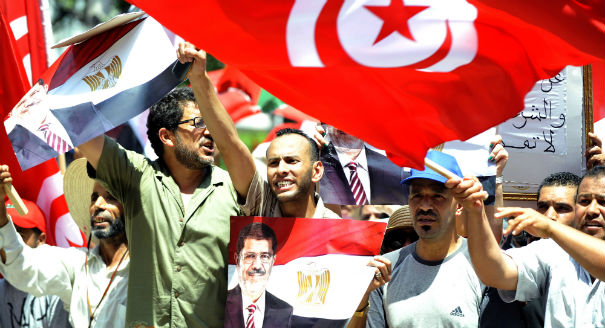
Source: Getty
In the aftermath of Morsi’s ouster, Muslim Brotherhood offshoots across the region seek to distance themselves from the “mother” organization—yet they all face the same fundamental challenges.
Whether in the street or in parliament, Islamist parties and movements have relied on one key strength for their successes in the immediate post-Arab Spring period—their cohesion and unity. But this could be endangered in the wake of Mohamed Morsi's ouster from the Egyptian presidency. Brotherhood offshoots throughout the region have tried to distance themselves from the governing methods of the "mother" organization in order to weather the storm. Although there has been a tendency to fixate on the Brotherhood’s governance style as the main culprit for its downfall, other fundamental issues threaten the movement’s unity, its future, and that of its offshoots.
Predictably, Islamist parties associated with the Muslim Brotherhood in the region reacted with condemnation and consternation to the ouster of President Mohamed Morsi in Egypt. But, they were mostly careful to disassociate themselves from the Egyptian Brotherhood's uncompromising style of leadership (rushing in a new Islamist constitution and monopolizing power around Mohamed Morsi). "We in Tunisia," stressed Rachid Ghannouchi, leader of Ennahda, "have offered compromises in terms of the constitution so that it will represent all Tunisians.” He went on to add: “We live under a national unity government and there are three heads of authority each of which is affiliated with a large and well-known party and all take part in the rule." Party leaders also like to recall last February: when thousands marched in the streets of Tunis to protest against the government, it took only a few days for the Islamist party to replace the prime minister and relinquish the most sensitive ministries to consensual technocrats. Similarly, the Syrian Muslim Brotherhood's spokesman bluntly asserted that the Egyptian Brotherhood had made "a mistake." "Egypt was a sinking boat and you can't come and change it the way you are doing; I believe that we have to work within a coalition." Likewise in Morocco, the leader of the ruling Justice and Development Party (PJD), Abdelilah Benkirane, stressed that "we [PJD] have nothing to do with the Muslim Brotherhood."
But what these groups fail to see is that style of governance alone is not responsible for the Brotherhood's downfall in Egypt. Other fundamental factors—which affect the group’s other branches as well—are to blame. Among these is a failure to promote younger and more pragmatic leaders; as a result, old-guard-type dogmatic figures prevail. In Egypt, young Brotherhood activists were disgruntled by what they regarded as the excessive interference of their old guard leaders in composing the leadership of the Freedom and Justice Party (FJP). Because they also focus on party loyalty, most Brotherhood affiliates in the region are similarly led by members who have been in charge for decades. For instance, within Ennahda and the Syrian Muslim Brotherhood, the leadership distrusts younger members and those who have not been jailed or tortured. This has often led to the departure of talented young members from some Brotherhood branches.
Another factor is the lack of separation between their outreach efforts (also known as proselytizing activities or da‘wa) and their role as political actors. In Egypt, the proximity between the Brotherhood and the FJP led many to see them as one and the same, to the extent that there was no differentiation between the effects of Morsi’s policies on the FJP and their impact on the Brotherhood. A clearer separation between the Brotherhood's socio-religious wing and its political wing could resolve the dilemma it has been facing regarding who should be the ultimate source of authority on politics. It would also clarify to the electorate who—between the Egyptian Brotherhood's Mohammed Badie and the President Mohamed Morsi, or between Ennahda's Rachid Ghannouchi and Tunisian Prime Minister Ali Laarayedh—really holds the reins of power within the party and in the country.
Both of these issues are part of a wider debate taking place within many of the offshoots. It pits the younger generations against the leadership as they seek to promote a pragmatic approach via the establishment of a party independent from the Brotherhood and unhampered by the old guard. This also means a shift away from a decades-old modus operandi suited for a clandestine organization to an open structure based on transparency and internal democracy. Moroccan and Jordanian Islamists opened up the door of reform by setting up the Justice and Development Party (PJD) and the Islamic Action Front (IAF), respectively. But while the former acts as an independent political force, the latter still seems to be under the oversight of the local Brotherhood branch. In Syria, for instance, the recently created National Party for Justice and the Constitution (NPJC), known as Waa'd*, or "Promise" in Arabic, is made up roughly of 30% Muslim Brothers, 40% independent Islamists and 30% national figures1—suggesting that other Brotherhood offshoots might be heading in that direction.
Most Brotherhood movements in the region are deeply heterogeneous, comprising a wide spectrum of views on issues of ideological, generational, and regional representation at the leadership level. The lack of deep reforms that reflect progress in some Brotherhood organizations has already led to divisions over the past two years. This was, for example, what pushed Abdelfattah Mourou and Abdel Moneim Aboul Fotouh, two prominent moderate Islamists, to split respectively from Ennahda and the Egyptian Brotherhood in 2011. At the same time in Syria, a group of younger Muslim Brothers who did not feel represented by the leadership of the local Brotherhood branch split and created the National Action Group (NAG), which is an active component within Syrian opposition bodies. So far, however, and despite these symbolic departures, the bulk of the membership of Brotherhood organizations around the region has remained loyal to the current leaderships.
Conceivably, however, the current debate among Islamist ranks as to whether violence is a justifiable response to Morsi’s overthrow could become a wedge issue. The question of resorting to violence is a recurring theme, and in the mid-1980s caused a split within the Syrian Muslim Brotherhood. Although the factions later reconciled, tension remains. Similarly in Tunisia, successive attempts by a splinter group to unseat the Bourguiba and Ben Ali regimes in the late 1980s and early 1990s caused a rift within the organization. It is precisely the memory of these splits that might soon fuel internal controversy when statements condoning political violence are made by party members and leaders. This time, however, if internal reform is not embraced, the split could be more than just temporary, given the range of other topics on which members internally disagree.
Raphaël Lefèvre is visiting fellow at the Carnegie Middle East Center. He is the author of Ashes of Hama: the Muslim Brotherhood in Syria (London, Hurst, 2013).
* Correction: an earlier version of the article identified the Arabic name of the party as Wahad (which means one in Arabic), the correct name in Arabic is Waa’d, which means promise.?
1. The estimated percentages were provided to the author by a source close to the party leader.?

Former Nonresident Scholar, Middle East Center
Raphaël Lefèvre was a nonresident scholar at the Carnegie Middle East Center, where his research focuses on Sunni Islamist movements in Lebanon.
Recent Work
Raphaël Lefèvre
Raphaël Lefèvre
Carnegie does not take institutional positions on public policy issues; the views represented herein are those of the author(s) and do not necessarily reflect the views of Carnegie, its staff, or its trustees.
From anime heroes to online gaming communities, Morocco’s Gen Z is building a new protest culture. What does this digital imagination reveal about youth politics, and how should institutions respond?
Abdelilah Farah
In a volatile Middle East, the Omani port of Duqm offers stability, neutrality, and opportunity. Could this hidden port become the ultimate safe harbor for global trade?
Giorgio Cafiero, Samuel Ramani
Is Morocco’s migration policy protecting Sub-Saharan African migrants or managing them for political and security ends? This article unpacks the gaps, the risks, and the paths toward real rights-based integration.
Soufiane Elgoumri
Iraq’s foreign policy is being shaped by its own internal battles—fractured elites, competing militias, and a state struggling to speak with one voice. The article asks: How do these divisions affect Iraq’s ability to balance between the U.S. and Iran? Can Baghdad use its “good neighbor” approach to reduce regional tensions? And what will it take for Iraq to turn regional investments into real stability at home? It explores potential solutions, including strengthening state institutions, curbing rogue militias, improving governance, and using regional partnerships to address core economic and security weaknesses so Iraq can finally build a unified and sustainable foreign policy.
Mike Fleet
How can Saudi Arabia turn its booming e-commerce sector into a real engine of economic empowerment for women amid persistent gaps in capital access, digital training, and workplace inclusion? This piece explores the policy fixes, from data-center integration to gender-responsive regulation, that could unlock women’s full potential in the kingdom’s digital economy.
Hannan Hussain