

Article
Thomas de Waal, Areg Kochinyan, Zaur Shiriyev
{
  "authors": [
    "Thomas de Waal"
  ],
  "type": "legacyinthemedia",
  "centerAffiliationAll": "dc",
  "centers": [
    "Carnegie Endowment for International Peace",
    "Carnegie Europe"
  ],
  "collections": [],
  "englishNewsletterAll": "ctw",
  "nonEnglishNewsletterAll": "",
  "primaryCenter": "Carnegie Europe",
  "programAffiliation": "russia",
  "programs": [
    "Russia and Eurasia"
  ],
  "projects": [],
  "regions": [
    "Caucasus",
    "Armenia"
  ],
  "topics": [
    "Political Reform",
    "Economy",
    "Foreign Policy"
  ]
}
Source: Getty
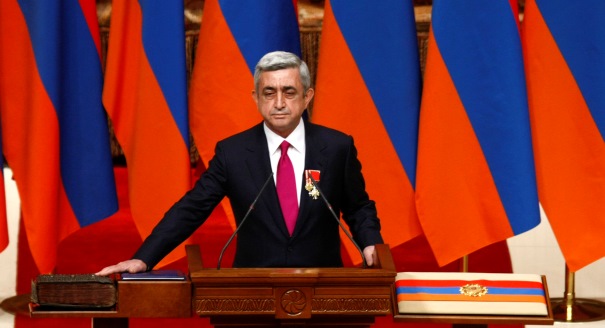
There are still many questions about Armenia’s future in the Russia-led Eurasian Customs Union, as well as the future of the union itself.
Source: Radio Free Europe/Radio Liberty
In an interview with Radio Free Europe/Radio Liberty’s Armenian Service, Carnegie’s Tom de Waal discussed the factors behind Armenia’s decision to join the Russia-led Eurasian Customs Union and halt its plans to sign an Association Agreement with the European Union. De Waal suggested that the Armenian government is now working to speed up the process of Customs Union ascenscion in order to avoid being left in a vacuum without the benefits of European integration or Customs Union membership. Armenian society is less pro-Russian than the political elite, de Waal stated. However, the political elite is quite pro-Russian, and President Serzh Sargsyn may have decided to join the Customs Union to avoid a pro-Russian threat to his rule in the future.
This interview was originally aired on Radio Free Europe/Radio Liberty.

Senior Fellow, Carnegie Europe
De Waal is a senior fellow at Carnegie Europe, specializing in Eastern Europe and the Caucasus.
Recent Work

Thomas de Waal, Areg Kochinyan, Zaur Shiriyev
Thomas de Waal
Carnegie does not take institutional positions on public policy issues; the views represented herein are those of the author(s) and do not necessarily reflect the views of Carnegie, its staff, or its trustees.
Although Ukrainian strikes have led to a noticeable decline in the physical volume of Russian oil exports, the rise in prices has more than made up for it.

Sergey Vakulenko
Five problems—and solutions—to make it actually work as a tool of great power competition.
Afreen Akhter
The Russian leadership wants to avoid a dangerous precedent in which it is squeezed out of Iran by the United States and Israel—and left powerless to respond in any meaningful way.

Nikita Smagin
One is hopeful. One is realistic. One is cautionary.

Andrew Leber, Sam Worby
In Ukraine, Gaza, and Iran, AI warfare has come to dominate, with barely any oversight or accountability. Europe must lead the charge on the responsible use of new military technologies.

Raluca Csernatoni