• Research
  • Emissary
  • About
  • Experts
Carnegie Global logoCarnegie lettermark logo
DemocracyIran
  • Donate
{
  "authors": [
    "Thomas Carothers"
  ],
  "type": "legacyinthemedia",
  "centerAffiliationAll": "dc",
  "centers": [
    "Carnegie Endowment for International Peace",
    "Malcolm H. Kerr Carnegie Middle East Center",
    "Carnegie Russia Eurasia Center"
  ],
  "collections": [
    "Arab Awakening"
  ],
  "englishNewsletterAll": "democracy",
  "nonEnglishNewsletterAll": "",
  "primaryCenter": "Carnegie Endowment for International Peace",
  "programAffiliation": "DCG",
  "programs": [
    "Democracy, Conflict, and Governance",
    "Middle East"
  ],
  "projects": [
    "Eurasia in Transition"
  ],
  "regions": [
    "North Africa",
    "Egypt",
    "North America",
    "United States"
  ],
  "topics": [
    "Political Reform",
    "Foreign Policy"
  ]
}
Source: Getty

In The Media

How Not To Promote Democracy In Egypt

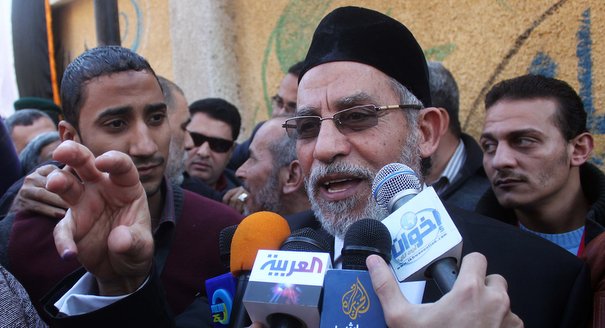
If the United States offers assistance for the development of political parties to Egypt, such aid should go to all legal parties, potentially including the Muslim Brotherhood, or Washington risks undermining U.S. credibility as a pro-democratic actor.

Link Copied
By Thomas Carothers
Published on Feb 24, 2011
Program mobile hero image

Program

Democracy, Conflict, and Governance

The Democracy, Conflict, and Governance Program is a leading source of independent policy research, writing, and outreach on global democracy, conflict, and governance. It analyzes and seeks to improve international efforts to reduce democratic backsliding, mitigate conflict and violence, overcome political polarization, promote gender equality, and advance pro-democratic uses of new technologies.

Learn More
Program mobile hero image

Program

Middle East

The Middle East Program in Washington combines in-depth regional knowledge with incisive comparative analysis to provide deeply informed recommendations. With expertise in the Gulf, North Africa, Iran, and Israel/Palestine, we examine crosscutting themes of political, economic, and social change in both English and Arabic.

Learn More
Project hero Image

Project

Eurasia in Transition

Learn More

Source: Washington Post

How Not To Promote Democracy In EgyptAs the U.S. government assesses the uprisings across the Middle East and scrambles to support Egypt's fledgling democratic transition, many ideas are on the table. One notably bad proposal is already being heard frequently in Washington: that to help Egypt prepare for elections we should support not just the development of political parties - a reasonable though sensitive undertaking - but favor one side of the party spectrum. That is, of course, the secular liberal side we feel comfortable with.

This is a recipe for trouble.

Former ambassador Martin Indyk recently called for the U.S. government "to mobilize funding for the well-oiled American democracy promotion machinery that can help Egypt's youthful secular forces organize for the coming elections." Rep. Ileana Ros-Lehtinen (R-Fla.) has said that "engaging the Muslim Brotherhood must not be on the table." Rep. Howard Berman (D-Calif.) noted that we should not tell Egyptians who can participate in their political life, but that, nevertheless, "our job is to create an alternative" to the Muslim Brotherhood.

A perennial tension in supporting democracy abroad is maintaining a clear line between bolstering key democratic principles - such as political openness and fair competition - and trying to shape particular electoral outcomes. When we begin to choose favorites from a field of political competitors and seek to give them a boost, we step over this line. Not only do such efforts at engineering electoral outcomes undercut our credibility, they also usually backfire against the very people we are trying to help. Witness the futility of the efforts of U.S. diplomats in Iraq to throw U.S. weight behind certain candidates or parties during the various elections since 2005.
 
If Egyptians decide to allow the Muslim Brotherhood to participate in the next presidential and parliamentary elections - a decision they will make through their own constitutional reform process - we will have to make a clear choice if we wish to aid Egypt's political party development. Either we open our programs to all legally registered nonviolent parties, or we stay away from political party support.
 
It is possible that the Brotherhood may choose not to take part in whatever U.S. party training programs we offer. (These are likely to focus on party organization, campaign methods and other basics.) But then again they might, and that would not be so bad. The National Democratic Institute, operating with U.S. government funds, has been an active, effective supporter of political party development in numerous Arab countries for the past 10 years. It has frequently included Islamist parties in its activities, such as the Islamic Action Front in Jordan, the Party for Justice and Development in Morocco, and Islah in Yemen. That inclusion has not hurt U.S. interests and has led to many fruitful dialogues between Arab political Islamists and Americans.
 
While carrying out research in Indonesia in 2004, I was struck to learn that the International Republican Institute was including in its multiparty training programs the Prosperous Justice Party (PKS), a conservative Islamist party known at the time for organizing fiery anti-American demonstrations outside the U.S. Embassy there. Neither the IRI representative in Jakarta, with whom I spoke, nor PKS officials expressed concern about this relationship. I asked the vice president of the PKS why his party was working with a U.S. government-funded organization affiliated with the Republican Party, at a time when a Republican-led U.S. government was being denounced by Muslims around the world for the invasion of Iraq. He expressed admiration both for U.S. Republicans' political skills and the fairmindedness with which they approached Indonesia's political scene.
 
It is good that the U.S. government has woken up after decades of support for dictatorship in Egypt and is ready to stand on the side of democracy. We should be acutely aware, however, that unlike Central and Eastern Europe in 1989, local political actors in the Arab world harbor enormous and often bitter skepticism of our democratic bona fides. Our pro-autocracy record in the region is well-known, and our new stance is still taking shape: Shortly after President Obama said his government stands ready to assist Egypt in its pursuit of democracy, Joint Chiefs of Staff Chairman Mike Mullen visited the Gulf to "reassure" America's autocratic allies there of continued U.S. friendship.
 
If we want to help democracy take root in Egypt, our "job," to use Berman's term, is first to begin building our own credibility. Proceeding on the basis of democratic principles such as openness and inclusion rather than political favoritism and exclusion would be a good way to start.

About the Author

Thomas Carothers

Harvey V. Fineberg Chair for Democracy Studies; Director, Democracy, Conflict, and Governance Program

Thomas Carothers, director of the Carnegie Endowment for International Peace’s Democracy, Conflict, and Governance Program, is a leading expert on comparative democratization and international support for democracy.

    Recent Work

  • Article
    How Anger Over Corruption Keeps Driving Global Politics
      • McKenzie Carrier

      Thomas Carothers, McKenzie Carrier

  • Commentary
    When Do Mass Protests Topple Autocrats?
      • McKenzie Carrier

      Thomas Carothers, McKenzie Carrier

Thomas Carothers
Harvey V. Fineberg Chair for Democracy Studies; Director, Democracy, Conflict, and Governance Program
Thomas Carothers
Political ReformForeign PolicyNorth AfricaEgyptNorth AmericaUnited States

Carnegie does not take institutional positions on public policy issues; the views represented herein are those of the author(s) and do not necessarily reflect the views of Carnegie, its staff, or its trustees.

More Work from Carnegie Endowment for International Peace

  •  A machine gun of a Houthi soldier mounted on a police vehicle next to a billboard depicting the U.S. president Donald Trump and Mohammed Bin Salman, the Crown Prince and Prime Minister of Saudi Arabia, during a protest staged to show support to Iran against the U.S.-Israel war on March 27, 2026 in Sana'a, Yemen.
    Collection
    The Iran War’s Global Reach

    As the war between the United States, Israel, and Iran continues, Carnegie scholars contribute cutting-edge analysis on the events of the war and their wide-reaching implications. From the impact on Iran and its immediate neighbors to the responses from Gulf states to fuel and fertilizer shortages caused by the effective shutdown of the Strait of Hormuz, the war is reshaping Middle East alliances and creating shockwaves around the world. Carnegie experts analyze it all.

  •  A machine gun of a Houthi soldier mounted on a police vehicle next to a billboard depicting the U.S. president Donald Trump and Mohammed Bin Salman, the Crown Prince and Prime Minister of Saudi Arabia, during a protest staged to show support to Iran against the U.S.-Israel war on March 27, 2026 in Sana'a, Yemen.
    Article
    Amid Iran War, Gulf Countries Slow the Pace of Reforms

    The return of war as the organizing factor in Middle Eastern politics has predictable consequences: governments are prioritizing regime stability and becoming averse to political and social reform.

      • Sarah Yerkes

      Sarah Yerkes, Amr Hamzawy

  • Commentary
    Carnegie Politika
    Power, Pathways, and Policy: Grounding Central Asia’s Digital Ambitions

    Central Asia’s digital ambitions are achievable, but only if policy is aligned with the region’s physical constraints.

      Aruzhan Meirkhanova

  • Commentary
    Strategic Europe
    Taking the Pulse: Can NATO Survive the Iran War?

    Donald Trump has repeatedly bashed NATO and European allies, threatening to annex Canada and Greenland and deploring their lack of enthusiasm for his war of choice in Iran. Is this latest round of abuse the final straw?

      • Rym Momtaz

      Rym Momtaz, ed.

  • Photo of a man conducting repairs in a technical center, surrounded by wires.
    Article
    Africa’s Digital Infrastructure Imperative

    The Africa Technology Policy Tracker reveals policymakers’ priorities for the continent’s digital transformation.

      Jane Munga

Get more news and analysis from
Carnegie Endowment for International Peace
Carnegie global logo, stacked
1779 Massachusetts Avenue NWWashington, DC, 20036-2103Phone: 202 483 7600Fax: 202 483 1840
  • Research
  • Emissary
  • About
  • Experts
  • Donate
  • Programs
  • Events
  • Blogs
  • Podcasts
  • Contact
  • Annual Reports
  • Careers
  • Privacy
  • For Media
  • Government Resources
Get more news and analysis from
Carnegie Endowment for International Peace
© 2026 Carnegie Endowment for International Peace. All rights reserved.