

Commentary
Thomas de Waal
{
  "authors": [
    "Thomas de Waal"
  ],
  "type": "commentary",
  "centerAffiliationAll": "",
  "centers": [
    "Carnegie Endowment for International Peace",
    "Carnegie Europe",
    "Carnegie Russia Eurasia Center"
  ],
  "collections": [],
  "englishNewsletterAll": "",
  "nonEnglishNewsletterAll": "",
  "primaryCenter": "Carnegie Europe",
  "programAffiliation": "",
  "programs": [],
  "projects": [],
  "regions": [
    "Caucasus",
    "Russia",
    "Azerbaijan",
    "Armenia",
    "Georgia",
    "Eastern Europe",
    "Ukraine"
  ],
  "topics": [
    "Security",
    "Global Governance",
    "Foreign Policy"
  ]
}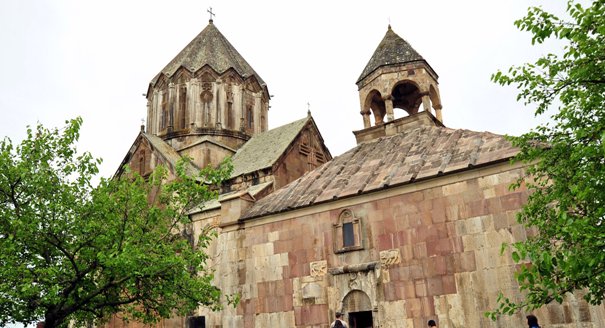
Source: Getty
As soon as the Crimea crisis struck, both Armenia and Azerbaijan immediately hardened their positions on the Nagorny Karabakh conflict.
The repercussions of the Russian takeover of Crimea continue to cascade across the post-Soviet space.
President Vladimir Putin's move has re-opened the Pandora's Box of sovereignty disputes that spread conflict across the region in the 1990s. In the Caucasus, the protagonists are now re-assessing what this means for the unresolved conflicts of that era.
It is not a good moment to stir up Nagorny Karabakh, the oldest and biggest of the conflicts. The spring thaw in the mountains often causes breaches in the ceasefire—and, sad to say, two Armenian soldiers have been reported killed in the past week.
Over the years Russia has had several agendas and changing roles in Karabakh, from active meddling during the conflict and negotiating the 1994 ceasefire to a long period of fairly harmonious cooperation with the other two mediators in the OSCE Minsk Group, France and the United States, since 1998.
Has this changed? The Minsk Group will probably survive—indeed the French and U.S. co-chairs just traveled to Moscow. But its ability to deliver a peace settlement now looks even more diminished and Vladimir Putin's calculus on Karabakh is likely to be different from what it was a few months ago, as it is on everything else in his "near abroad."
As soon as the Crimea crisis struck, both Armenia and Azerbaijan immediately hardened their positions on the conflict. Armenian President Serzh Sargsyan called Putin and gave him a half measure of support—although even that was enough for Ukraine to recall its ambassador from Yerevan. Sargsyan supported the first half of the maneuver, the Crimean referendum, but said nothing about Russia's right of annexation.
By doing so he reaffirmed Armenia's position on Karabakh—that the Karabakh Armenians have a right of secession by referendum.
It is no secret that Azerbaijan sympathizes with Ukraine in this crisis. But it has mostly keep silent, not wanting to offend Russia without good reason. President Ilham Aliyev did however issue an unusually aggressive speech on the Karabakh issue on the occasion of the Novruz holiday, saying that not just Karabakh but also parts of Armenia were "ancient Azerbaijani land."
The two presidents were both at the Hague nuclear summit this week. They met the mediators but not each other. If they had more strategic vision, they could see the Crimea crisis as an opportunity to reach out to each other and try to resolve their differences over Karabakh together, rather than allow themselves to be manipulated by a new agenda set by outside powers. But there is so little trust between Armenia and Azerbaijan, and so little evidence of any willingness to build any, that it is much more likely that Crimea will end up being one more barrier to peace.
Senior Fellow, Carnegie Europe
Thomas de Waal is a senior fellow at Carnegie Europe, specializing in Eastern Europe and the Caucasus.
Recent Work
Thomas de Waal
Thomas de Waal
Carnegie does not take institutional positions on public policy issues; the views represented herein are those of the author(s) and do not necessarily reflect the views of Carnegie, its staff, or its trustees.

Russia’s AI-driven propaganda campaigns operate in a fragmented, chaotic, and often illogical manner. That’s not necessarily a problem for the Kremlin, though: It’s much easier to mimic genuine public debate that way.
Ilya Klishin

Ahead of a tough winter for Ukraine, Donald Trump’s swing back toward Russia bodes ill. But instead of panicking, Kyiv’s European allies are focusing on action.

Rym Momtaz

Without a ceasefire with Ukraine on attacking each other’s energy infrastructure—to which the Kremlin is unlikely to agree—the diesel agreement between Putin and Trump is largely for show, rather than representing a genuine increase in the volumes of Russian diesel on the global market.

Sergey Vakulenko
Funding Ukraine remains a priority for European leaders. As Russia’s war of aggression heads into another winter, two feasible options to mobilize support for Kyiv should be fast-tracked.
Vladyslav Rashkovan, Gregory P. Wilson

Russian strikes are weakening the economy sustaining Ukraine’s war effort. Closing the growing funding gap will require more European support and politically contentious reforms in Kyiv.

Balázs Jarábik