

Article
Thomas de Waal
{
  "authors": [
    "Thomas de Waal"
  ],
  "type": "legacyinthemedia",
  "centerAffiliationAll": "dc",
  "centers": [
    "Carnegie Endowment for International Peace",
    "Carnegie Europe"
  ],
  "collections": [],
  "englishNewsletterAll": "ctw",
  "nonEnglishNewsletterAll": "",
  "primaryCenter": "Carnegie Europe",
  "programAffiliation": "russia",
  "programs": [
    "Russia and Eurasia"
  ],
  "projects": [],
  "regions": [
    "Russia",
    "Eastern Europe",
    "Ukraine"
  ],
  "topics": [
    "Security",
    "Foreign Policy",
    "Global Governance"
  ]
}
Source: Getty
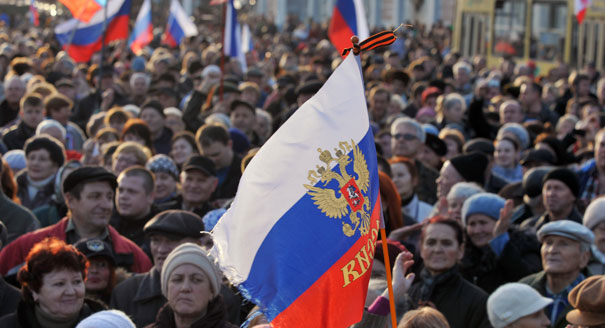
There is now a danger that suppressed tensions between local Russians, Ukrainians, and Tatars could lead to a mini Crimean civil war.
Source: POLITICO Magazine
Russians of a certain generation associate the name Aksyonov with a dissident writer who wrote a celebrated novel of political satire, Island of Crimea. First published in 1979, Vasily Aksyonov’s fantasy imagines that Crimea is an island, not a peninsula, that had survived as a White Russian enclave after the 1917 Bolshevik takeover and then grown into a sort of Russian Taiwan, booming, decadent and crammed full with all the luxuries that Brezhnev-era Russians craved. It ends with a war, as mainland Russia invades and the anomalous experiment comes to an end.
Fast forward 35 years and the novel looks like a strange parody of current events. The Russian government is seeking to repossess Crimea, supposedly to save it from falling into the hands of decadent Western fascists. And the man chosen by Moscow to be leader of the new Crimean secessionist movement happens to be called Aksyonov—Sergei, not Vasily.
On Tuesday, President Vladimir Putin said he had no wish to annex Crimea. He knows how risky that would be. Even Belarus and Kazakhstan, the two other pillars of the Eurasian Union, Putin’s quixotic plan for a Soviet-Union-lite for the 21st century, have re-affirmed the territorial integrity of Ukraine, while China strongly objects to anything that smacks of separatism anywhere in the world. Besides, wasn’t the point that Russia still recognized Viktor Yanukovych as president of (all of) Ukraine?Putin did, however, slyly leave himself a small out clause, saying, “We will never support such trends. Only people who live in a certain territory have the right to decide their own future.”
Enter Sergei Aksyonov, the newly installed Russian prime minister in Simferopol, the Crimean capital, whose party got only 4 percent of the vote in the last regional election. He has now duly called for a referendum on joining Russia on the improbably early date of March 16. Will they even be able to print the ballot papers on time?
This quasi-legal attempt to thread the separatist needle is far more brazen than Russia’s previous meddling in Abkhazia, South Ossetia or Transnistria, three other post-Soviet separatist conflicts. (South Ossetia and Abkhazia were autonomous regions of Soviet Georgia that ended up at war with the Georgian state in 1991 and 1992 respectively. Transnistrians, who live on the left bank of the Dniester River and are mostly Slavic, fought a small conflict with the new government of Moldova in 1992.)
All of those conflicts have their context in the disputed legacy of the Soviet Union. Most Abkhaz, Ossetians and non-Moldovan Transnistrians wanted to stay in the USSR and not become part of an independent Georgia or Moldova. Georgians and Moldovans wanted to stop them.
Moscow manipulated these conflicts by supporting the rebels and used them to install its troops to shape the peace settlements—but it did not start them, contrary to the claims of Georgian and Moldovan nationalists. (The Russian military also played a smaller role in a fourth conflict between Armenia and Azerbaijan over Nagorny Karabakh, but had less of a determining role in the outcome).
All of these separatist territories built a new identity on the basis that they must resist putative aggression from their former Soviet-era masters. In August 2008, South Ossetians’ fears vis-à-vis Tbilisi seemed to be borne out when President Mikheil Saakashvili foolishly ordered his troops to capture the South Ossetian capital Tskhinvali. That of course was exactly the pretext Russia needed to stage an invasion.
In Crimea, there are no excuses. There has been no provocation, no shooting. Russians already ran a local parliament with autonomous powers. Russian is the main language of communication.
The dangers are also bigger. Crimea has a substantial population still on the ground that does not want to be part of Russia or merely more autonomy within Ukraine. There are maybe half a million Ukrainians, out of a total population of 2.4 million people, with loyalty to Kyiv. There are also 250,000 Crimean Tatars, whose resentment of Moscow runs deep after Stalin’s mass deportation of them to Central Asia in 1944. They are not only loyal to Ukraine but can call on support from a strong diaspora community in Turkey.
Thankfully there is no recent tradition of political violence in Crimea. But there is pervasive organized crime, which could end up being just as dangerous. Over the last week observers have reported seeing freelance security personnel, working for oligarchs, alongside regular troops outside Ukrainian bases in what one Western analyst has described as Russian “state-private sector synergy. These unstable local dynamics could give some home-grown bosses a lot more leverage than we would want to see in an international crisis zone.
Sergei Aksyonov, the new Crimean prime minister, is alleged to be more Tony Soprano than Giuseppe Garibaldi, and to have been part of an organized crime syndicate named Salem, where he went by the unsavory name of Goblin.
He is also head of Crimea’s local Greco-Roman Wrestling Organization—a classic occupation for someone engaged in shady business. So he may now have a double incentive here: defending both his newly expanded business patch and his newly declared sovereign entity. (Doubtless, in his mind, they come to the same thing.)
South Ossetia points up some worrying parallels. A profoundly peaceful place in Soviet times, with many mixed marriages, it was pushed into violence in 1991 by the provocations of a nationalist constituency (in this case a Georgian one). It then morphed into an intractable dispute in which, after 2001, the local leader and strongman, former wrestling champion Eduard Kokoity, tried to manipulate his patrons in Moscow to fight Georgia on his behalf.
Putin has still left himself a little breathing space. A notoriously provocative member of the Russian parliament, Yelena Mizulina, has already tried to submit a draft law authorizing anschluss, in other words allowing Moscow to incorporate a secessionist part of another state. But the speaker of the Duma says parliament will only consider this after the March 16 referendum.
But there is now a danger that suppressed tensions between local Russians, Ukrainians and Tatars could lead to a mini Crimean civil war anyway. Theoretically, Putin could even decide he wants after all to cut a deal with the West over a new government in Kyiv—after all, Ukraine as a whole is ultimately more important to him than Crimea—only to find his puppets on the ground have developed ideas of their own.
Vasily Aksyonov’s black vision of a battle over “independent Crimea” looked like a grotesque fantasy in 1979. But it is getting a little uncomfortably close now.

Senior Fellow, Carnegie Europe
Thomas de Waal is a senior fellow at Carnegie Europe, specializing in Eastern Europe and the Caucasus.
Recent Work
Thomas de Waal
Thomas de Waal
Carnegie does not take institutional positions on public policy issues; the views represented herein are those of the author(s) and do not necessarily reflect the views of Carnegie, its staff, or its trustees.
It should address the shortcomings of previous crisis communication efforts and adapt to the demands of frontier AI.

Lucy Luo

If the Russian-speaking community in Latvia cannot articulate their interests without being seen as disloyal, they could end up embracing a pro-Kremlin agenda.

Sergejs Potapkins
Washington’s decision to support some UN functions while letting others wither is pulling the organization apart at the seams.

Stewart Patrick, Theodore Zaritsky

Are Germany’s economic, industrial, and political struggles becoming a liability for the EU’s ability to rise to the geopolitical moment?

Rym Momtaz, ed.

Russia’s ruling party would have benefited from Putin appearing as its distant patron, but as an active frontman imposing his views on the public, he has done nothing but harm both the party’s election campaign and the ruling system overall.

Andrey Pertsev