

In The Media
Lina Khatib
{
  "authors": [
    "Lina Khatib"
  ],
  "type": "legacyinthemedia",
  "centerAffiliationAll": "dc",
  "centers": [
    "Carnegie Endowment for International Peace",
    "Malcolm H. Kerr Carnegie Middle East Center"
  ],
  "collections": [
    "Arab Awakening"
  ],
  "englishNewsletterAll": "menaTransitions",
  "nonEnglishNewsletterAll": "",
  "primaryCenter": "Malcolm H. Kerr Carnegie Middle East Center",
  "programAffiliation": "MEP",
  "programs": [
    "Middle East"
  ],
  "projects": [],
  "regions": [
    "Levant",
    "Lebanon",
    "Syria",
    "Iraq",
    "Middle East"
  ],
  "topics": [
    "Political Reform",
    "Security",
    "Military",
    "Religion"
  ]
}
Source: Getty
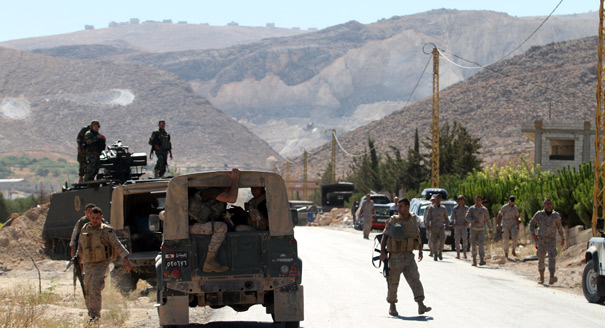
The battle that pitted the Lebanese Armed Forces against Islamist extremist groups led by the Islamic State (ISIS) in the border town of Arsal in early August 2014 has exposed a web of intertwined problems in Lebanon.
Source: Al-Hayat
The battle that pitted the Lebanese Armed Forces (LAF) against Islamist extremist groups led by the Islamic State (ISIS) in the border town of Arsal in early August 2014 has exposed a web of intertwined problems in Lebanon. Those problems have been exacerbated by the continued unrest in Syria, and the deterioration of the security situation in Iraq following the rise of ISIS.
Two key observations can be inferred from the battle in Arsal.
Firstly, the Sunni leadership in Lebanon has proven to be fragile, without moderate and effective leaders. The protracted absence of former Prime Minister and leader of the largest Sunni political bloc in the country, Saad Hariri, who left the country out of security concerns three years ago; divisions over the choice of the country’s next Mufti; and mounting sectarian tension between Sunnis and Alawites in Tripoli, as well as between Shias and Sunnis, over Hezbollah’s entanglement in Syria have paved the way for attempts by extremist groups to lure the Sunni community away from state institutions. Lebanon’s Sunnis have thus become a target of ISIS, which leveraged the battle in Arsal to present itself as a defender of Sunnis against the LAF and Hezbollah. Some alarming indicators arose. In Tripoli, for instance, the battle in the Sunni town of Arsal was exploited by some minor Sunni figures to foment sectarian tension and demand allegiance to ISIS in the event of victory over the LAF.Hariri unexpectedly arrived in Lebanon in the wake of the battle of Arsal. His return was intended to achieve two key objectives.
The first objective was to unite the Sunni community around state institutions, particularly the LAF, away from Islamist extremist groups, such as ISIS. Simultaneous to Hariri’s return, a new Mufti of the Republic was elected. As the new Mufti is a cleric considered acceptable to all political and Sunni factions, his appointment is likely to buttress the standing of Dar El Fatwa, the state-affiliated Sunni authority in Lebanon. This is important because Dar El Fatwa’s weakened role over the last years has given the upper hand to extremists such as Sheikh Ahmad Al Assir, who have tried to steer Lebanon’s Sunnis away from the state’s authority. The second goal behind Hariri’s return was to revive the role of Saudi Arabia in Lebanon in general and within the Sunni community in particular. This follows Saudi Arabia’s recent change of foreign policy on Syria and its shift of focus towards counterterrorism as the primary strategic framework to counter the rising influence of ISIS, which Saudi Arabia sees as posing a grave risk to security in the Middle East at large. In spite of these goals and their possible positive repercussions, Hariri’s protracted absence and return have diagnosed Lebanon’s main political and social woe: the precedence of sectarian affiliation over a sense of national unity. Amid the current unfortunate circumstances, the only way people from any sectarian community in Lebanon can be rallied around state institutions is through the guidance of leaders of those communities.
Secondly, the battle in Arsal has shed light on Hezbollah’s role. The battle in Arsal was compared to that of Naher Bared Camp (NBC) in northern Lebanon, where the LAF fought the terrorist group, Fateh al-Islam, in 2007. The scenario in Arsal is quite different, however. In NBC, the LAF tightened their grip on the camp and deterred Fateh al-Islam. In Arsal, the LAF won the battle, but not the war. ISIS fighters have not only maintained a foothold on the outskirts of Arsal, but have also infiltrated the country’s fabric, thereby becoming a security time bomb for Lebanon. By pursuing its fight against opposition groups alongside the Syrian regime, in a flagrant violation of the Lebanese Government’s official disassociation policy, Hezbollah also provides Syrian-based extremist groups with a pretext to pursue their anti-Hezbollah operations on Lebanese territory.
With political vacuum persisting in Lebanon -- pending the election of a new President and Parliament -- and sectarian tension exacerbating, particularly in the wake of clashes among various radical groups in northern Lebanon and a string of terrorist attacks mounted by extremist Sunni groups in Hezbollah’s strongholds, the LAF have emerged as a key, unifying, and trustworthy institution. The LAF’s victory in NBC lent credibility to the election of then-Army Commander, General Michel Sleiman, as president. Today, in the aftermath of the battle in Arsal, the LAF have attracted further popular sympathy, which will likely translate into support for current Army Commander General Jean Kahwagi’s candidacy in the presidential elections. A comparison between Arsal and NBC highlights the Lebanese people’s desperate yearning for a breakthrough in the election of a President.
Hezbollah is highly likely to manipulate sympathy for the LAF in its favor. After having repeatedly voiced support for March 8 coalition leader Michel Aoun as its presidential candidate, it can now “bow” to the people’s demand, eschewing support for Aoun, in favor of Kahwagi. After all, Kahwagi would be more beneficial for Hezbollah’s interests than any of the other current presidential candidates.
Thus far, Hezbollah appears to be the key beneficiary of the Arsal battle. It has shied away from direct involvement in the battle to avert a confrontation with Sunnis on Lebanese soil: Hezbollah’s engagement in the battle would have fanned the flames of sectarian violence and entrenched the confessional narrative that ISIS has attempted to employ to rally Lebanese Sunnis, which could have in turn plunged Lebanon into a yet another civil war. In Arsal, the LAF have fought anti-Hezbollah Sunni groups. In so doing, they have buttressed Hezbollah’s position that these groups jeopardize national security, despite this being in complete disregard of the party’s initial role as a magnet attracting these groups to Lebanon. In another advantage for Hezbollah, the battle in Arsal has pitted the poorly armed LAF against a well-armed ISIS, which took hold of advanced weapons after its invasion of Iraq in the last two months. Because of the LAF’s weakness, which translated into heavy losses in Arsal, Hezbollah upheld the legitimacy of its weapons, depicting them as a prerequisite for Lebanon. In this vein, Hezbollah is also using its sway over the current interim government to obstruct a three-billion-dollar grant from Saudi Arabia to boost the LAF’s capabilities.
In this sense, the battle in Arsal is a diagnostic tool for the entwined political and military dynamics in Lebanon. Cooperation will have to be developed now, not only within the Sunni community, but also at national and regional levels, to help Lebanon rise to its internal and external challenges. The Arsal battle has not only identified the real shortcomings domestically, but has also chalked a way out for Lebanon.
This article was originally published in Arabic in Al-Hayat.
Former Director, Middle East Center
Khatib was director of the Carnegie Middle East Center in Beirut. Previously, she was the co-founding head of the Program on Arab Reform and Democracy at Stanford University’s Center on Democracy, Development, and the Rule of Law.
Recent Work
Lina Khatib
Lina Khatib
Carnegie does not take institutional positions on public policy issues; the views represented herein are those of the author(s) and do not necessarily reflect the views of Carnegie, its staff, or its trustees.

Before the next wave of EU enlargement takes place, the union needs to grapple with thorny questions of how power is distributed among its members.


Emil Sondaj Hansen, Ditte Brasso Sørensen

The Horn of Africa countries are among those facing a new security calculus.


Andrew Leber, Lesley Anne Warner

The European far right might fail to steer EU policy in the direction Russia wants, but they will create enough chaos inside Europe to benefit the Kremlin.

Dimitar Bechev

The new U.S.–Denmark–Greenland agreement will help Washington exert political, economic, and financial dominance under the guise of security. Yet, it acknowledged Copenhagen’s and Nuuk’s sovereignty on the island.

Marc Pierini

A summer of escalation in the Black Sea has hurt Ukraine economically and is exacerbating world food security. A truce is needed—as is a broader reframing of Europe’s Ukraine strategy.

Thomas de Waal