

Commentary
It should address the shortcomings of previous crisis communication efforts and adapt to the demands of frontier AI.
Lucy Luo
{
  "authors": [
    "Vladimir Dvorkin"
  ],
  "type": "legacyinthemedia",
  "centerAffiliationAll": "dc",
  "centers": [
    "Carnegie Endowment for International Peace",
    "Carnegie Russia Eurasia Center"
  ],
  "collections": [],
  "englishNewsletterAll": "ctw",
  "nonEnglishNewsletterAll": "",
  "primaryCenter": "Carnegie Russia Eurasia Center",
  "programAffiliation": "russia",
  "programs": [
    "Russia and Eurasia"
  ],
  "projects": [],
  "regions": [
    "North America",
    "United States",
    "Russia"
  ],
  "topics": [
    "Security",
    "Military",
    "Foreign Policy",
    "Nuclear Policy",
    "Arms Control"
  ]
}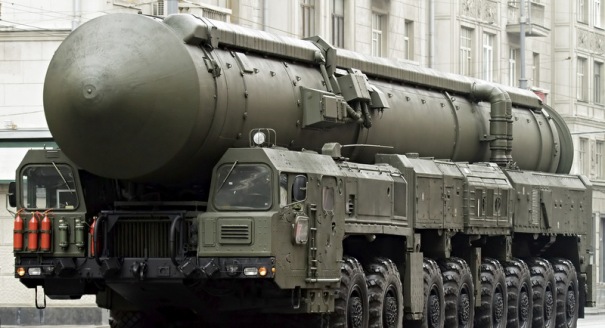
Source: Getty
It would be advisable for the presidents of Russia and the United States to make joint decisions to abandon the concept of launch-on-warning strikes based on the information provided by early-warning systems as well as refrain from conducting the respective exercises of the countries’ strategic nuclear forces.
Source: IMEMO
The period of the Cold War and nuclear confrontation between the Soviet Union and the United States gave rise to three possible types of strategic nuclear strikes: first strike, launch-on-warning strike, and retaliatory strike. There is absolutely no reason to believe that current nuclear-strike strategies have discarded these types of response, especially given that the concept of mutual nuclear deterrence between Russia and the United States unfortunately continues to exist to this day with practically no changes.
The decision to launch a launch-on-warning strike, that is, an attempt to launch one’s nuclear missiles before they are destroyed, is to be made on the basis of information received from Russian and American nuclear-strike early-warning systems. The decision to launch the strike must be made in a matter of minutes. Therefore, this option appears to be the riskiest choice, since the slightest provocations, errors, or malfunctions can trigger a global catastrophe.
Pentagon officials periodically asserted that the role of launch-on-warning strikes is minimal, reiterating their preference for retaliatory strikes, which would allow sufficient time to analyze the situation and make an intelligent decision. In particular, it would help to eliminate possible errors in information analysis. In the decades that Russian and American computer and information systems have been in existence, the likelihood of such errors has been reduced to the minimum, but it still exists. Therefore, the possibility of an error that might have catastrophic consequences cannot be ruled out completely.Neither the Soviet Union nor Russia ever stated that they would mostly rely on a retaliatory strike. However, just as was the case in the past, the deployment of mobile missile systems as a significant part of the land-based contingent, as well as the efforts to strengthen submarine missile carriers, point to creating the conditions for a guaranteed second strike.
Тhe space-based tier of Russia’s early-warning system ceased to exist after two 74D6 satellites deployed in highly elliptical orbits, which detects ballistic missile launches from U.S. territory, stopped functioning in 2014, as did the 71Kh6 satellite deployed in geostationary orbit to monitor sea areas. In this context, there have been some questions in the media about Russia’s capability to use its missile defense systems and launch-on-warning strikes.
As for the missile defense, it will not be affected at all by the loss of its space-based component, since Russia simply does not have a tested and functional system for intercepting intermediate-range and intercontinental missiles. One can single out the Moscow Region A-135 missile defense system, which was aimed at nuclear interception but is now being rearmed with non-nuclear interceptor missiles. This is a rational step, since it prevents nuclear fireworks over the region in response to a provocative launch of a conventional missile or even an AP shell.
When talking about the effect that the loss of the space-based missile defense component will have on Russia’s launch-on-warning capability, it is important to understand that the currently existing Russian space-based tier could only report on where the missiles are launched from and how massive the nuclear attack may be but provided no information on where the missiles are heading. This information is to be furnished by the second tier—the radar units deployed along the country’s borders. In recent years, Russia’s land-based missile defense tier has been strengthened by highly prefabricated Voronezh radars that can be set up in a short period of time. Some of the radars are already operational; some are still being tested. The decision on possible missile launches is made only after the information from these radars is received, since they are able to specify the actual scale of the attack and determine where the warheads are heading by calculating their trajectory. It appears that the currently developed Unified Space System will be able to make preliminary calculations of the attacking missiles’ trajectories to a certain degree, but most of the data will still have to be provided by the land-based radars.
Based on these data, the country’s leadership will make a decision on a possible response, which may include a launch-on-warning strike—thus, the decision can be made before the adversary’s nuclear missiles strike the territory under attack.
Theoretically, any sensible head of state will not make a decision on an immediate launch-on-warning strike after receiving information on a single or multiple-missile launch. However, as was mentioned above, the concept of such a strike in response to a massive nuclear attack, as well as planning for it, continues to exist in both Russia and the United States. Thus, the risk of a fatal error—however miniscule—still remains.
It is extremely important to realize that the risks associated with making launch-on-warning decisions based on data provided by early-warning systems is especially great at a time of crisis and escalating military-political tensions. Such escalation is underway at this time, and it is hard to predict how long it will last.
In addition, one can rely on leaders’ sensibility when they make the launch-on-warning strike decisions in a calm atmosphere. However, when such decisions are made within minutes under stress and exacerbated by the escalation of military-political tensions and militaristic frenzy, one cannot guarantee a reasonable response.
Therefore, at this particular juncture, it would be advisable for the presidents of Russia and the United States to make joint decisions to abandon the concept of launch-on-warning strikes based on the information provided by early-warning systems as well as refrain from conducting the respective exercises of the countries’ strategic nuclear forces.
These decisions will have no effect on the parties’ nuclear deterrence capabilities, since, as part of their nuclear triads, both Russia and the United States possess highly survivable components that guarantee second strikes.
While these decisions cannot be verified at this stage, they would be no less significant for preserving strategic stability and might serve as positive signals in preparation for the NPT Review Conference. Non-verified decisions on not aiming stationed missiles at each other, about which the parties feel confident, could also be helpful.
In the future, after the Russian-American partnership is restored, the parties could commence with the coordinated phased demonstration of organizational and technical measures that would ensure reliable verification of their prior decisions within the framework of the New START Treaty. These measures are based on the detailed methods for the phased reduction of combat readiness for strategic nuclear forces, which provides greater time for making decisions.
This article originally appeared in Russian on the website of the Russian Academy of Sciences’ Institute of World Economy and International Relations (IMEMO).
Vladimir Dvorkin
Major General Dvorkin (retired) is a chief researcher at the Center for International Security at the Institute of World Economy and International Relations.
Carnegie does not take institutional positions on public policy issues; the views represented herein are those of the author(s) and do not necessarily reflect the views of Carnegie, its staff, or its trustees.

It should address the shortcomings of previous crisis communication efforts and adapt to the demands of frontier AI.

Lucy Luo

Washington’s decision to support some UN functions while letting others wither is pulling the organization apart at the seams.

Stewart Patrick, Theodore Zaritsky

While there are notable demographic, economic, and geographic divides over AI, there is also substantial alignment between Republicans and Democrats.



Ian Klaus, Mark Baldassare, Rachel George, …

Are Germany’s economic, industrial, and political struggles becoming a liability for the EU’s ability to rise to the geopolitical moment?

Rym Momtaz, ed.

Russia’s ruling party would have benefited from Putin appearing as its distant patron, but as an active frontman imposing his views on the public, he has done nothing but harm both the party’s election campaign and the ruling system overall.

Andrey Pertsev