

Commentary
Farea Al-Muslimi
{
  "authors": [
    "Farea Al-Muslimi"
  ],
  "type": "legacyinthemedia",
  "centerAffiliationAll": "dc",
  "centers": [
    "Carnegie Endowment for International Peace",
    "Malcolm H. Kerr Carnegie Middle East Center"
  ],
  "collections": [],
  "englishNewsletterAll": "menaTransitions",
  "nonEnglishNewsletterAll": "",
  "primaryCenter": "Malcolm H. Kerr Carnegie Middle East Center",
  "programAffiliation": "MEP",
  "programs": [
    "Middle East"
  ],
  "projects": [],
  "regions": [
    "Gulf",
    "Yemen",
    "Middle East",
    "Western Europe"
  ],
  "topics": [
    "Political Reform",
    "Security",
    "Foreign Policy"
  ]
}
Source: Getty
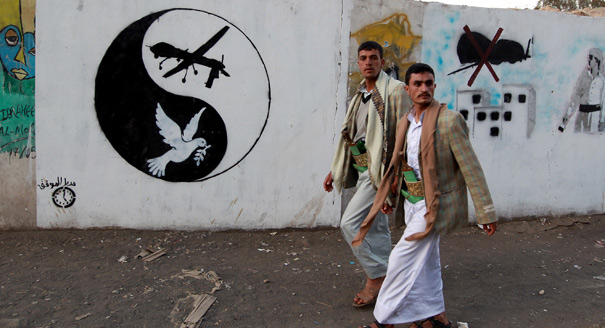
The worsening violence in Yemen has led to exacerbating regional disputes, hindering any chance for a regional role or mediation to achieve peace.
On April 21, the foreign ministers of the European Union (EU) issued an official position on the war in Yemen in a statement blaming the Houthi group for the situation. The statement offered a more comprehensive and balanced diagnosis of the issues compared to the usual statements and positions made by regional and Western powers.
Regional and international polarization concerning Yemen has reached extreme levels. The rift in Yemen, which the regional countries could have bridged if they had not decided to side with one faction against another, has widened dramatically. The absence of any regional or international party that carries weight and credibility in Yemen, means that the European Union must mediate a domestic and regional peace to preserve the country against the imminent threat of fragmentation and the catastrophic humanitarian situation. As Operation Restoring Hope – formerly Operation Decisive Storm – goes into its fourth week, no clear prospects for a political solution are emerging so far.
The EU has a better chance to help achieve peace in Yemen compared to other international organizations for a number of reasons. The EU is a leading body that is not subject to the control of any particular country and its attitudes, which would have otherwise invited accusations of subordination to a particular country’s interests and biases or in favor of one of the parties to the conflict in Yemen. This means the EU is a more acceptable mediator to the parties of the conflict, which do not believe the United Nations has the same level of neutrality as in it did 2011.In addition, the position of the EU has been different from the official U.S. position concerning Yemen over the past few years, and it has remained independent from the position of the United Nations as well, following the latter’s failed intervention which has often been questioned in Yemen and the region.
Furthermore, several European countries possess the necessary political and economic weight to help, including Germany, one of the long-standing donors that assist Yemen, which gives it an advanced moral position among the Yemeni people. In addition, Germany has maintained relations for a long time with the Houthis; for instance, Yahya al-Houthi, brother of the leader of the Houthi group, had been living as a refugee in Germany until 2014.
In addition, the EU has strong knowledge about the nature of the conflict in Yemen, and relies on multiple sources that are familiar with the situation. This means the EU has a deeper and broader knowledge of the manifestations, motives, and results of the conflict in a way that is closer to the truth on the ground.
Many nations in continental Europe accumulated broader knowledge and expertise on Yemen compared to what the United States or Britain have acquired. So far, none of the EU-led initiatives in Yemen have failed, at least when compared to the UN and Gulf record.
Another important factor in this regard has to do with economics. Many major European energy companies such as France’s TOTAL had to suspend their operations in Yemen, where they were developing major liquefied natural gas projects. The continuing violence in Yemen therefore has direct consequences for the regional economy and the world economy, including EU economies.
Internationally, the EU can play a mediation role between the United States and Russia, and the two powers’ respective allies. Even locally, the EU can deploy a carrot and stick approach much more effectively than organizations like the United Nations, thanks to the network of relations and interests maintained by local parties in many EU nations.
The EU currently has the opportunity to be a peacemaker in a number of ways, either by drafting a joint peace initiative or by inviting the Yemeni parties to come and present their visions for a solution, or even by calling an unconditional dialogue in one of its countries or in Brussels, the capital of the EU that the Yemeni parties have no reservations against. At the very least, the EU can support or coordinate with the Omani efforts for a broad-based peace initiative that would be binding and realistic, backed by the full weight of the EU and not just by Muscat.
Today, the EU can push directly for a comprehensive cease-fire in Yemen by both local and foreign parties, to allow humanitarian aid to pass and end the naval blockade on food supplies. This alone would give the EU wide approval in the Yemeni street and among the parties involved in the conflict.
Yemen is falling gradually into the abyss, which portends to cause one of the worst humanitarian crises in the world. The worsening violence in this already impoverished country has led to exacerbating regional disputes, hindering any chance for a regional role or mediation to achieve peace.
All this means that not only a possible role for the EU has higher odds of success, but also gives the EU an opportunity to assume an enormous moral responsibility. Indeed, not many organizations and nations can lead peace efforts like the EU can in Yemen.
Finally, the EU is one of the few international blocs that have not supplied weapons to Yemen in the past decades. As such, this has given the EU a widely respected moral standing in Yemen.
The EU now has the chance to put this moral and political weight into use in Yemen, and achieve a long and durable peace.
This article was originally published in Arabic by Al-Hayat.

Research fellow at Chatham House’s Middle East and North Africa Programme
Farea Al-Muslimi is a research fellow at Chatham House’s Middle East and North Africa Programme.
Recent Work
Farea Al-Muslimi
Farea Al-Muslimi
Carnegie does not take institutional positions on public policy issues; the views represented herein are those of the author(s) and do not necessarily reflect the views of Carnegie, its staff, or its trustees.
It should address the shortcomings of previous crisis communication efforts and adapt to the demands of frontier AI.

Lucy Luo

If the Russian-speaking community in Latvia cannot articulate their interests without being seen as disloyal, they could end up embracing a pro-Kremlin agenda.

Sergejs Potapkins
Washington’s decision to support some UN functions while letting others wither is pulling the organization apart at the seams.

Stewart Patrick, Theodore Zaritsky

Are Germany’s economic, industrial, and political struggles becoming a liability for the EU’s ability to rise to the geopolitical moment?

Rym Momtaz, ed.

Russia’s ruling party would have benefited from Putin appearing as its distant patron, but as an active frontman imposing his views on the public, he has done nothing but harm both the party’s election campaign and the ruling system overall.

Andrey Pertsev