

• Research
  • Emissary
  • About
  • Experts
Carnegie Global logoCarnegie lettermark logo
DemocracyIran
  • Donate
{
  "authors": [
    "Frances Z. Brown",
    "Mara Karlin"
  ],
  "type": "legacyinthemedia",
  "centerAffiliationAll": "dc",
  "centers": [
    "Carnegie Endowment for International Peace",
    "Malcolm H. Kerr Carnegie Middle East Center"
  ],
  "collections": [
    "Violence and Conflict"
  ],
  "englishNewsletterAll": "democracy",
  "nonEnglishNewsletterAll": "",
  "primaryCenter": "Carnegie Endowment for International Peace",
  "programAffiliation": "DCG",
  "programs": [
    "Democracy, Conflict, and Governance"
  ],
  "projects": [],
  "regions": [
    "North America",
    "United States",
    "Middle East",
    "Türkiye",
    "Iraq",
    "Lebanon",
    "Syria",
    "Levant"
  ],
  "topics": [
    "Political Reform",
    "Democracy"
  ]
}

Source: Getty

In The Media

Friends With Benefits

The Trump administration appears committed to working "by-with-through" local partners in the Middle East. Doing so effectively requires a clear political strategy and continued diplomatic engagement in the region.

Link Copied
By Frances Z. Brown and Mara Karlin
Published on May 8, 2018
Program mobile hero image

Program

Democracy, Conflict, and Governance

The Democracy, Conflict, and Governance Program is a leading source of independent policy research, writing, and outreach on global democracy, conflict, and governance. It analyzes and seeks to improve international efforts to reduce democratic backsliding, mitigate conflict and violence, overcome political polarization, promote gender equality, and advance pro-democratic uses of new technologies.

Learn More

Source: Foreign Affairs

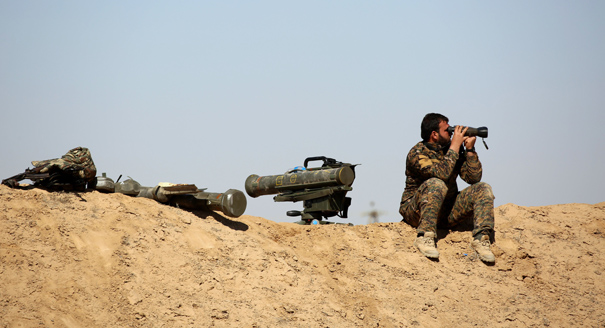
What does an “America first” national security strategy look like in action? The White House provided a hint in April, when news broke that National Security Adviser John Bolton had asked Arab nations, including Egypt and possibly Saudi Arabia, to supply ground forces to replace U.S. troops in Syria. (This came only weeks after U.S. President Donald Trump announced his desire to “bring our troops back home.”) Although details are scarce, Bolton’s new initiative appears to mirror a broader talking point coming from the Trump administration: rather than putting American lives at risk, the United States will work “by, with, and through” local forces to achieve its national security objectives.

Champions of the by-with-through model argue that it is a better (and cheaper) means of fighting wars and winning the peace than sending U.S. troops into harm’s way. Testifying before Congress in March, General Joseph Votel of U.S. Central Command explained that “working ‘by, with, and through’ our allies and partners allows us to multiply the effect of relatively modest commitments,” ensuring that the Middle East “never again requires a mass deployment of U.S. forces.” For Trump, this sounds like the ultimate deal: working with local partners will enable the United States to get more of its desired security outcomes for less of its blood and treasure.  

Working with local partners is not a new model: the administrations of George W. Bush and Barack Obama both relied heavily on local partners to fight the “war on terror,” whether through major efforts to develop national armies and police forces in Iraq and Afghanistan or through more limited partnerships across Africa, Asia, and the Middle East. Today, however, it has assumed a new centrality as Trump seeks to wind down U.S. military commitments abroad. Votel has said that the by-with-through model now underpins U.S. campaigns in Afghanistan, Egypt, Iraq, Lebanon, Syria, and Yemen. Defense Secretary James Mattis cited it on a recent visit to U.S. military allies in the Pacific. General Raymond Thomas, commander of U.S. Special Operations Command, testified to Congress that “by, with, and through” is the “primary approach” to achieving his command’s objectives. And General Thomas Waldhauser, commander of U.S. Africa Command, cites it as a central tenet of U.S. operations on the continent.

Read Full Text

This article was originally published in Foreign Affairs.

About the Authors

Frances Z. Brown

Vice President for Studies

Dr. Frances Z. Brown is a vice president for studies at the Carnegie Endowment for International Peace. Brown served on the White House National Security Council (NSC) staff over the past three presidential administrations. Her research focuses on U.S. foreign policy, Africa, the Middle East, and governance.

Mara Karlin

Brookings Institution

Authors

Frances Z. Brown
Vice President for Studies
Frances Z. Brown
Mara Karlin
Brookings Institution
Political ReformDemocracyNorth AmericaUnited StatesMiddle EastTürkiyeIraqLebanonSyriaLevant

Carnegie does not take institutional positions on public policy issues; the views represented herein are those of the author(s) and do not necessarily reflect the views of Carnegie, its staff, or its trustees.

More Work from Carnegie Endowment for International Peace

  • Commentary
    Deciphering Europe’s Relationship with Turkey

    Debate is heating up on how Turkey could be integrated into a common European defense framework. Commercial and industrial deals offer a better chance at alignment than sweeping political efforts.

      Marc Pierini

  • Commentary
    Diwan
    Music, Memory, and Identity in the Afro-Iraqi Community

    In Basra, an ethnoracial minority wages a constant struggle to assert itself in the face of marginalization.

      Zeinab Shuker

  • Construction site
    Commentary
    Emissary
    The Iran War Isn’t the Only Challenge Facing Saudi Arabia’s Vision 2030

    As the monarchy appears to question its grandest projects, the state could do with more critical debate than rote cheerleading.

      • Andrew Leber

      Andrew Leber

  • Commentary
    Strategic Europe
    Taking the Pulse: Is it Worth it for Europeans to Placate Trump?

    After spending much of 2025 trying to placate Donald Trump, some European leaders are starting to change posture. But is even a hostile Washington still so important to Europe that the U.S. president’s outbursts are worth putting up with?

      • Rym Momtaz

      Rym Momtaz, ed.

  • Commentary
    Carnegie Politika
    In Russia, the Public Mood Is Souring

    The Russian regime is now visibly motivated by fear.

      Alexander Baunov

Get more news and analysis from
Carnegie Endowment for International Peace
Carnegie global logo, stacked
1779 Massachusetts Avenue NWWashington, DC, 20036-2103Phone: 202 483 7600
  • Research
  • Emissary
  • About
  • Experts
  • Donate
  • Programs
  • Events
  • Blogs
  • Podcasts
  • Contact
  • Annual Reports
  • Careers
  • Privacy
  • For Media
  • Government Resources
Get more news and analysis from
Carnegie Endowment for International Peace
© 2026 Carnegie Endowment for International Peace. All rights reserved.