

Commentary
Cornelius Adebahr
{
  "authors": [
    "Cornelius Adebahr"
  ],
  "type": "legacyinthemedia",
  "centerAffiliationAll": "dc",
  "centers": [
    "Carnegie Endowment for International Peace",
    "Carnegie Europe"
  ],
  "collections": [
    "Europe’s Southern Neighborhood",
    "Iranian Proliferation"
  ],
  "englishNewsletterAll": "ctw",
  "nonEnglishNewsletterAll": "",
  "primaryCenter": "Carnegie Europe",
  "programAffiliation": "EP",
  "programs": [
    "Europe"
  ],
  "projects": [],
  "regions": [
    "Middle East",
    "North America",
    "United States",
    "Iran"
  ],
  "topics": [
    "Foreign Policy",
    "Nuclear Policy"
  ]
}
Source: Getty
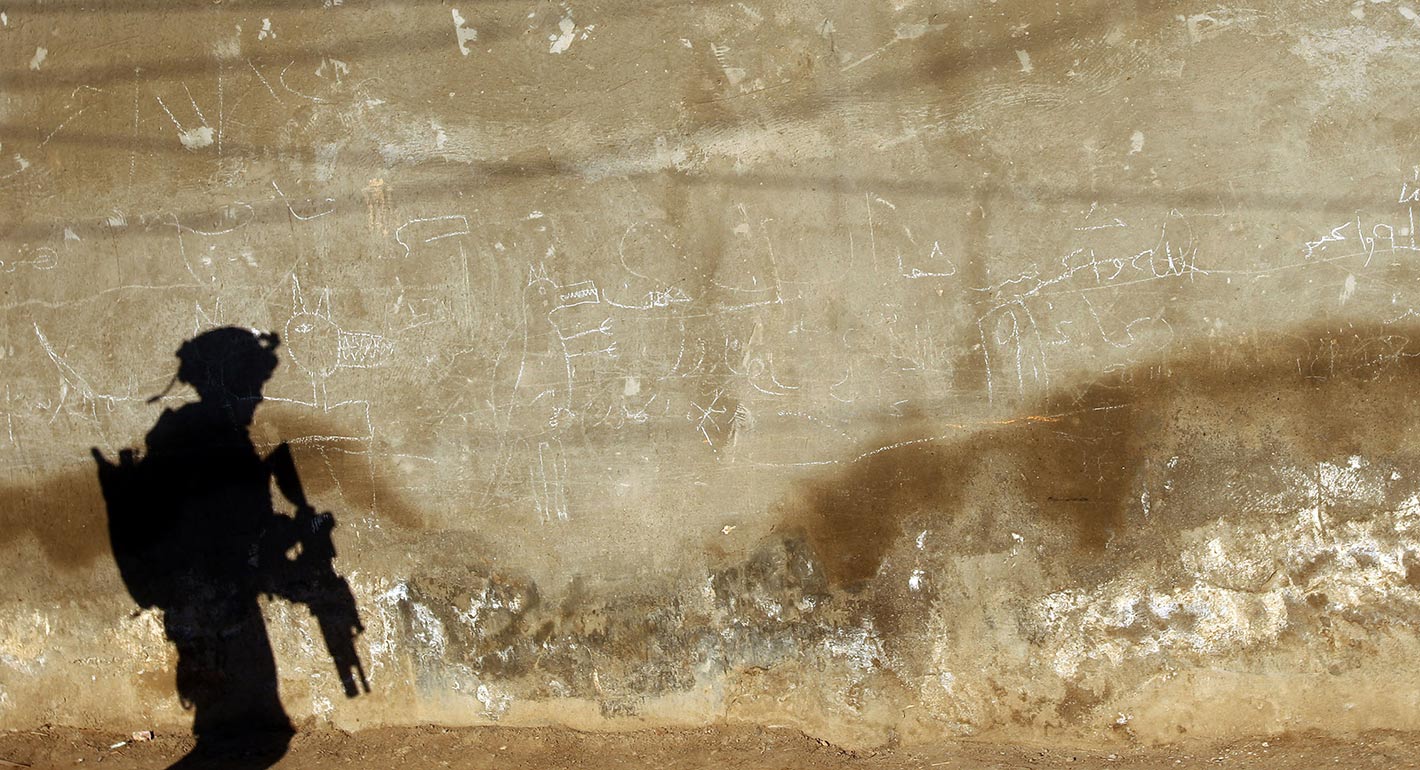
The current escalation between the United States and Iran bears similarities to the run-up to the 2003 Iraq invasion. Yet while the danger of military confrontation is real, there are also important differences.
Source: Die Zeit
In Washington, members of Congress and commentators alike warn of a repetition of the “2003 Iraq playbook.” The U.S. government claims that an adversary is seeking weapons of mass destruction, despite the fact that Iran has so far adhered to the 2015 nuclear agreement, which precisely precludes such a path. The U.S. secretary of state has intelligence that implicates Tehran in a string of tanker attacks in the Gulf of Oman. And John Bolton, one of the unapologetic masterminds of the Iraq invasion and now national security adviser, is pulling the strings, pleading for regime change in Iran.
Can history repeat itself in such a simple way some 16 years later? Of course it could, though there are reasons to expect a different outcome. Then again, to paraphrase Marx, history repeats itself, first as tragedy, then as farce.A first difference are the siren calls, not so noticeable in 2003 but now loud and clear. Then, much of Washington’s foreign policy establishment was convinced of the need for military intervention. Today, a chorus of critics can point to the long-term consequences of the U.S. occupation of Iraq, including the costs in lives and money, both American and Iraqi. Moreover, a war with Iran does not fit with the strategy of a president who campaigned for pulling U.S. forces out of the Middle East.
Second, there is the nuclear agreement that Washington abandoned over a year ago and which Iran (still) respects. The conflict with Iraq prior to 2003 was about a possible nuclear weapons program that international inspectors were not able to detect for lack of access. In the case of Iran, the 2015 deal has ensured this access exactly in order to reassure the world, at least for the duration of the deal, that Tehran is not able to build a bomb—or at least not without getting caught in time. So far, the International Atomic Energy Agency has confirmed in more than a dozen reports that Tehran is compliant.
This leads to the third important difference from 2003: America’s global isolation on the issue. Apart from Israel and Persian Gulf allies such as Saudi Arabia and the United Arab Emirates, hardly any state supports an increased confrontation with Iran. Europeans in particular—unlike in 2003 when Washington succeeded in dividing the continent into “old” and “new” Europe—are united in their support for the nuclear agreement that France, Germany, and the United Kingdom jointly negotiated under EU leadership with China, Russia, and the United States.
Yet despite these major dissimilarities with 2003—in the Washington policy debate, in the potential nuclear threat from Iran, and in the geopolitical constellation—the risk of war persists.
Since U.S. diplomats were taken hostage in the wake of the 1979 Iranian Revolution, the Islamic Republic has become public enemy number one in the United States. The Americans who only superficially consume the news media see Iran as a malign country that wants to destroy Israel and attack America, and which now also assaults free shipping and oil trade, thus endangering the world economy. Should there be American casualties following an attack attributed to Iran in, say, Iraq or the Persian Gulf, this would be used as a casus belli for a comprehensive war to bring down the regime in Tehran.
Even without such a direct clash, however, the U.S. government is preparing the ground for a possible military intervention. In order to make use of the 2001 congressional Authorization for Use of Military Force, originally directed against Al-Qaeda as the perpetrator of the September 11 attacks, U.S. Secretary of State Mike Pompeo and other government officials have on several occasions alleged Iranian ties to the Afghan terrorist network. This has in turn angered U.S. senators who fear the government’s encroaching on their authority to declare war, recognizing very well that Tehran has in fact repeatedly fought Sunni terrorists together with Washington—whether Al-Qaeda in Afghanistan in 2001 or the Islamic State in Iraq after 2014.
And then, crucially, there is the danger of a military escalation based on misinterpretations and automatisms. Both the Iranian and the American leaders have repeatedly declared that they do not want a war, vowing at the same time to defend their country or assets against any attack. Obviously, Iran is no match to the U.S. military in its entirety, but U.S. forces in the region—from Afghanistan to Bahrain and from Kuwait to Qatar—are especially vulnerable to asymmetric attacks. As long as no direct (military) communication channel exists between Washington and Tehran, a serious misreading of the other side’s intentions or actions could quickly escalate to all-out war.
The string of precarious incidents of the past weeks illustrates these dangers. First, the multiple attacks on oil tankers demonstrated how diffuse the threat is: Were these actions perpetrated by Iran’s Revolutionary Guards as Washington claims? Or could it have been a false flag act of sabotage to create a pretext for a military strike? It is plausible to suspect Iran behind this, but, given that the United States appears bent on crushing the Islamic Republic anyway and has a track record of forging intelligence, it is not Tehran’s fault that doubts remain.
Second, after the shooting down of a U.S. drone by Iran on June 19, allegedly in Iranian airspace, the U.S. President blew off a military strike at the last minute and instead executed a cyberattack with no casualties. If, however, the main contact to the Iranian leadership is via Twitter, it is hard to avoid Tehran reading this stand-down as a sign of weakness (just as some American conservative commentators see it). Consequently, there will be pressure on the U.S. president to respond resolutely to the next incident—even based on poor evidence.
It is an unwelcome irony of history that the Islamic Republic was not only able to expand its influence to neighboring Iraq after the American overthrowing of Saddam Hussein, but now also benefits from the widespread mistrust of Washington’s intentions. As it seems, the only thing that helps against a repeat performance of the 2003 playbook by certain Washington actors is an increased scrutiny that prevents another use of fabricated findings to justify an illegal invasion. Today, the reasoning for any military reaction—after a true exhaustion of diplomatic means—must be watertight. Once a liar. . .

Former Nonresident Fellow, Carnegie Europe
Cornelius Adebahr was a nonresident fellow at Carnegie Europe. His research focuses on foreign and security policy, in particular regarding Iran and the Persian Gulf, on European and transatlantic affairs, and on citizens’ engagement.
Recent Work
Cornelius Adebahr

Cornelius Adebahr, Barbara Mittelhammer
Carnegie does not take institutional positions on public policy issues; the views represented herein are those of the author(s) and do not necessarily reflect the views of Carnegie, its staff, or its trustees.

The EU can impose sanctions but struggles to enforce them without the United States. With Washington increasingly disinterested in backing European interests, the bloc must now fend for itself.


Nicu Popescu, Tiago Antunes
Global and rising powers will need to engage with Africa’s priorities and agency in order to secure the continent’s increasingly attractive partnerships.

Fonteh Akum

Rubio’s recent visit brought welcome attention, but more capital requires governance changes that may be a hard sell for regional governments.

Jennifer B. Murtazashvili
America’s foreign-policy objectives have grown more demanding while Americans have demanded greater focus on their own affairs.

Stephen Wertheim

Japan’s long-term security policy is driven by concerns about China, and there is little appetite for (or interest in) pursuing a confrontation with Moscow.

James D.J. Brown