

Q&A
- +2
Judy Dempsey, Alexander Gabuev, Rose Gottemoeller, …
{
  "authors": [
    "Rose Gottemoeller"
  ],
  "type": "questionAnswer",
  "centerAffiliationAll": "dc",
  "centers": [
    "Carnegie Endowment for International Peace"
  ],
  "collections": [],
  "englishNewsletterAll": "ctw",
  "nonEnglishNewsletterAll": "",
  "primaryCenter": "Carnegie Endowment for International Peace",
  "programAffiliation": "NPP",
  "programs": [
    "Nuclear Policy"
  ],
  "projects": [],
  "regions": [
    "Russia"
  ],
  "topics": [
    "Security",
    "Nuclear Policy",
    "Arms Control",
    "Foreign Policy"
  ]
}
Source: Getty
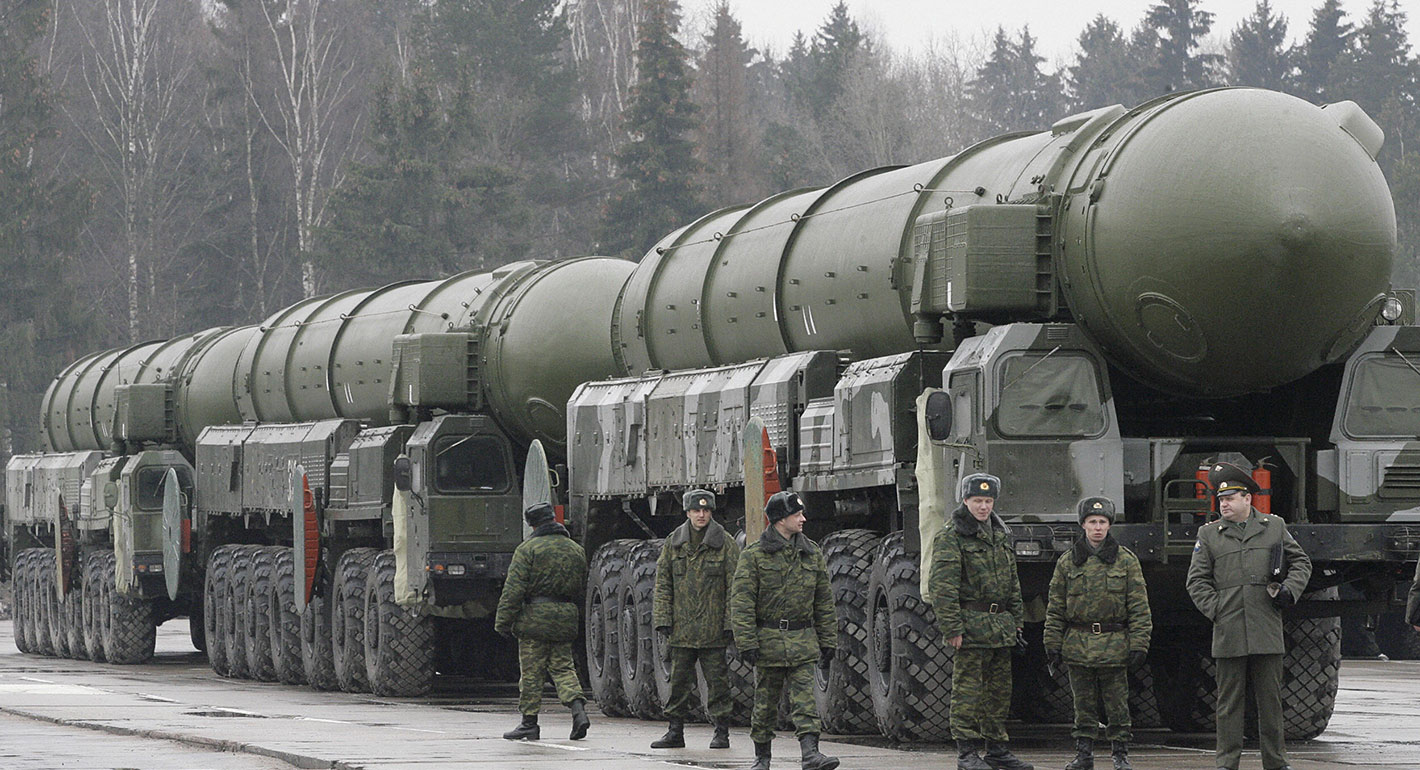
Russia is replacing older nuclear technology with more modern, more functional options. What are the implications for the United States, Europe, and the future of arms control?
In the big strategic game, the Russians and Americans have the same reason for modernizing their nuclear forces: they want to maintain parity. If the two sides have the same number of nuclear warheads deployed, then they will not be tempted to shoot at each other. They also have a reason to avoid an arms race that would entail constantly seeking more nuclear weapons to try to achieve superiority—however temporary. As expensive as nuclear weapons and their delivery vehicles are, parity has kept the costs down by holding the arms race in check.
In the past few years, President Vladimir Putin does seem to be after nuclear weapons for another reason—to show that Russia is still a great power to be reckoned with. He has been trumpeting new and exotic systems that are unique, like the nuclear weapon delivery system known as the Burevestnik nuclear-propelled cruise missile.
These exotic systems have more of a political function than a strategic or security one. Their role is to signal Russia’s continuing scientific and military prowess at a time when the country does not otherwise have much on offer. Devilishly expensive and sometimes dangerous to operate, they are unlikely to be deployed in big numbers, as a 2019 fatal testing accident of the Burevestnik shows. If U.S.-Russian arms control remains in place, such systems definitely will not be deployed in big numbers, because they would displace proven and highly reliable intercontinental ballistic missiles in the Russian force structure. These ballistic missiles are the backbone of nuclear deterrence for Russia. The exotics don’t add to that deterrent. They have some show-off value, but they will do no more than make the rubble bounce.
The Europeans, most prominently the NATO allies, are very concerned about Russia’s nuclear modernization programs. Their concerns revolve more around new nuclear missiles to be deployed on European soil than the intercontinental systems that threaten the United States. Poland and Lithuania, for example, are NATO countries bordering Kaliningrad, a Russian enclave in the heart of NATO territory. Russia has put increasingly capable missiles there, including the Iskander, a highly accurate modern missile that is capable of launching either nuclear or conventional warheads.
Likewise, the Europeans are of one mind about the threat posed by a missile known as the 9M729 (SSC-8 in NATO parlance), which is an intermediate-range ground-launched cruise missile that the Russians developed and deployed in violation of the Intermediate-Range Nuclear Forces (INF) Treaty. The allies all agree that this missile poses a threat to NATO. Although it has not been deployed forward in Kaliningrad, its range is sufficient to threaten all of NATO Europe when deployed in European Russia. It too is said to support both nuclear and conventional weapons.
Since Russia seized Crimea in 2014, the Russians have begun to build up basing sites for their advanced systems there too, including the Iskanders. If Russia brings nuclear weapons into Crimea, it will spark complex political, legal, and moral problems. The world community has largely held firm in condemning Russia’s seizure of Crimea and considers Crimea to be Ukrainian territory. Should Russia bring nuclear weapons to Crimea, it will be violating the Nuclear Non-Proliferation Treaty (NPT) in a fundamental manner, for Ukraine is a non-nuclear weapon state under the NPT. Russia in this case would be behaving in a manner no better than North Korea.
The most basic role of arms control regimes is to create mutual predictability, ensuring that no country participating is uncertain about its security both now and into the future. In this way, arms control helps to keep defense spending in check, but it also allows countries to build up mutual confidence and stability, which can translate into broader security and economic ties. This assumes, of course, that the deal is properly implemented by all parties, which is why former U.S. president Ronald Reagan’s old adage “trust but verify” is so important. If participants are allowed to cheat on an arms control regime, then it becomes hollowed out, detrimental to the security of all.
The fundamental benefits of arms control, however, can be helpful in times of trouble. I like to think that all the work Russia, the United States, and Europe did together in the 1990s was enabled by the then thirty-year legacy of arms control cooperation. We worked together to protect nuclear weapons and materials from the former Soviet arsenal from being stolen or misused. The same goes for the safety of nuclear power plants. When Ukraine, Russia, the European Union, and the United States began to work together in the early 1990s to mitigate the effects of the 1987 Chernobyl disaster, existing relationships in the nuclear realm helped the cleanup project run smoother. Nuclear energy is clearly a different world from the nuclear weapons establishment, but the scientific underpinnings and the scientists and engineers working the issues are the same.
Nowadays, I think that we must contemplate what it will mean if no nuclear arms control regimes remain in force. For the generation that worked these issues in Russia, the United States, and Europe, enough of a residual relationship exists that experts can grasp at opportunities for cooperation when they present themselves. Some mechanisms such as scientist-to-scientist dialogues are likely to remain, such as the Pugwash and Dartmouth dialogues and the National Academy of Sciences exchanges with the Russian Academy of Sciences. These were the first places where Soviet and Western scientists gathered together to confront the problems of nuclear war and to look together for solutions.
We should be concerned, however, that they may revert to the talk shops of the Cold War, with few opportunities to work together on practical projects. Meanwhile, pragmatic and persistent tools, such as the Nuclear Risk Reduction Centers (NRRCs) that operate in the U.S. Department of State and the Russian Ministry of Defense, may find their missions sharply curtailed as they cease to serve any treaty purpose. The United States, Russia, and Europe may thus be heading to a time when their means of communications in a nuclear crisis is no better than they had during the Cold War.

Nonresident Senior Fellow, Nuclear Policy Program
Rose Gottemoeller is a nonresident senior fellow in Carnegie’s Nuclear Policy Program. She also serves as lecturer at Stanford University’s Freeman Spogli Institute for International Studies and is a research fellow at the Hoover Institution. Ambassador Gottemoeller served as the deputy secretary general of NATO from 2016 to 2019.
Recent Work


Judy Dempsey, Alexander Gabuev, Rose Gottemoeller, …
Rose Gottemoeller
Carnegie does not take institutional positions on public policy issues; the views represented herein are those of the author(s) and do not necessarily reflect the views of Carnegie, its staff, or its trustees.

Funding Ukraine remains a priority for European leaders. As Russia’s war of aggression heads into another winter, two feasible options to mobilize support for Kyiv should be fast-tracked.


Vladyslav Rashkovan, Gregory P. Wilson

Russian strikes are weakening the economy sustaining Ukraine’s war effort. Closing the growing funding gap will require more European support and politically contentious reforms in Kyiv.

Balázs Jarábik

While the EU and European governments are embracing the much-lauded middle-power moment, this entails three difficult conundrums.

Richard Youngs

The middle power moment will not be defined by sovereign states alone, and California stands out for its potential contributions to international cooperation.


Ian Klaus, Stewart Patrick

Europe is facing rising populism internally as well as external pressures from Russia, China, Turkey, and the United States.

Dimitar Bechev