

Article
Paul Stronski
{
  "authors": [
    "Paul Stronski"
  ],
  "type": "commentary",
  "centerAffiliationAll": "dc",
  "centers": [
    "Carnegie Endowment for International Peace"
  ],
  "collections": [],
  "englishNewsletterAll": "ctw",
  "nonEnglishNewsletterAll": "",
  "primaryCenter": "Carnegie Endowment for International Peace",
  "programAffiliation": "russia",
  "programs": [
    "Russia and Eurasia"
  ],
  "projects": [],
  "regions": [
    "North America",
    "United States",
    "Caucasus",
    "Russia",
    "Azerbaijan",
    "Armenia"
  ],
  "topics": [
    "Security",
    "Foreign Policy"
  ]
}
Source: Getty
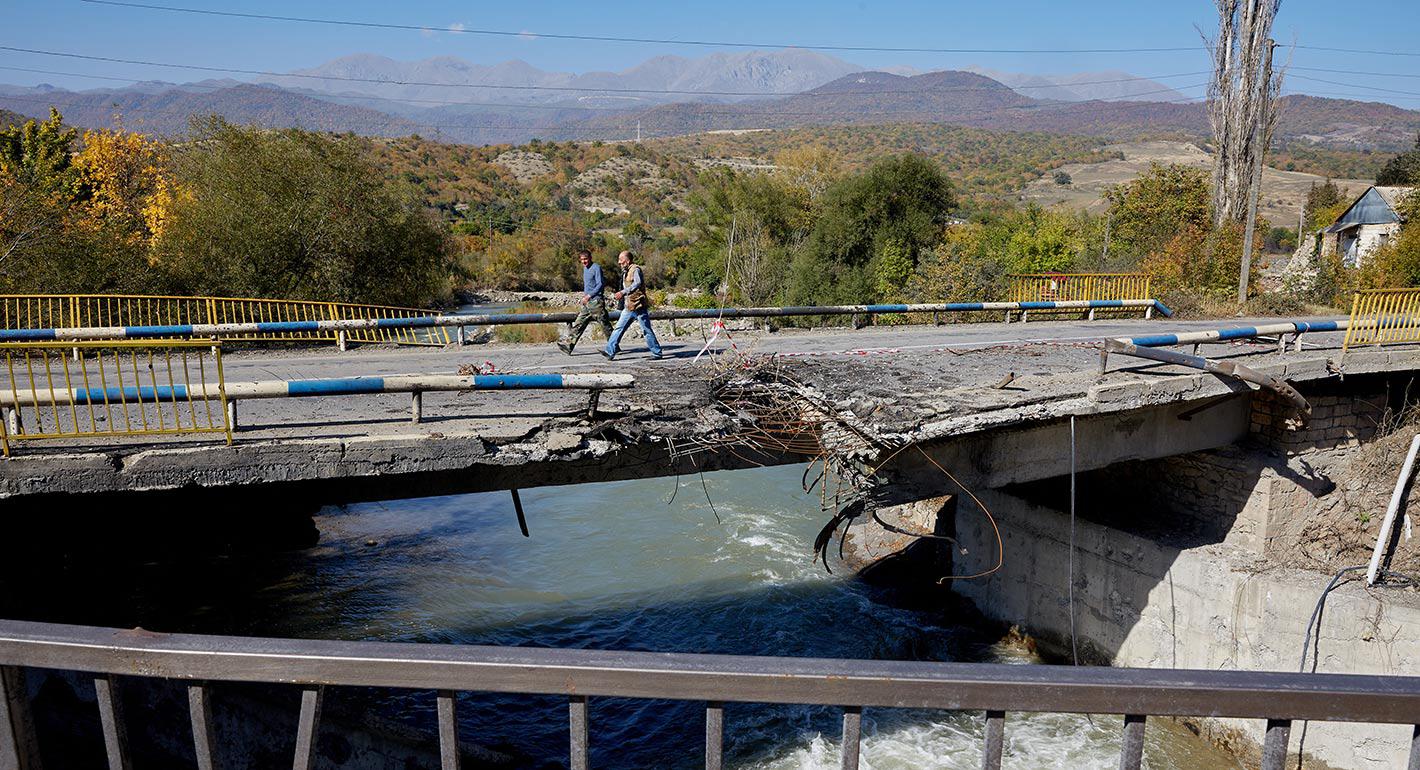
With the United States shrugging off its erstwhile role as the world’s policeman, can anyone stop the fierce fighting now raging between Armenia and Azerbaijan?
The 1914 assassination of Austrian Archduke Franz Ferdinand on a street corner in Sarajevo spurred World War I, a conflict that marked the dawn of the twentieth century’s industrial-scale brutality and bloodletting. This time, will an obscure corner of the South Caucasus be remembered as a similar turning point?
The long-running Nagorno-Karabakh conflict between Armenia and Azerbaijan, which dates to the waning days of the Soviet Union, is not going to trigger a global war. Nor will it affect the vital interests of the world’s great powers. Yet it shines a harsh spotlight on the unraveling post–Cold War world that the United States led for more than three decades. The United States and the European regional powers that previously cherished and protected these arrangements are now pulling back, along with the multilateral institutions they lead. Moreover, they are no longer displaying much unity of purpose when it comes to emerging powers, like Russia and Turkey, who want to carve out a bigger role for themselves in a multipolar world.
Recent calls for the United States to swoop in to stop the fighting seem quaint and outdated against the backdrop of U.S. global retreat that has accelerated over the past four years. U.S. President Donald Trump’s administration, which has yet to issue a coherent policy for the South Caucasus, has been irrelevant during this round of the Nagorno-Karabakh crisis. That’s not all that surprising given Trump’s recent coronavirus diagnosis, the demands of his reelection campaign, and the general dysfunction of his foreign policy team. Yet, even if Democratic nominee Joe Biden, who has urged a more robust U.S. diplomatic response to the crisis, becomes the forty-sixth U.S. president, Washington’s credibility and alliances are strained. Far-away regional conflicts are unlikely to spur much interest or action from an increasingly isolationist American public and a political leadership that faces far more pressing challenges at home, including a pandemic, a fragile economy, and deeply rooted racial injustice.
Europe is also distracted by its own problems: a second wave of coronavirus infections, the threat of a no-deal Brexit, and tensions swirling in the Eastern Mediterranean. Europe’s recent track record of conflict resolution (in the Central African Republic, Georgia, Libya, and Ukraine) offers little hope that it is up to the task. France—the obvious European power to step in given its mediation in recent South Caucasian conflicts such as the 2008 war in Georgia—is distrusted by Azerbaijan and Azerbaijan’s most important ally Turkey. Despite the efforts of France and the United States, NATO ally Turkey continues to pursue policies that conflict with the alliance’s interests, dealing a blow to Western credibility. Turkish President Recep Tayyip Erdogan is giving Russian President Vladimir Putin a run for his money when it comes to using low-cost and sometimes deniable methods to carve out influence and fill power vacuums. These are precisely the same tactics that Moscow has used in places like Libya, Syria, and Ukraine. The fact that they are being applied in Russia’s backyard—which no one would have predicted—is all the more remarkable. Indeed, it is now Turkey, not Russia, that is acting like the most adventurous power in Eurasia.
For more than a decade, Russia proclaimed that the South Caucasus was part of its privileged sphere of influence, warning the West to steer clear. Such pronouncements were rejected outright by the United States and its European allies, who portrayed Moscow as horribly out of touch with modern-day realities (even though they were hardly in a hurry to bring parts of the region into organizations like NATO or the EU). As an array of economic energy and political links blossomed, the Kremlin largely stood by, as it had relatively few competitive advantages in these areas.
While Russia has sold weapons to both Armenia and Azerbaijan, it appears that strong diplomatic backing and military support from outside powers (first, Turkey, and second, Israel) are making a big difference for Azerbaijan in the current fighting, which is the worst since the early 1990s. Azerbaijani forces are able to draw upon armed drones, long-range artillery systems, and the reported deployment of U.S.-made Turkish F-16s to Azerbaijan and hundreds of Syrian mercenaries.
For all the Western hand-wringing about the threat posed by Russian neo-imperialism since the war in Ukraine began in 2014, there are thinly disguised hopes in some quarters in the West that Russia will once again knock heads and bring Armenia and Azerbaijan back to the negotiating table. Yet the Kremlin continues to lag behind fast-moving events in its neighborhood—a reflection of the peculiarities of the Putin-centric decisionmaking apparatus and the persistence of blinkered thinking about neighboring countries. All too often, Moscow’s default response to new crises is to allege that the hidden hand of the West is stirring up trouble, while secretly hoping that any new fire will somehow burn itself out.
The other reality is that Putin is juggling multiple crises at the moment, which means that he hardly welcomes a new set of headaches in the Caucasus. The humanitarian ceasefire Moscow brokered between Armenia and Azerbaijan on October 10 unraveled almost immediately. The Belarus crisis remains extremely fragile. In recent days, Kyrgyzstan has once again descended into chaos. And a worsening COVID-19 outbreak in Moscow is forcing new shutdown measures.
Throughout the Trump era, Moscow has been eager to insert itself into hotspots in the Middle East and Africa—to highlight U.S. failures and to portray itself as a major power on the world stage. But Russia rarely is a problem solver and its interventions generally exacerbate instability. China, too, is more assertive globally and eager to benefit from a dysfunctional West. But while it has cash to throw around, cash is not a stabilizing force. Thus, the number of intractable conflicts is growing. The dynamics that grip parts of Africa, Libya, Syria, eastern Ukraine, Venezuela, and Yemen are now spreading to the Caucasus. With the West no longer capable or willing to lead this messy world, regional powers—Iran, Turkey, and the Gulf states, among others—are stepping in but not necessarily bringing order. That is a bad omen not only for Azerbaijan and Armenia but also for the many efforts aimed at maintaining peace and stability around the globe.

Former Senior Fellow, Russia and Eurasia Program
Paul Stronski was a senior fellow in Carnegie’s Russia and Eurasia Program, where his research focuses on the relationship between Russia and neighboring countries in Central Asia and the South Caucasus.
Recent Work
Paul Stronski
Paul Stronski
Carnegie does not take institutional positions on public policy issues; the views represented herein are those of the author(s) and do not necessarily reflect the views of Carnegie, its staff, or its trustees.

The EU can impose sanctions but struggles to enforce them without the United States. With Washington increasingly disinterested in backing European interests, the bloc must now fend for itself.


Nicu Popescu, Tiago Antunes
Global and rising powers will need to engage with Africa’s priorities and agency in order to secure the continent’s increasingly attractive partnerships.

Fonteh Akum

Rubio’s recent visit brought welcome attention, but more capital requires governance changes that may be a hard sell for regional governments.

Jennifer B. Murtazashvili
America’s foreign-policy objectives have grown more demanding while Americans have demanded greater focus on their own affairs.

Stephen Wertheim

Japan’s long-term security policy is driven by concerns about China, and there is little appetite for (or interest in) pursuing a confrontation with Moscow.

James D.J. Brown