


• Research
  • Emissary
  • About
  • Experts
Carnegie Global logoCarnegie lettermark logo
DemocracyIran
  • Donate
Human Rights in the Arab World: Independent Voices
Book

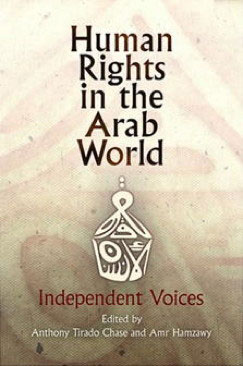
Human Rights in the Arab World: Independent Voices

Human Rights in the Arab World: Independent Voices offers perspectives from those at the forefront of research and debate at the intersection of human rights and Islam, globalization, transnational advocacy, and the politics of key states such as Egypt, Morocco, and Yemen.

Link Copied
By Amr Hamzawy and Anthony Chase
Published on Jun 1, 2006
Program mobile hero image

Program

Democracy, Conflict, and Governance

The Democracy, Conflict, and Governance Program is a leading source of independent policy research, writing, and outreach on global democracy, conflict, and governance. It analyzes and seeks to improve international efforts to reduce democratic backsliding, mitigate conflict and violence, overcome political polarization, promote gender equality, and advance pro-democratic uses of new technologies.

Learn More

Source: University of Pennsylvania Press

New in Paperback

Why have human rights been marginalized in the Arab world? How do we gauge the relevance of human rights in the region, given the political, social, and economic context? What are the practical and theoretical obstacles to the implementation of these rights?

Human Rights in the Arab World: Independent Voices offers perspectives from those at the forefront of research and debate at the intersection of human rights and Islam, globalization, transnational advocacy, and the politics of key states such as Egypt, Morocco, and Yemen. Some chapters provide essential historical background to current political realities, while others consider ways to confront this region's practical and theoretical challenges to human rights. By placing the question of human rights in the often tragic context of Arab politics, the very real stakes are made clear.

This book is available from University of Pennsylvania Press. To order the book from Penn Press, please click here.

Amr Hamzawy is Senior Associate at the Democracy and Rule of Law Project, Carnegie Endowment for International Peace.

Anthony Chase teaches in the Department of Diplomacy and World Affairs at Occidental College.


About the Authors

Amr Hamzawy

Director, Middle East Program

Amr Hamzawy is a senior fellow and the director of the Carnegie Middle East Program. His research and writings focus on Egypt’s and other middle powers’ involvement in regional security in the Middle East, particularly through collective diplomacy and multilateral conflict resolution

Anthony Chase

Authors

Amr Hamzawy
Director, Middle East Program
Amr Hamzawy
Anthony Chase
Middle EastNorth AfricaEgyptMoroccoYemenPolitical ReformDemocracyEconomy

Carnegie does not take institutional positions on public policy issues; the views represented herein are those of the author(s) and do not necessarily reflect the views of Carnegie, its staff, or its trustees.

More Work from Carnegie Endowment for International Peace

  • Commentary
    Sada
    Syria on the Brink of Water Scarcity: Climate Change, Drought, and Threats to Food Security

    Syria’s worsening drought is no longer a seasonal crisis. This report explains what climate change is doing to rainfall, groundwater, and food security, and what solutions experts say are still possible.

      Milia Esper

  • Commentary
    Strategic Europe
    There Is No Shortcut for Europe in Armenia

    Europe has an interest in supporting Armenian leader Nikol Pashinyan as he tries to make peace with neighbors and loosen ties with Russia. But it is depersonalized support in the long term, not quickfire flash, that will win the day.

      Thomas de Waal

  • Article
    From Labor Scarcity to AI Society: Governing Productivity in East Asia

    The debate over AI and work too often centers on displacement. Facing aging populations and shrinking workforces, East Asian policymakers view AI not as a threat, but as a cross-sectoral workforce strategy.

      Darcie Draudt-Véjares, Sophie Zhuang

  • Article
    Governing AI in the Shadow of Giants: Korea’s Strategic Response to Great Power AI Competition

    In its version of an AI middle power strategy, Seoul is pursuing alignment with the United States not as an endpoint but as a strategy to build industrial and geopolitical leverage. Whether this balance holds remains an open question.

      Darcie Draudt-Véjares, Seungjoo Lee

  • China Financial Markets
    Commentary
    China Financial Markets
    Is China’s High-Quality Investment Output Economically Viable?

    China’s rapid technological progress and its first-rate infrastructure are often cited as refuting the claim that China has been systematically overinvesting in non-productive projects for many years. In fact, as the logic of overinvestment and the many historical precedents show, the former is all-too-often consistent with the latter.

      Michael Pettis

Get more news and analysis from
Carnegie Endowment for International Peace
Carnegie global logo, stacked
1779 Massachusetts Avenue NWWashington, DC, 20036-2103Phone: 202 483 7600
  • Research
  • Emissary
  • About
  • Experts
  • Donate
  • Programs
  • Events
  • Blogs
  • Podcasts
  • Contact
  • Annual Reports
  • Careers
  • Privacy
  • For Media
  • Government Resources
Get more news and analysis from
Carnegie Endowment for International Peace
© 2026 Carnegie Endowment for International Peace. All rights reserved.










