

Commentary
Are Germany’s economic, industrial, and political struggles becoming a liability for the EU’s ability to rise to the geopolitical moment?
Rym Momtaz, ed.
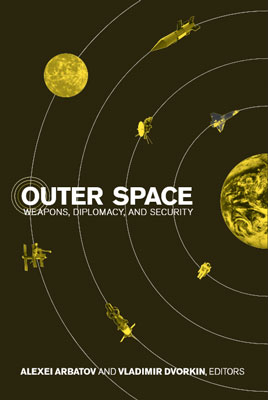
In this global era, the world faces a host of security challenges which cannot be resolved by any one nation, especially through the unilateral use of military force. One key issue that requires urgent international attention is the military use of outer space.
Source: Washington

This collection of essays by leading Russian experts analyzes how many countries are using outer space for military purposes. Adapted from the Russian version, Outer Space: Weapons, Diplomacy, and Security describes the space weapons programs of various countries. It details the history of negotiations to prevent, or at least control, the weaponization of space, including analyses of the political, military, technical, and legal problems facing negotiators trying to avoid a catastrophic new space race.
Download a free limited preview.
"As the globalization of economic, political, military, and technological development expands the realm of activity in outer space, this volume provides a compelling road map on how to avoid future conflicts in a critical arena."
—Jessica T. Mathews, President, Carnegie Endowment for International Peace
Alexey Arbatov
Alexey Arbatov is the head of the Center for International Security at the Primakov National Research Institute of World Economy and International Relations.
Vladimir Dvorkin
Major General Dvorkin (retired) is a chief researcher at the Center for International Security at the Institute of World Economy and International Relations.
Carnegie does not take institutional positions on public policy issues; the views represented herein are those of the author(s) and do not necessarily reflect the views of Carnegie, its staff, or its trustees.

Are Germany’s economic, industrial, and political struggles becoming a liability for the EU’s ability to rise to the geopolitical moment?

Rym Momtaz, ed.

Russia’s ruling party would have benefited from Putin appearing as its distant patron, but as an active frontman imposing his views on the public, he has done nothing but harm both the party’s election campaign and the ruling system overall.

Andrey Pertsev

China’s police training infrastructure construction projects provide benefits to recipient countries, promote China’s image as a major global security provider, and are likely to reinforce alignment between Beijing’s security priorities and those of countries in the Global South.


Cameron Waltz, Sheena Chestnut Greitens, Kim Nguyen, …
They face an uphill climb, but they could draw on a strategy that other diplomats have used in the past.


Shana Tabak, Alejandro Martin Rodriguez

European Commission President Ursula von der Leyen is about to give her annual address on the state of the EU. Here’s what she won’t—but should—say.
Rym Momtaz