

Article
James F. Collins
Source: Getty
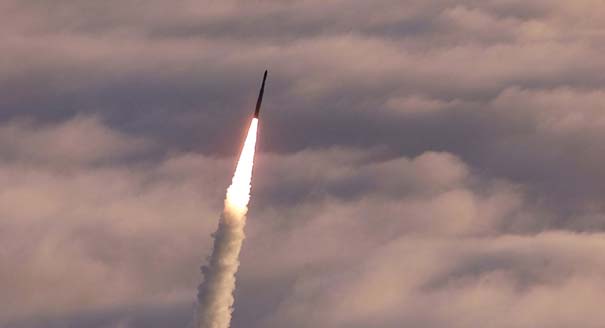
Europe, Russia, and the United States can take steps to build trust and find a way to work together cooperatively on missile defense.
North Korea’s recent missile test, although a failure, was a salutary reminder of the dangers of missile proliferation. A hostile state armed with a weapon of mass destruction and a missile delivery system is a matter of concern to governments everywhere. So you might imagine that a shared dilemma of this kind should motivate leaders toward shared solutions. But sadly, this is not the case to date.
While North Korea may have nuclear technology and is clearly still struggling to master the missile, Iran on the other hand—a country that is seemingly seeking a nuclear weapon—already has the missile technology to project a weapon of mass destruction into large parts of Russia and Europe. And yet despite this shared emergent threat, Europe, Russia, and the United States have been unable to find a way to work together cooperatively on this issue.
For two decades, NATO and Russia have pursued the development of separate but parallel missile shield projects. All efforts to create cooperative programs of defense have foundered on the fear that national security will be weakened by working together. In fact the opposite is the case: cooperation offers the enormous advantage of better early warning.The greatest challenge of building a successful missile defense program is being able to defeat countermeasures, such as decoys, that might be added to a missile to complicate the task of intercepting it. Distinguishing between decoys and real warheads is extremely difficult and the United States cannot currently do so. The Pentagon’s “work around” solution is to hope to hit missiles early in flight before any countermeasures can be deployed. For this reason, early detection isn't just nice, it's critical to success.
Say for instance that an intermediate range missile emerges from the south and crosses over Azerbaijan, Georgia, and Russia before heading into Eastern Europe. Because of their southern position, the Russian radars would pick up such a missile earlier than any NATO radar. By the time it had been positively identified as an incoming threat that must be shot down, it could well be over a NATO country, giving NATO the best chance to shoot it down. But because there was no information-sharing between Russia and NATO, the chances of a successful strike will have been lessened dramatically.
Four months ago, a joint Russian, American, and European working group issued an important paper, Missile Defense: Toward a New Paradigm. This laid out the first pathway toward a workable common missile defense strategy for the entire Euro-Atlantic community. The working group was independent of any government and was led by Stephen Hadley, former president George W. Bush’s national security adviser, Vyacheslav Trubnikov, the former head of Russia’s Foreign Intelligence Service, and Volker Rühe, the former defense minister of Germany. It was part of a wider initiative called the Euro-Atlantic Security Initiative (EASI).
The working group’s main recommendation is a very simple one: that Russia and NATO should establish a system for “pooling” all early warning missile data from their respective satellite and radar sensors. This data would be sent in real time to “cooperation centers” that would be staffed jointly by Russian and NATO officials working together to provide a complete picture of the threat environment and notification of ballistic missile attack.
Protocols could be drawn up that would commit one party to intercept a missile that was flying over its territory aimed at the territory of another party. In other words, whoever had the best chance of shooting it down would do so. This would not preclude either side, however, from attempting to shoot it down through their own command and control system if they deemed it necessary for their own security. There would be no compromise of sovereignty—contrary to claims often made by hawks in both the U.S. Congress and the Russian Duma. Each party would still be free to protect its own territory.
Missile defense has been a toxic issue between Russia and the United States for more than two decades. Deep distrust, lingering Cold War habits, and an absence of political will have all contributed to the failure to find a way to move from conflict to cooperation on missile defense. But the recommendations by this group offer a common sense solution. By working together and by training together, senior NATO and Russian military officials would start to build up trust, which over time could lead to an improved security climate for the entire region. And where better to start than by collaborating on a threat that both sides face. When it comes to the danger of missile attack, no country is an island.
Nonresident Senior Fellow, Russia and Eurasia Program; Diplomat in Residence
Ambassador Collins was the U.S. ambassador to the Russian Federation from 1997 to 2001 and is an expert on the former Soviet Union, its successor states, and the Middle East.
Recent Work
James F. Collins
Dmitri Trenin, James F. Collins
Carnegie does not take institutional positions on public policy issues; the views represented herein are those of the author(s) and do not necessarily reflect the views of Carnegie, its staff, or its trustees.

Rubio’s recent visit brought welcome attention, but more capital requires governance changes that may be a hard sell for regional governments.

Jennifer B. Murtazashvili

America’s foreign-policy objectives have grown more demanding while Americans have demanded greater focus on their own affairs.

Stephen Wertheim

Japan’s long-term security policy is driven by concerns about China, and there is little appetite for (or interest in) pursuing a confrontation with Moscow.

James D.J. Brown

Russia is testing the waters of NATO’s mutual defense clause. What do strikes in Romanian territorial waters mean for the alliance’s posture toward Moscow?

Dimitar Bechev

China has showcased its engineering prowess with small modular reactor demonstration projects. But turning these technological achievements into commercial success will be a greater challenge.

Tong Zhao