

In The Media
Pang Xun
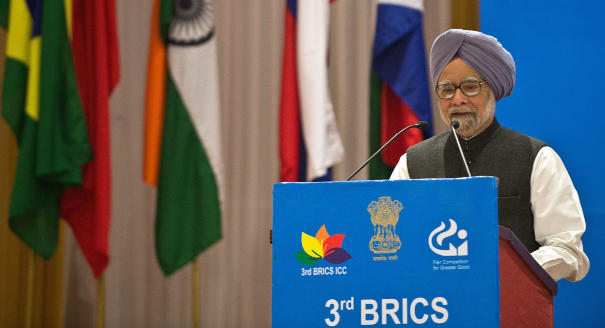
Source: Getty
While the collective economic power of Brazil, Russia, India, China, and South Africa may be waning, the foundation of the group’s political partnership remains strong.
After a decade as the darling of the economic world, the BRICS group is rumored to be facing its demise. While the collective economic power of Brazil, Russia, India, China, and South Africa is indeed waning, the foundation of the group’s political partnership remains strong. Even as China pulls ahead of other countries in terms of economic might, political cooperation will ensure that the BRICS remains a salient grouping in the years to come.
The BRICS group began as an international political force when Russia initiated a meeting with Brazil, India, and China in 2006. Four years later, China invited South Africa to join the club. And today, the BRICS nations are the self-selected representatives of the world’s emerging economies and developing countries, collectively leading a challenge to Western-dominated international governance. However, most predictions about the association’s future—which are based on the assumption that BRICS is, first and foremost, an economic grouping—regard its demise as imminent.
In recent years, talk of the breakdown of the BRICS and the attendant rise of some new group of emerging countries has come into fashion. Even Goldman Sachs, whose economist Jim O’Neill first coined the catchy acronym BRICs (then without South Africa) in 2001, considered replacing the grouping with the Next 11—Bangladesh, Egypt, Indonesia, Iran, Mexico, Nigeria, Pakistan, the Philippines, Turkey, South Korea, and Vietnam. But Next 11 was not nearly as catchy as BRICS, and Goldman Sachs’s campaign had limited success.After a series of lesser-known proposals that have not gained much traction, MINT (short for Mexico, Indonesia, Nigeria, and Turkey) has joined the field. MINT is the current front-runner to be the next stylish acronym—even O’Neill has endorsed the grouping.
Can the BRICS survive as a meaningful concept in this post-BRICS world—one in which global growth is powered by MINT or any other combination of letters and countries?
It is clear that few commentators seriously believe the BRICS grouping is a bloc. With the exception of economic performance and influence—both amorphous concepts—the BRICS group lacks a shared defining characteristic.
And even the economic performance component is open to debate. It is increasingly clear that these countries lack economic mortar. Economist Paul Donovan recently sought to explain “the failure of BRICs as an economic concept.” It seems his choice of phrase could be right.
The economic era of the BRICS may have been an illusion fashioned by economic stylists. Recent economic performance has been lackluster, and—with the exception of China—the BRICS countries have not lived up to their predicted role as powerhouses of global economic growth.
Moreover, as a group, the BRICS countries should in theory follow similar development models and have a shared vision of the future if they are to be a real bloc. But they share neither of these characteristics.
The BRICS nations are so heterogeneous that it is often unclear what differentiates them from other countries. South Africa’s acceptance seems to have done nothing more than change the lowercase “s” in BRICs to an uppercase one. And if South Africa qualified for inclusion in the group, then why not Turkey, Mexico, Indonesia, or any other relatively strong performer in the world of emerging economies? Including Egypt, for example, as was proposed by former Egyptian president Mohamed Morsi would yield E-BRICS—more suitable to the electronic era. Similarly, Forbes proposed expanding BRICS into BRICSDVIKS by adding Dubai, Vietnam, Indonesia, Korea, and Singapore to the mix.
These expansion proposals unambiguously suggest that the grouping is not well delineated. Any emerging economy with good economic performance and regional influence seems to be a candidate to join the club.
Regardless of whether the BRICS association has ever been considered a proper economic concept, the group seems unlikely to survive in the future as one.
Nevertheless, it was not economic but rather political calculations that inspired the BRICS countries to take advantage of the catchy label and cooperate. They did not think of themselves as a category until several years after the term was coined. They might have been flattered by O’Neill’s initial assertions that they would be the next big thing, but at the outset they seemed to lack an understanding of how to translate his statements into reality.
But words have power, and with repetition and time, they can create an identity, provide justifications for certain behaviors, and change people’s perceptions of the world. In 2006, the BRICs countries finally realized that there was value in the grouping beyond a catchy name. They determined that they could use the already-established label to launch a new international political entity.
The political and strategic aims of this effort were demonstrated by the countries’ decision to invite South Africa to join the grouping. South Africa’s economic size, influence, and growth rate make it an economic lightweight in comparison to the other BRICS countries. But from a political perspective, including South Africa significantly expands the BRICS group’s global network and increases its representativeness.
Thus, the BRICS countries refashioned themselves as a political concept, one that could easily outlast the economic relevance of the group. The BRICS have much more substance as a political grouping than as an economic one. All of the countries are ambitious regional powers with the will and capability to challenge the Western status quo—particularly once they join forces.
The BRICS countries are still only loosely associated with one another. The rhetoric of cooperation and their yearly summits make for a good show but lack substance. Some argue that there remains an insufficient convergence of interests among the BRICS nations to ensure their cooperation as a bloc.
However, the BRICS countries all see themselves as rising powers in a system dominated by the West, and they would like global governance to reflect their increasing importance. What would an international order remade in the image of the BRICS look like? That remains unclear. The BRICS countries may have different answers to this question. But they share one vitally important characteristic—they are dissatisfied with the existing order and believe that together they can generate change.
In particular, they have a shared interest in challenging the current governance of Western financial institutions like the International Monetary Fund and the World Bank. This common interest is strong enough to hold the BRICS together.
And while their multilateral cooperation may not be substantive, even seemingly superficial interactions reflect the political importance of the grouping to its constituent countries. As long as the BRICS nations are not happy with their international standing and influence in global governance and affairs, the grouping will remain a useful means for challenging the existing order—including in Beijing’s eyes.
China’s behemoth economic status relative to the other countries is frequently pointed out as a reason why the BRICS group is likely to collapse. If the BRICS countries viewed the grouping as primarily economic in nature, that would be true. But looking at the BRICS as a political grouping predicts the opposite course.
Beijing has no plans to abandon its traditional policy of nonalignment, but it is nevertheless eager to increase its involvement and influence in international affairs and governance. To do this, it needs to create its own networks rather than participate as a peripheral member in existing systems created and dominated by the West. The BRICS grouping is the cornerstone of China’s attempt to create parallel international governance networks, and Beijing is committed to using its vast resources to keep the BRICS concept alive and pertinent.
As an economic concept, the BRICS may never have been relevant. But a strong political basis for the grouping exists and has staying power—regardless of whether the new sweetheart of the economic world is the Next 11, BASIC, VISTA, CIVET, EAGLES, E11, or MINT.
This article was published as part of the Window into China series
Former Resident Scholar, Carnegie-Tsinghua Center for Global Policy
Pang Xun was a resident scholar at the Carnegie-Tsinghua Center until June 2020.
Recent Work
Pang Xun
Pang Xun
Carnegie does not take institutional positions on public policy issues; the views represented herein are those of the author(s) and do not necessarily reflect the views of Carnegie, its staff, or its trustees.

Despite public disputes over trade and immigration, the strategic partnership’s foundations remain sturdy.

Sameer Lalwani

Russia spent years building a “sovereign internet,” concentrating web infrastructure exclusively within Russian territory. Ukrainian drone attacks have shown how vulnerable that approach has left the Russian internet.

Maria Kolomychenko

With its public finances in shambles, the far right polling at 35 percent ahead of the 2027 presidential election, and a growing protest movement, is France’s crisis a threat to the EU’s geopolitical awakening?

Rym Momtaz, ed.

Putin’s conservative staffing policies and search for ever greater control have cemented parliament’s transformation into a bureaucratic appendage of the executive branch.

Andrey Pertsev

Russia’s AI-driven propaganda campaigns operate in a fragmented, chaotic, and often illogical manner. That’s not necessarily a problem for the Kremlin, though: It’s much easier to mimic genuine public debate that way.

Ilya Klishin