

Commentary
- +1
Paul Haenle, Xue Gong, Ngeow Chow Bing, …
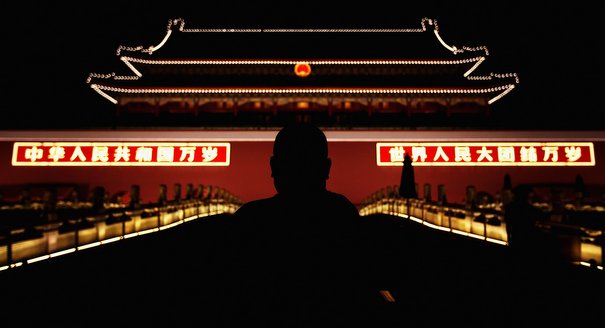
Source: Getty
China is unusually secure in its policy of nonintervention in the Syrian conflict. But will strong rhetoric and vetoes be enough?
This piece is part of the Global Dynamics of the Syrian Conflict series, in which Carnegie experts from all over the world analyze the strategic and geopolitical interests at play in the ongoing civil war. View the full series here.
While a debate rages in Washington over missed opportunities and future action to address Syria’s deteriorating humanitarian crisis, China appears unusually secure in its Syria policy. From the perspective of Beijing, China’s opposition to external interference and its ability to remain neutral have helped prevent foreign military intervention in Syria while protecting vital Chinese economic interests in the region. Despite calls and criticism that it should be playing a more active role, Beijing believes its handling of the Syrian crisis will stand the test of time.
China has calculated that its main economic interests in the Middle East—energy supplies and commercial relations—are not directly threatened by the Syrian civil war. Compared to other countries in the region, Syria is not a major oil producer or exporter. And Syria is not Beijing’s strategic partner.
While spillover from the conflict threatens the stability of neighboring oil-rich nations, in China’s view that risk does not justify contradicting its long-standing foreign policy principles of noninterference. With lessons from Libya still fresh, China has vetoed all three UN Security Council resolutions aimed at condemning or imposing sanctions on Bashar al-Assad’s regime, as well as the May 2014 resolution calling for allegations of war crimes carried out in Syria to be referred to the International Criminal Court.Instead, Beijing has called for a diplomatic resolution to the three-year-long conflict and has been eager to project an image of a responsible major power. The Chinese navy has participated in the escort and surveillance of chemical weapons from Syria under the deal the United States and Russia brokered, and China supported UN Security Council resolution 2139 that called for an increase in access to humanitarian aid in Syria. Finally, China has made great efforts to distinguish its position from that of Russia and show it is not taking sides in the conflict. Chinese Foreign Minister Wang Yi put forward a five-point proposal for the resolution of the conflict in January 2014, and China has played host to leading opposition figures, such as the head of the officially recognized opposition coalition, the National Coalition for Syrian Revolutionary and Opposition Forces, Ahmad al-Jarba in April 2014 and a delegation from the All-Nation Union for Dialogue in September 2013.
China’s policy of noninterference has not been problem-free, however. As the conflict endures, Chinese leaders have expressed increasing concern that Syria is becoming a breeding ground for terrorism directed at China. Chinese officials have blamed opposition forces for training Uighur extremists. And they are worried that the continuation of the Syrian conflict will affect China’s internal security and lead to the proliferation of terrorists in Xinjiang Province.
Beijing’s opposition to action at the UN has also caused strains in its bilateral relations with Gulf countries, particularly Saudi Arabia, which has supported Syrian opposition groups. In 2012, Saudi King Abdullah made a rare, sharp criticism of China’s UN Security Council vetoes. Bilateral negotiations, including on the China–Gulf Cooperation Council (GCC) free trade zone, were stalled, leading to concern among the Chinese leadership. But since then, Chinese scholars believe that Gulf states have come to understand, and even accept, the reasoning behind China’s staunch commitment to its principle of nonintervention and refusal to support more forceful involvement in Syria. During former premier Wen Jiabao’s official tour of the Gulf region in 2012, for example, all countries expressed their desire to increase activities with China. In March 2014, Saudi Crown Prince Salman bin Abulaziz al-Saud visited China, and the China-GCC free trade agreement was one of the key topics on the agenda.
In the eyes of many in Beijing, these developments have validated China’s approach to the Syrian conflict. As they see it, China has been able to expand its economic footprint in the Middle East without taking unnecessary diplomatic risks or contradicting its established foreign policy principles. According to many Chinese scholars, such reassurances have led China’s new, more confident generation of leaders to more strongly oppose Western action in Syria and defend Chinese policies in the face of international criticism.
Nonetheless, other experts have urged that China not mistake its economic power of attraction for international acceptance of its foreign policy. Although members of the international community have unquestionably strong interests in preserving good trade and commercial ties with the world’s second-biggest economy and largest consumer market, many countries are now looking to China to play a greater leadership role in working to resolve the Syrian conflict—one commensurate with China’ economic weight.
The international community, like China, would also prefer a political solution to the Syrian conflict, but given failed peace initiatives, a near-term resolution appears highly unlikely. Beijing’s new leadership is eager for China to be respected as a great power on the world stage. But can simply calling for dialogue and criticizing the approaches of other major powers deliver China the respect it seeks?
China is becoming too big, rich, and internationally interconnected to continue to leave the heavy-duty diplomatic work to other major powers while it focuses solely on its domestic challenges. On these and other global issues, Beijing will need to instead begin looking inward and ask: What effective and constructive solution can China put forward that will help turn the situation around?
On Syria, China has an important stake in holding Assad accountable for using chemical weapons, massacring his people, and destabilizing a region that is of growing strategic interest to Beijing. As China continues its rise to global leadership, the international community will increasingly look to China to begin developing its own original ideas and solutions to global challenges, actively presenting them for consideration by the international community and taking ownership of them. Strong rhetoric and vetoes will not be enough.

Former Maurice R. Greenberg Director’s Chair, Carnegie China
Paul Haenle held the Maurice R. Greenberg Director’s Chair at the Carnegie Endowment for International Peace and is a visiting senior research fellow at the East Asian Institute, National University of Singapore. He served as the White House China director on the National Security Council staffs of former presidents George W. Bush and Barack Obama.
Recent Work


Paul Haenle, Xue Gong, Ngeow Chow Bing, …

Paul Haenle, Chong Ja Ian
Carnegie does not take institutional positions on public policy issues; the views represented herein are those of the author(s) and do not necessarily reflect the views of Carnegie, its staff, or its trustees.

The EU can impose sanctions but struggles to enforce them without the United States. With Washington increasingly disinterested in backing European interests, the bloc must now fend for itself.


Nicu Popescu, Tiago Antunes

Rubio’s recent visit brought welcome attention, but more capital requires governance changes that may be a hard sell for regional governments.

Jennifer B. Murtazashvili

America’s foreign-policy objectives have grown more demanding while Americans have demanded greater focus on their own affairs.

Stephen Wertheim

Japan’s long-term security policy is driven by concerns about China, and there is little appetite for (or interest in) pursuing a confrontation with Moscow.

James D.J. Brown

Russia is testing the waters of NATO’s mutual defense clause. What do strikes in Romanian territorial waters mean for the alliance’s posture toward Moscow?

Dimitar Bechev