

• Research
  • Emissary
  • About
  • Experts
Carnegie Global logoCarnegie lettermark logo
DemocracyIran
  • Donate
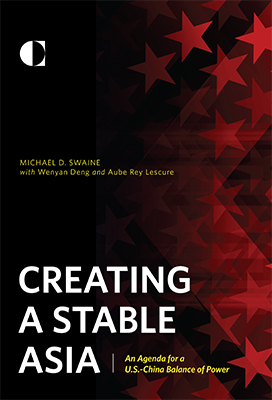
Creating a Stable Asia: An Agenda for a U.S.-China Balance of Power
Report
Carnegie China

Creating a Stable Asia: An Agenda for a U.S.-China Balance of Power

The Western Pacific is experiencing a fundamental and potentially destabilizing military and economic power transition driven primarily by China’s economic and military rise and a corresponding relative decline in American power

Link Copied
By Michael D. Swaine, Wenyan Deng, Aube Rey Lescure
Published on Oct 26, 2016

Additional Links

Full Text
Program mobile hero image

Program

Asia

The Asia Program in Washington studies disruptive security, governance, and technological risks that threaten peace, growth, and opportunity in the Asia-Pacific region, including a focus on China, Japan, and the Korean peninsula.

Learn More

The Western Pacific is experiencing a fundamental and potentially destabilizing military and economic power transition driven primarily by China’s economic and military rise and a corresponding relative decline in American power. Efforts by the United States or China to secure future predominance will prove futile and dangerous, given a host of security, economic, and diplomatic factors. Instead, creating a stable de facto balance of power is necessary and feasible for both countries. This shift could take the form of a more durable balance that would necessitate major regional changes that would be difficult to achieve, or a more feasible but less stable balance involving more modest adjustments. The incremental, conditional process this would entail involves developing domestic consensus, securing allied and friendly support, deepening U.S.-China dialogue, and achieving interlinked changes in several existing regional security policies.

The Emerging Western Pacific Order

  • This trend of power transition and heightened instability is highly likely to deepen. China will almost certainly manage to significantly increase its economic and military capabilities vis-à-vis the United States and its allies. Moreover, Washington and Beijing handle volatile regional issues very differently, and their respective offense-oriented escalatory military doctrines are likely to persist under existing conditions, increasing the likelihood of severe crises. Key U.S. allies will probably remain unwilling and unable to compensate for America’s relative decline.
  • Achieving a stable balance of power requires that the countries concerned develop the commitment to overcome significant obstacles. The magnitude and scope of relative military and economic strength between the major powers of the region are decisive in determining the pace, scale, and intensity of security competitions. Delaying or futilely pursuing either Chinese or American predominance will put the region at greater risk. The most stable and preferable outcome would involve major changes to volatile regional hotspots, whereas a more modest vision would be more feasible albeit less stable.
  • Both versions of such a balance would entail some common elements. These include: mutual denial force postures and military doctrines including confidence-building measures, voluntary arms limitations, and other steps; limited freedom-of-navigation operations to verify the regional balance and assert international law; and a strengthened but limited U.S.-Japan security relationship. Balance of power arrangements can and do emerge naturally but must be deliberately calibrated and adjusted via a process of understandings to become stable. To reach such understanding, it will be necessary to overcome the inertia of large, complex governments and both sides’ cultural hubris and bureaucratic and political biases.
  • In other respects, a more durable balance would require more sweeping regional changes than its less preferable but more achievable alternative. A highly stable balance would necessitate substantial progress on several security hotspots, including the creation of a unified, largely nonaligned Korean Peninsula, a demilitarized Taiwan Strait, and militarily limited, jointly developed East and South China Seas. It would also encompass a more open economic environment characterized by an inclusive, region-wide trade and investment agreement. A more attainable though less stable balance instead would involve joint efforts to sustain a regional free trade and investment system short of a comprehensive regional trade agreement, as well as shared understandings regarding potential crisis contingencies on the Korean Peninsula and Taiwan.

Policy Recommendations

  • Washington and Beijing must conduct a serious, comprehensive, probability-based internal assessment of long-term regional economic, military, and political trends. On the U.S. side, the deliberate pursuit of a balance would start by clearly understanding continued American strengths in Asia, as well as the difficulties and dangers involved in achieving a stable balance. It does not require Washington to make deals with Beijing from a position of weakness—in fact, it necessitates effectively using America’s substantial military and economic power.
  • Initial discussions with Beijing should aim to ultimately create a larger set of understandings about long-term regional security and its requirements. U.S. officials should convey willingness to consider broader mutual policy adjustments involving confidence-building measures, crisis management mechanisms, and surveillance activities near China if sufficient progress is made.
  • Washington must consult with regional allies and friends at every step in this process. Areas of focus should include gaining acceptance of a strengthened but limited U.S.-Japan alliance, obtaining South Korean approval of the transition to a stable balance, and reaching agreement on the most optimal long-term status for the Korean Peninsula.
  • Washington should have detailed discussions with allies and China about mutual limits on the types and numbers of their offensive weapons systems. China needs to agree to similar types of capabilities and limits, as well as specific demilitarization assurances provided as part of future agreements reached with regard to Taiwan and maritime territorial disputes. The difficulties of transitioning to a mutual denial force posture (including verification, definitions, bureaucratic problems, and ally coordination) make it vital that early consultations are successful.
  • The United States, China, and other regional economies must strengthen their domestic economic growth and deepen their commitments to free trade. Successful long-term integration will depend on getting Beijing and Washington to join a common trade architecture, creating an eventual region-wide free-trade agreement, and conducting more active and focused U.S. economic diplomacy.

Read Full Text

About the Authors

Michael D. Swaine

Former Senior Fellow, Asia Program

Swaine was a senior fellow at the Carnegie Endowment for International Peace and one of the most prominent American analysts in Chinese security studies.

Wenyan Deng

Former Junior Fellow, Asia Program

Aube Rey Lescure

Former Research Assistant, Asia Program

Authors

Michael D. Swaine
Former Senior Fellow, Asia Program
Michael D. Swaine
Wenyan Deng
Former Junior Fellow, Asia Program
Aube Rey Lescure
Former Research Assistant, Asia Program
North AmericaUnited StatesEast AsiaChinaJapanSecurityArms ControlForeign Policy

Carnegie does not take institutional positions on public policy issues; the views represented herein are those of the author(s) and do not necessarily reflect the views of Carnegie, its staff, or its trustees.

More Work from Carnegie Endowment for International Peace

  • Commentary
    Diwan
    Shockwaves Across the Gulf

    The countries in the region are managing the fallout from Iranian strikes in a paradoxical way.

      • Angie Omar

      Angie Omar

  • Commentary
    Strategic Europe
    Taking the Pulse: Is France’s New Nuclear Doctrine Ambitious Enough?

    French President Emmanuel Macron has unveiled his country’s new nuclear doctrine. Are the changes he has made enough to reassure France’s European partners in the current geopolitical context?

      • Rym Momtaz

      Rym Momtaz, ed.

  • Commentary
    The Iran War’s Dangerous Fallout for Europe

    The drone strike on the British air base in Akrotiri brings Europe’s proximity to the conflict in Iran into sharp relief. In the fog of war, old tensions in the Eastern Mediterranean risk being reignited, and regional stakeholders must avoid escalation.

      Marc Pierini

  • Commentary
    Diwan
    The U.S. Risks Much, but Gains Little, with Iran

    In an interview, Hassan Mneimneh discusses the ongoing conflict and the myriad miscalculations characterizing it.

      Michael Young

  • Indian Prime Minister Narendra Modi, wearing an orange cap, and the Chief Minister of Uttar Pradesh, Yogi Adityanath, dressed in saffron robes, are greeting supporters of the Bharatiya Janata Party (BJP) during a roadshow ahead of the Indian General Elections in Ghaziabad, Uttar Pradesh, India, on April 6, 2024.
    Paper
    India’s Foreign Policy in the Age of Populism

    Domestic mobilization, personalized leadership, and nationalism have reshaped India’s global behavior.

      Sandra Destradi

Get more news and analysis from
Carnegie Endowment for International Peace
Carnegie global logo, stacked
1779 Massachusetts Avenue NWWashington, DC, 20036-2103Phone: 202 483 7600Fax: 202 483 1840
  • Research
  • Emissary
  • About
  • Experts
  • Donate
  • Programs
  • Events
  • Blogs
  • Podcasts
  • Contact
  • Annual Reports
  • Careers
  • Privacy
  • For Media
  • Government Resources
Get more news and analysis from
Carnegie Endowment for International Peace
© 2026 Carnegie Endowment for International Peace. All rights reserved.