

Commentary
Thomas de Waal
{
  "authors": [
    "Thomas de Waal"
  ],
  "type": "legacyinthemedia",
  "centerAffiliationAll": "dc",
  "centers": [
    "Carnegie Endowment for International Peace",
    "Carnegie Europe"
  ],
  "collections": [],
  "englishNewsletterAll": "ctw",
  "nonEnglishNewsletterAll": "",
  "primaryCenter": "Carnegie Europe",
  "programAffiliation": "russia",
  "programs": [
    "Russia and Eurasia"
  ],
  "projects": [],
  "regions": [
    "North America",
    "United States",
    "Caucasus",
    "Georgia"
  ],
  "topics": [
    "Economy",
    "Security",
    "Military",
    "Foreign Policy"
  ]
}
Source: Getty
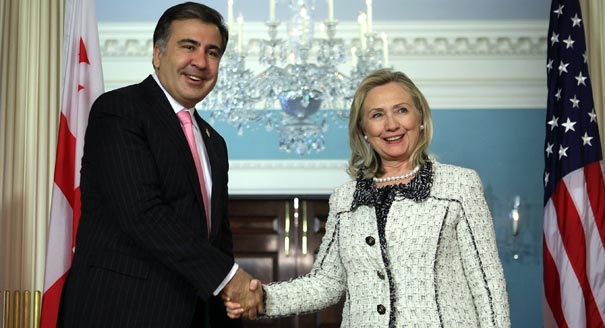
The Obama administration faces conflicting interests in its relations with Georgia, especially as the United States tries to pursue the reset in its bilateral relationship with Russia.
Source: National Interest

That is forgivable hyperbole. The January 30 meeting of the two presidents, Obama and Saakashvili, was primarily about the meeting itself. Saakashvili had long sought the symbolic achievement of an Oval Office meeting with Barack Obama, having had two with George W. Bush. As for Obama, his Freudian slip, when he started to say “Russia” and then corrected himself to “Georgia,” told us a lot about what was on his mind. For Obama, it is important to be able to defend himself against accusations by candidate Romney or Gingrich that he had “thrown Georgia under the bus” because of his reset policy with Russia. Saakashvili’s phrase—“I’ll be leaving this office very happy”—will have made the U.S. president happy too.
The result is a dance where the Georgians talk about weapons and NATO and lobby Congress hard on these issues, and the White House burnishes its language of equivocation. After their Oval Office meeting, Obama said, “We will continue to strengthen our defense cooperation,” and “The United States will continue to support Georgia’s aspirations to ultimately become a member of NATO.” The lack of clarity here confirms the impression that this administration will look for new types of military cooperation that do not involve weapons sales and that in Chicago they will try to duck the Georgia issue in deference to European allies, who have been allergic to the Georgia-in-NATO issue since the 2008 war.
The second issue was trade. Last year, U.S. exports to Georgia were worth $538 million and imports amounted to $176 million. That is seven times more than a decade ago but still smaller by a factor of more than two hundred than U.S. combined turnover with Germany, the next country alphabetically on its list of trading partners. Georgia is a tiny economy in world terms.
Yet the major news story Obama announced in the White House was “the possibility of a free-trade agreement” with Georgia. This would be a big political prize for Saakashvili as the United States currently does not have a free-trade agreement with a single European country.
For the White House, this was something they could offer Saakashvili in lieu of a new defense deal. And it positions them cleverly as they seek to have Congress repeal the Jackson-Vanik amendment, something that needs to happen before American companies can get the trade privileges they are entitled to with Russia under World Trade Organization rules. The push to scrap Jackson-Vanik will be made in the early summer, just after Vladimir Putin’s presumed return to the Kremlin. It will help to be able to tell Congress that business is blind and the United States is seeking free trade not just with Russia but with its archenemy Georgia as well.
Finally, the meeting was all about the domestic politics of Georgia. Interestingly, this was the topic with which Obama began his postmeeting remarks, suggesting that it had been a major part of the private conversation in the Oval Office.
Here again, the United States is in a bind. Usually, of course, the United States tries not to get too involved in the domestic political minutiae of other states. But Georgia has come perilously close to being a U.S. client state, being as it’s a major recipient of aid money, defense training and political advice. It’s not just President Saakashvili—two senior representatives of the opposition were in Washington the same week. That means that there are two elections being fought in Georgia, one in Georgia itself and one in Washington.
The number-one political issue in Georgia is the personal intentions of Saakashvili. As soon as he steps down at the end of his presidential term next year, a new constitution will come into effect that creates a powerful new prime ministerial position. Saakashvili will be legally entitled to take that job, but if he does it will certainly tarnish his reputation abroad. As he ponders this dilemma, internal political pressures to hang on to power compete with international political messages to leave the scene.
In the Oval Office meeting, Obama used an eye-catching phrase: “the formal transfer of power that will be taking place in Georgia, which I think will solidify many of these reforms that have already taken place.” It sounded as though Saakashvili was told that Washington expects him not to move to the prime minister’s job.
If so, it was a useful piece of advice for Saakashvili—but one which inevitably pulls Washington even deeper into Georgian domestic politics. It looks as though it will be a bumpy year politically in Georgia. Being half-in already, it is probably better for the United States to get fully engaged than to pretend it is a detached bystander—especially when the Georgian public suspects that a lot of key decisions on their future are being made in Washington anyway.
This article was originally published in The National Interest.

Senior Fellow, Carnegie Europe
Thomas de Waal is a senior fellow at Carnegie Europe, specializing in Eastern Europe and the Caucasus.
Recent Work
Thomas de Waal
Thomas de Waal
Carnegie does not take institutional positions on public policy issues; the views represented herein are those of the author(s) and do not necessarily reflect the views of Carnegie, its staff, or its trustees.
Despite its flop at the box office, the film raises important questions for the climate community to answer.
Leonardo Martinez-Diaz

Funding Ukraine remains a priority for European leaders. As Russia’s war of aggression heads into another winter, two feasible options to mobilize support for Kyiv should be fast-tracked.


Vladyslav Rashkovan, Gregory P. Wilson

Russian strikes are weakening the economy sustaining Ukraine’s war effort. Closing the growing funding gap will require more European support and politically contentious reforms in Kyiv.

Balázs Jarábik

In an interview, Rozina Ali discusses her new book on the rise and manifestations of Islamophobia in the United States.

Michael Young

While the EU and European governments are embracing the much-lauded middle-power moment, this entails three difficult conundrums.

Richard Youngs