

Commentary
Judy Dempsey
{
  "authors": [
    "Judy Dempsey"
  ],
  "type": "legacyinthemedia",
  "centerAffiliationAll": "dc",
  "centers": [
    "Carnegie Endowment for International Peace",
    "Carnegie Europe"
  ],
  "collections": [
    "Transatlantic Cooperation"
  ],
  "englishNewsletterAll": "ctw",
  "nonEnglishNewsletterAll": "",
  "primaryCenter": "Carnegie Europe",
  "programAffiliation": "EP",
  "programs": [
    "Europe"
  ],
  "projects": [],
  "regions": [
    "Europe",
    "Western Europe",
    "Iran"
  ],
  "topics": [
    "Foreign Policy",
    "Security"
  ]
}
Source: Getty
Without a big push by Berlin, Paris, or London to tackle strategy, threats, and the future of the transatlantic relationship, a strong European foreign policy will remain elusive.
Source: The Security Times
After a gap of seven years, European Union leaders gathered in Brussels last December to discuss security and defense issues. The debate was long overdue, given the immense changes in Europe’s eastern and southern neighborhoods.
Even the paperwork is badly out of date. The only proper Security Strategy that the EU ever put forward was published back in 2003. Despite the changing geopolitical landscape, several member states, including Germany, have consistently refused to update it.
But most important is the double impact of the Euro crisis: saving Europe’s common currency has for several years taken precedence over all other issues, especially foreign and security policies. Indeed, until late last year, the Euro crisis dominated every EU summit. That crisis, inevitably, also took its toll on defense spending as governments thought of ways to save and rein in their budget deficits.In 2012, for example, France slashed its military personnel by 10 percent and reduced its rapid deployment capacity by a whopping 50 percent. Britain cut its armed forces by a fifth. In Spain, the armed forces were cut by 20,000 with further reductions on the way. The Netherlands scaled back its orders for new fighter aircraft, and Germany cut spending too. Denmark and Poland were rare exceptions when they increased their defense spending.
This enormous pressure on defense budgets should have spurred governments into pooling and sharing military equipment and capabilities – how else would Europe be able to afford modern armed forces? Yet nothing of the sort happened. Indeed Europe lost a great chance to have its own genuine top-notch defense company when Chancellor Angela Merkel vetoed the merger of Britain’s BAE Systems with EADS. Almost perversely, short-term national interests prevailed.
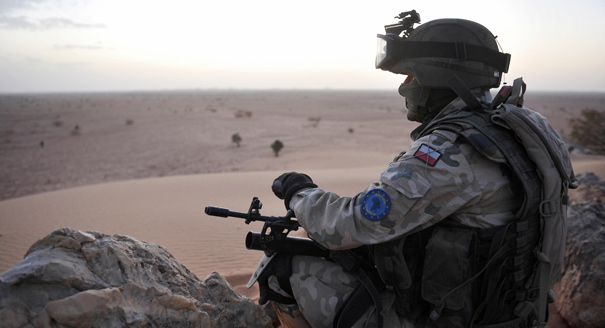
What all of this reflects is the fact that among European countries, there is very little appetite for military missions. Britain’s parliament last year scuppered plans by Prime Minister David Cameron to intervene militarily in Syria. France, the lone exception to intervention fatigue, went it alone in Mali a year ago and again last December in the Central African Republic. EU leaders praised the French effort but offered almost no help.
No wonder then that the EU has never sent its battle groups into action. Launched with great fanfare in 2003, the battle groups were supposed to be Europe’s crack rapid reaction forces. Highly trained for combat missions, they were supposed to be able to deploy within days. Yet when soundings were made in early December to get a battle group sent to the Central African Republic, Britain and other countries immediately and unequivocally said no.
Given this background, the biggest surprise was that the EU’s defense summit in December produced any concrete results at all.
With most governments recognizing that the current impasse over the EU’s security and defense policy was not acceptable, there were agreements to develop ‘strategic enablers,’ such as drones, air-to-air refueling, cyber security and satellite communications. The European Commission will play a greater role since the ‘strategic enablers’ also have a civilian use.
The European Defense Agency (EDA), set up several years to reduce duplication and make savings, has always faced an uphill struggle. That now may be changing. The EDA received the green light to speed up procurement rules and harmonize standards among the member states.
These decisions are tied to specific timetables. Even though it will require much cajoling and focus by the Commission, Catherine Ashton, the EU’s High Representative for Foreign and Security Policy and her successor, there is a real chance to get these projects off the ground.
Yet leaders failed to deal with the two biggest issues: the need for a strategy, and the impact the US pivot to Asia will have on the transatlantic relationship.
EU leaders shirked the issue of strategy for several reasons. First, the 28 member states have different security and defense cultures and different military experiences. These differences alone make it difficult to forge a European strategy.
Also, most Europeans simply do not feel threatened by the outside world. This makes it difficult for their leaders to agree on what constitutes common threats, undermining efforts to arrive at a European security strategy.
This doesn’t mean, of course, that no such threats exist. In Europe’s Eastern and Southern neighborhoods and in the Caucasus, it isn’t just the rise of radical Islamic movements that concerns Europe. Possible threats affecting Europe’s interests and values range from the impact of high unemployment and political instability, demography and migration to competition for scarce water and energy sources.
Yet EU leaders avoided any discussion about how to deal with threats and conflicts. Just as there is no appetite to debate strategy, they show no desire to discuss the relationship between soft and hard power.
The second big issue summit leaders shirked concerns the state of the transatlantic relationship.
There was plenty of lip service about NATO’s importance to the Western world, but no attempt was made to end the long and debilitating dispute that has prevented NATO and the EU from working together. This is a problem because sooner or later both the EU and NATO will have to start asking hard questions about what happens to European defense as America’s interest in Europe wanes.
It is not as if the Europeans don’t know that Washington judges their unwillingness to take security and defense seriously very harshly. Time and again, US defense secretaries have castigated the Europeans for failing to develop their military capabilities and to share and pool resources. And time and again, Europeans have played deaf.
Add to that the fact that America is cutting its own defense budget. Most importantly, it is shifting its attention away from Europe to Asia. Yet Europeans still seem to believe they can continue to take America’s security guarantees as well as its military and financial commitment to NATO for granted. This is a dangerous and short-sighted assumption.
The Euro crisis seems to have been contained, and Europe’s economies are finally taking an upward turn. Even so, it is difficult to see Chancellor Angela Merkel, President Francois Hollande or Prime Minister David Cameron engaging in a real discussion over strategy, threats and the future of the transatlantic relationship. Yet without a big push by Berlin, Paris or London to finally start tackling these issues, a strong European foreign policy will remain elusive.
This article was originally published in The Security Times.

Nonresident Senior Fellow, Carnegie Europe
Judy Dempsey is a nonresident senior fellow at Carnegie Europe
Recent Work
Judy Dempsey
Judy Dempsey
Carnegie does not take institutional positions on public policy issues; the views represented herein are those of the author(s) and do not necessarily reflect the views of Carnegie, its staff, or its trustees.

The EU can impose sanctions but struggles to enforce them without the United States. With Washington increasingly disinterested in backing European interests, the bloc must now fend for itself.


Nicu Popescu, Tiago Antunes
Global and rising powers will need to engage with Africa’s priorities and agency in order to secure the continent’s increasingly attractive partnerships.

Fonteh Akum

Rubio’s recent visit brought welcome attention, but more capital requires governance changes that may be a hard sell for regional governments.

Jennifer B. Murtazashvili

America’s foreign-policy objectives have grown more demanding while Americans have demanded greater focus on their own affairs.

Stephen Wertheim

Japan’s long-term security policy is driven by concerns about China, and there is little appetite for (or interest in) pursuing a confrontation with Moscow.

James D.J. Brown