

Commentary
Dmitri Trenin
{
  "authors": [
    "Dmitri Trenin"
  ],
  "type": "commentary",
  "centerAffiliationAll": "",
  "centers": [
    "Carnegie Endowment for International Peace",
    "Carnegie Russia Eurasia Center"
  ],
  "collections": [],
  "englishNewsletterAll": "",
  "nonEnglishNewsletterAll": "",
  "primaryCenter": "Carnegie Russia Eurasia Center",
  "programAffiliation": "",
  "programs": [],
  "projects": [
    "Eurasia in Transition"
  ],
  "regions": [
    "North America",
    "United States",
    "Middle East",
    "Israel",
    "Palestine",
    "East Asia",
    "China",
    "Russia",
    "Eastern Europe",
    "Ukraine",
    "Western Europe",
    "Germany"
  ],
  "topics": [
    "Security",
    "Foreign Policy",
    "Global Governance"
  ]
}
Source: Getty
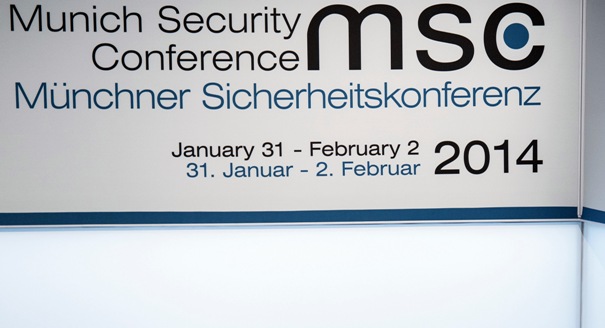
The 50th Munich Security Conference marked the charting of a course toward Berlin’s more robust engagement in the world, including with military means. At the same time, the conference was overshadowed by the unfolding crisis in Ukraine.
This year's Munich Security Conference was remarkable in many ways. It was the 50th annual event. Two of its original participants, Henry Kissinger and Helmut Schmidt, were again on the podium—together with two other patriarchs, Egon Bahr and Valéry Giscard d'Estaing: among the four of them, an accumulated 370 years of human and political wisdom.
The conference also marked the beginning of a subtle, yet fundamental shift in the German foreign and security policy, with President Joachim Gauck, Foreign Minister Frank-Walter Steinmeier and Defense Minister Ursula von der Leyen—Chancellor Angela Merkel stayed away this time—charting a course toward Berlin's more robust engagement in the world, including with military means.
Politically, the conference was overshadowed by the unfolding crisis in Ukraine, and its most spectacular moment came when Ukraine's opposition leader Vitali Klitschko and foreign minister Leonid Kozhara, seated together, painted very different pictures of what was happening in their country and asked each other tough questions.
I have taken away a lot from Munich. As I am flying across the Atlantic, however, let me share with you some of the quick quotes from the participants as they have stuck in my memory. These are not necessarily direct quotations, but I trust that the sense of the remarks has been essentially preserved.
Joachim Gauck, federal president of Germany:
“Germany is no island. Responsibility lies not only in acting, but also in abstaining from action.”
“Germany has acted effectively during the euro crisis. It needs to build on this to engage in other spheres too.”
Frank-Walter Steinmeier, German foreign minister:
“Germany is too big to sit on the sidelines on world issues. Military force is not the ultima ratio it used to be, but it can be used, with care.”
“Ukraine is a tinderbox, and the fuse is lit. There is no solution through violence in Ukraine.”
Laurent Fabius, French foreign minister:
"The EU should help the emergence of “organized multipolarity” in the currently non-polar world."
Anders Fogh Rasmussen, NATO secretary general:
“Russia should recognize the freedom of countries, such as Ukraine, to choose their alliances.”
“NATO is concerned about Russia's aircraft deployments in Belarus, Iskender missiles in Kaliningrad, the military build-up in the Arctic, and the development of new weapons systems.”
Sergey Lavrov, Russian foreign minister:
“The West appears to have decided for the Ukrainian people what their choice is. The EU does not condemn violent actions in Ukraine which are punishable in the West.”
“A free trade area between the EU and the emerging Eurasian Economic Union by 2020 is the best option for the 'lands between' Russia and the EU.”
John Kerry, U.S. secretary of state:
“The Ukrainian people should not be coerced. Make no mistake: the US stands together with the Ukrainians aspiring for democracy.”
“There should be a Transatlantic renaissance between the US and Europe based on shared prosperity, security, and values.”
Martin Indyk, U.S. president's special representative to the Middle East peace process:
“Engaging in the Middle East Peace Process requires a suspension of disbelief.”
Henry Kissinger, former U.S. secretary of state:
“China and Japan must learn the lesson from 1914 Europe and make sure they will never recourse to the use of force.”
“You should not go to war for the privilege of withdrawal. You need to define your objective and the outcome, and it cannot be the removal of one man.”
Helmut Schmidt, former West German chancellor:
“Population growth and the proliferation of mega-cities around the world redefines the entire global security agenda.”
“Whether NATO is around in 10 years is irrelevant, in view of the new security challenges.”
Zbigniew Brzezinski, former U.S. national security adviser:
“The Ukrainian opposition should adopt democratic unity as its main principle, and it also must have one leader.”
“The situation in Ukraine can only be resolved through a compromise: within Ukraine; between the EU and Russia; and between the United States and Russia. The West and Russia should also contribute money to jointly bail out Ukraine.”
David Milliband, former UK foreign secretary:
“The fundamental chasm in international relations today is that while the international system is designed to deal with conflicts between countries, most conflicts today happen within countries.”
Radek Sikorski, Polish foreign minister:
“The problem with humanitarian intervention is that when we have a quarrel with a head of state, we go to war against his country.”
Leonid Slutsky, chair, CIS Affairs Committee of the State Duma:
“The Ukrainian crisis is rooted in Western attempts to prevent Eurasian integration, in full accordance with Zbigniew Brzezinski's dictum that, without Ukraine, Russia cannot be an empire.”
Štefan Füle, EU commissioner for enlargement:
“Ukraine and other in Eastern Europe should be able to see the green light at the end of the tunnel. An EU membership perspective should be opened for them.”
There also have been a few lively exchanges between some of the panelists, such as:
Tzipi Livni, Israeli cabinet minister and principal negotiator with the Palestinians, to Saeb Erekat, the chief Palestinian negotiator:
“Show me a Palestinian map of the region with the word 'Israel' on it.”
Erekat to Livni:
“Show me the borders of Israel, and I will come up with such a map.”
German Foreign Minister Steinmeier to Russian Foreign Minister Lavrov:
“What binds Europe and Russia together?”
Lavrov to Steinmeier:
“We are bound by treaties and agreements.”
Ukraine's acting Foreign Minister Leonid Kozhara to opposition leader Vitali Klitschko:
“Are you with the radicals and extremists or not? Are you ready to share responsibility with the government?”
Klitschko to Kozhara:
“The people have had enough of the present system in Ukraine.”
I must add that Klitschko also received the longest and the most enthusiastic applause from the audience at the Munich conference. He was also truly lionized by the media. Yet, everyone without exception—on the podium and off it—was very concerned about the dangers facing Ukraine, and how they might affect the rest of Europe. In private talks on the fringes of the conference, this was a central topic—alongside Iran and Syria.
The world's security summit is over. Wolfgang Ischinger, Germany's former deputy foreign minister and the forum's chair, should feel pleased. Munich has become the place for open dialogue and discreet exchanges on security issues around the world. This dialogue itself is an emblem of Germany stepping up as a political, not just economic power with a global reach. And there were about as many uniformed Bundeswehr officers in the audience as those with the U.S. military insignia. This does not mean, however, a "militarization" of Germany's foreign policy. As President Gauck has said, this is the best Germany that has ever existed in history. And he is certainly right.
Former Director, Carnegie Moscow Center
Trenin was director of the Carnegie Moscow Center from 2008 to early 2022.
Recent Work
Dmitri Trenin
Dmitri Trenin
Carnegie does not take institutional positions on public policy issues; the views represented herein are those of the author(s) and do not necessarily reflect the views of Carnegie, its staff, or its trustees.

The Plaza Accord was not an externally imposed punishment of Japan but part of a broader restructuring that Japanese economists and policymakers themselves recognized was necessary. Its effects were undermined, however, when Tokyo responded to the resulting slowdown with policies that exacerbated investment, credit expansion, and the very imbalances the adjustment was intended to resolve.

Michael Pettis

Trump has promised Belarus a massive potash deal. But Minsk is seeking something greater: restored Western transit and greater room for maneuver from Russia.

Balázs Jarábik

Before the next wave of EU enlargement takes place, the union needs to grapple with thorny questions of how power is distributed among its members.


Emil Sondaj Hansen, Ditte Brasso Sørensen

The real test may come after the leaders leave the room.



Sheena Chestnut Greitens, Oriana Skylar Mastro, Yukon Huang, …

The Horn of Africa countries are among those facing a new security calculus.


Andrew Leber, Lesley Anne Warner