

Commentary
Cornelius Adebahr
{
  "authors": [
    "Cornelius Adebahr"
  ],
  "type": "legacyinthemedia",
  "centerAffiliationAll": "dc",
  "centers": [
    "Carnegie Endowment for International Peace",
    "Carnegie Europe",
    "Malcolm H. Kerr Carnegie Middle East Center"
  ],
  "collections": [
    "Iranian Proliferation"
  ],
  "englishNewsletterAll": "menaTransitions",
  "nonEnglishNewsletterAll": "",
  "primaryCenter": "Carnegie Europe",
  "programAffiliation": "MEP",
  "programs": [
    "Middle East",
    "Europe"
  ],
  "projects": [],
  "regions": [
    "North America",
    "United States",
    "Middle East",
    "Iran",
    "Russia",
    "Eastern Europe",
    "Ukraine"
  ],
  "topics": [
    "Security",
    "Nuclear Policy",
    "Global Governance"
  ]
}
Source: Getty
The idea that the assurances given twenty years past by three permament members of the UN Security Council are worth naught today is extremely dangerous.
Source: Global Policy
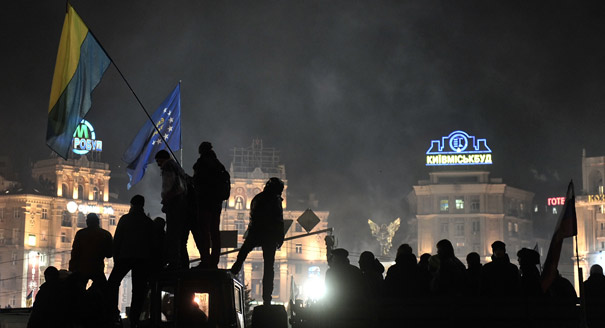
Chaos theory has it that the stroke of a butterfly in one part of the world may cause a hurricane in another. Clearly, the conflict in Ukraine and in particular Russia’s role in it are much more than this figurative butterfly. And it doesn’t need a scientiest to deduct that by confronting President Putin over the annexation of Crimea, Europeans and Americans will have a much harder time working with Russia on those international conflicts where they have – so far – shared an interest in jointly resolving them.
In addition to the civil war in Syria, the negotiations over Iran’s nuclear program are often mentioned as one potential victim of the fallout between Russia and the West. However, looking at Iran only through the prism of Russia’s role in the nuclear negotiations is short-sighted. Beyond the ‚Russian question’, two further points of comparison come to mind: the still lingering question of civic unrest in Iran and the wider effects of the violation of the territorial integrity of Ukraine, formerly a nuclear power, on the global non-proliferation regime.Interestingly, only a few years ago – with the president in Tehran still being called Ahmadinejad – many observers would have picked up on the idea of ‚velvet revolutions’ and asked first and foremost what the Maidan revolt meant for the reform movement in Iran. Indeed, some people in the establishment of the Islamic Republic seem to fear that „orange is the new green“, a reference to the 2004 Orange Revolution in Ukraine and what the latest events there could mean for the Green Movement in Iran.
The fact that the Ukrainians have for the second time achieved what Iranians have so far failed to do – first successfully oppose a rigged election, then oust a sitting president – is worrisome for the Iranian regime. Accordingly, the reactions to the departure of President Victor Yanukovich were neatly split, with conservative media deploring the violent ‚coup’ whereas reformist newspapers celebrated the release of opposition leader Yulia Tymoshenko (subtext: ‚our leaders are still under house arrest’). The government news agency IRNA, meanwhile, published an interview with the Ukrainian ambassador in Tehran brazenly likening the ouster of Yanukovich to the Islamic Revolution of 1979.
Without taking sides, the Justice Minister tried to end the debate and urged officials and press alike to show restraint. “Our country and system are not comparable to places like this” he said, arguing that a country like Ukraine did not even deserve to be treated with such bold headlines, supportive or not. All in all, however, there are only few official statements about the events in Ukraine – itself an indication of pronounced disagreements behind the scenes.
With the conflict in Ukraine shifting from the squares of the capital to the shores of Crimea, the debate in Iran has focused on the geopolitical consequences of this new East-West confrontation. Flirtation with a new axis between Moscow and Tehran aimed at containing Western influence is naive at best. Ultimately, this stance supposes that neither Iran nor Russia are serious about concluding the current negotiations but instead see them as a power play over global influence. At least from the point of view of President Hassan Rouhani, there is little indicating that his government could endure even harsher sanctions – if only from the US and the EU – as a result of the breakdown of negotiations while being bought off by the former-occupying-power-turned-friend. Russia, for its part, has no reason to let Iran off the hook without waterproof clarification of the country’s nuclear ambitions, lest such uncertainty triggers an arms race in the Middle East.
However, it is precisely Putin’s blatant show of unreliability that should worry Tehran, also with a view to their common position on Syria. While the Iranian elite may not mind an occasional snubbing of the 'Great Satan’ by its rival, it can hardly condone the methods Russia employs. As much as Iranian officials claim that they are not interfering in Syria’s internal affairs, Russian actions in Crimea clearly violate the territorial integrity of Ukraine, a principle that Iran itself upholds. (Interestingly, China – the sixth member to the nuclear negotiations club – has walked a very fine line between siding with Russia and upholding the princinple of non-interference, recently tilting to the former.)
Hence, 'active neutrality‘ may be what is called for right now, meaning that Iran tries to maintain its equidistance between Russia and the West, focusing on its immediate interests in the neighbourhood. This approach would clearly befit the country currently presiding the Non-Aligned Movement (NAM).
Which leads to the third aspect of how Ukraine affects Iran: Beyond the domestic – colour revolution or not? – and the geopolitical aspects – taking sides in a potential Cold War II scenario? – there is a multilateral dimension hidden in the ongoing conflict. This pertains to the now much-quoted Budapest Memorandum of 1994 between Ukraine, Russia, the United States, and the United Kingdom. In it, the latter three signatories extended security guarantees to Ukraine in return for its disarming of Soviet-inherited nuclear weapons – then the third largest arsenal in the world – and for joining the Non-Proliferation Treaty (NPT).
Therefore, Russia’s de-facto annexation of Crimea does not only break the norms of international law (a point on which the U.S. is not well suited to cry wolf), both general – in the form of the UN Charter – and specific – as Russia‘s commitments under the Helsinki Final Act of 1975. It also violates Russia’s explicit obligation from this memorandum „to refrain from the threat or use of force against the territorial integrity or political independence of Ukraine“ (never mind Russia’s obligation to refrain from economic coercion which it violated already with the 'gas disputes‘ of the second half of the past decade.)
More importantly, this conspicuous act of aggression undermines the very principle of why a country would give up its nuclear weapons in return for security guarantees. True, Iran is not Ukraine, the former denying the pursuit of any nuclear weapon and the latter giving up those that it inherited. However, just as much as Ukraine’s actions then strengthened the global NPT regime, a comprehensive deal with Iran involving increased IAEA inspections under the Additional Protocol in exchange for any type of security guarantees would bolster nuclear non-proliferation. Conversely, if Russia’s behaviour remains uncontested, countries around the world will come to understand that only a nuclear bomb can guarentee their territorial integrity and political stability against external threats.
The idea that the assurances given 20 years past by three permament members of the UN Security Council are worth naught today, is extremely dangerous. That is why both Americans and Europeans need not only react in the strongest possible terms to Russia’s illegitimate actions, but at the same time continue to work hard on a settlement with Iran. Finding a comprehensive agreement on this country’s nuclear program would be a much-needed counterpoint to the disregard of international norms and the decline of global governance mechanisms.
Former Nonresident Fellow, Carnegie Europe
Cornelius Adebahr was a nonresident fellow at Carnegie Europe. His research focuses on foreign and security policy, in particular regarding Iran and the Persian Gulf, on European and transatlantic affairs, and on citizens’ engagement.
Recent Work
Cornelius Adebahr

Cornelius Adebahr, Barbara Mittelhammer
Carnegie does not take institutional positions on public policy issues; the views represented herein are those of the author(s) and do not necessarily reflect the views of Carnegie, its staff, or its trustees.
Japan’s revision of its three strategic documents reflects an intention to keep the United States engaged in the region while Japan fills any vacuums of U.S. power to preserve the Indo-Pacific order.
Ryo Sahashi

In the discussions made possible by the State Duma election campaign, one question is being asked more and more loudly. “What next?”

Andrey Pertsev
Over the past decade, China has moved from marginal player to major producer of all things batteries. The United States, Europe, and others are aiming to balance the market.

Milo McBride

A look at how public opinion influences the credibility of coercive nuclear threats,and how it enables and constrains strategies of nuclear coercion.

Lauren Sukin, Samuel Seitz
The DFC should focus on advanced, low-carbon energy sources, prioritizing areas where the United States has comparative advantages.
Noah Gordon, Liana Schmitter-Emerson