

Commentary
Why governance of rapidly evolving technology will be distributed and complex.
Stewart Patrick, Scott Singer
{
  "authors": [
    "Michele Dunne",
    "Robert Kagan"
  ],
  "type": "legacyinthemedia",
  "centerAffiliationAll": "dc",
  "centers": [
    "Carnegie Endowment for International Peace",
    "Malcolm H. Kerr Carnegie Middle East Center"
  ],
  "collections": [],
  "englishNewsletterAll": "menaTransitions",
  "nonEnglishNewsletterAll": "",
  "primaryCenter": "Carnegie Endowment for International Peace",
  "programAffiliation": "MEP",
  "programs": [
    "Middle East"
  ],
  "projects": [],
  "regions": [
    "North Africa",
    "Egypt"
  ],
  "topics": [
    "Political Reform",
    "Security",
    "Foreign Policy"
  ]
}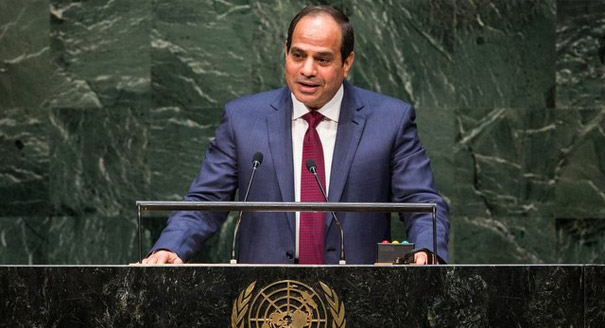
Source: Getty
The idea that Sisi will be an effective ally against Islamic terrorists is misguided. He has, in fact, become one of the jihadists’ most effective recruiting tools.
Source: Washington Post
Is Egyptian President Abdel Fatah al-Sissi really an ally in our ongoing struggle against Islamic jihadism and terrorism in the Middle East? That seems to be the prevailing view these days. The Wall Street Journal’s Bret Stephens called him a “geopolitical godsend.” The Post's George F. Will suggested on Fox News that he be given a Nobel Prize (for mass killing and torture, perhaps. A new category.). Last week, President Obama gave Sissi the ultimate benediction, restoring the military assistance that had been suspended following the 2013 military overthrow of the first freely elected president in Egypt and despite the government’s unrelenting campaign of human rights abuses. The decision came just days after Egypt announced it was sending four warships to aid Saudi Arabia in the fight against Iranian-backed rebels in Yemen. So Obama’s decision looks like a reward for Egypt’s enlisting in that fight.
Unfortunately the idea that Sissi will be an effective ally against Islamic terrorists is misguided. He has, in fact, become one of the jihadists’ most effective recruiting tools. The simple truth is that, since Sissi took power, the frequency of terrorist attacks in Egypt has soared; there have been more than 700 attacks over 22 months, as opposed to fewer than 90 in the previous 22 months. Harder to measure is the number of young people radicalized by Sissi’s repression, but we can assume it is significant and growing. A well-regarded Egyptian rights organization estimates that 42,000 political prisoners are being held; torture and sexual assault in the course of arrest or detention reportedly are rampant. There has been no accountability for the mass killings of 2013. Amnesty International listed Egypt as one of the top two countries issuing death sentences, with 509 people condemned in 2014.
Much of the political opposition, including secular youth activists as well as the Muslim Brotherhood, which won the greatest share of votes in 2012 elections, is in prison, and those still free face legal and extralegal harassment. The internal security apparatus, reinvigorated after the 2013 coup, has run amok. After the shooting of activist Shaimaa al-Sabbagh in the back by a masked police officer, during a small, peaceful march in Cairo in January, was caught on video, public outrage forced the government to investigate the killing and arrest the perpetrator. But the security apparatus then took its revenge by arresting a witness who stepped forward to give testimony.In this environment, is it surprising that reports surface regularly about the trend of radicalization of Egyptian youth, including previously peaceful Islamists? Sissi’s brutal actions speak far louder than his few words about reforming Islam; to believe that he, or the religious institutions of his government, can have a positive impact on young people susceptible to radicalization is beyond wishful thinking. It would be laughable if it were not dangerous self-delusion.
You would think we would have learned from experience. The idea of supporting dictators as proxies in a fight against radicalism in the Middle East is not new. Nor is the abject failure of that strategy any secret. We supported the shah of Iran, who stamped out moderate as well as radical opposition, only to see him overthrown by the most significant radical Islamic movement of the past century. We supported the Pakistani military dictator Muhammad Zia ul-Haq , who presided over a period of unprecedented Islamic radicalization. We supported the Saudis and the milder Egyptian dictatorship of Hosni Mubarak, only to watch as their repression produced al-Qaeda and the perpetrators of the 9/11 terrorist attacks.
The funny thing is, Sissi didn’t need the weapons. Egypt has large back stocks, and in any case the United States has all along provided critical counterterrorism assistance. What Sissi wanted and needed was a signal of full endorsement by the United States to strengthen his legitimacy. The Obama administration has now duly provided this gift. And in return for what? Do we need to pay Sissi to fight radicalism? This is another great folly of U.S. foreign policy: the idea that we have to ply dictators with hundreds of millions of dollars to get them to do what they already want to do. Sissi is going to fight radicalism in his special way whether we pay him or not. The only difference is our complicity. Now when our “ally” locks up and tortures young Egyptians, perhaps converting them to terrorism, they’ll have a bigger target to aim at.
We are back on the same old course in Egypt. It’s the Nixon Doctrine all over again, and we are falling prey to the same illusions that dictatorship equals stability, that brutal repression is the answer to radicalism. We lionize Sissi just as we lionized the shah, Mubarak and the other Middle East dictators before him. He is our guy, right up until the day his regime collapses. Geopolitical godsend? Try geopolitical time bomb.
This article was originally published in the Washington Post.

Former Nonresident Scholar, Middle East Program
Michele Dunne was a nonresident scholar in Carnegie’s Middle East Program, where her research focuses on political and economic change in Arab countries, particularly Egypt, as well as U.S. policy in the Middle East.

Former Senior Associate
Kagan, author of the recent book, The Return of History and the End of Dreams (Knopf 2008), writes a monthly column on world affairs for the Washington Post and is a contributing editor at both the Weekly Standard and the New Republic.
Carnegie does not take institutional positions on public policy issues; the views represented herein are those of the author(s) and do not necessarily reflect the views of Carnegie, its staff, or its trustees.
Why governance of rapidly evolving technology will be distributed and complex.


Stewart Patrick, Scott Singer

In Egypt’s dense cities, the disappearance of foliage has health implications and punishes daily commuters.

Angie Omar

It should address the shortcomings of previous crisis communication efforts and adapt to the demands of frontier AI.

Lucy Luo

If the Russian-speaking community in Latvia cannot articulate their interests without being seen as disloyal, they could end up embracing a pro-Kremlin agenda.

Sergejs Potapkins

Washington’s decision to support some UN functions while letting others wither is pulling the organization apart at the seams.
Stewart Patrick, Theodore Zaritsky